Edible and Medicinal Mushrooms (eBook)
John Wiley & Sons (Verlag)
978-1-119-14943-9 (ISBN)
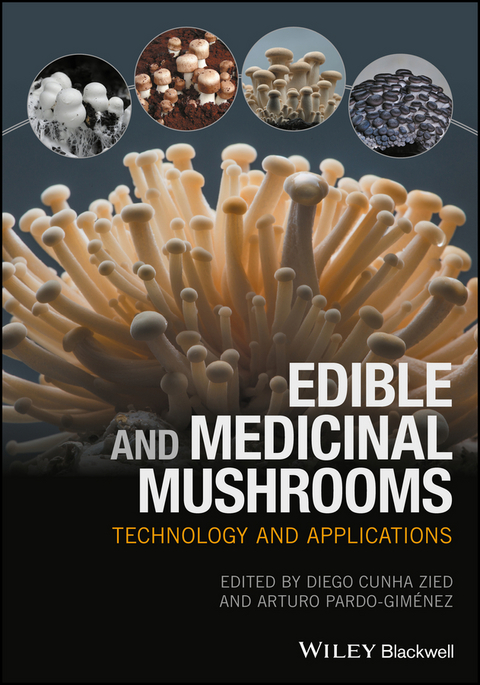
Comprehensive and timely, Edible and Medicinal Mushrooms: Technology and Applications provides the most up to date information on the various edible mushrooms on the market. Compiling knowledge on their production, application and nutritional effects, chapters are dedicated to the cultivation of major species such as Agaricus bisporus, Pleurotus ostreatus, Agaricus subrufescens, Lentinula edodes, Ganoderma lucidum and others. With contributions from top researchers from around the world, topics covered include:
- Biodiversity and biotechnological applications
- Cultivation technologies
- Control of pests and diseases
- Current market overview
- Bioactive mechanisms of mushrooms
- Medicinal and nutritional properties
Extensively illustrated with over 200 images, this is the perfect resource for researchers and professionals in the mushroom industry, food scientists and nutritionists, as well as academics and students of biology, agronomy, nutrition and medicine.
Edited by
Professor Dr Diego Cunha Zied of Universidade Estadual Paulista (UNESP), Brazil and Researcher Dr Arturo Pardo-Giménez of Centro de Investigación, Experimentación y Servicios del Champiñón (CIES), Spain.
Comprehensive and timely, Edible and Medicinal Mushrooms: Technology and Applications provides the most up to date information on the various edible mushrooms on the market. Compiling knowledge on their production, application and nutritional effects, chapters are dedicated to the cultivation of major species such as Agaricus bisporus, Pleurotus ostreatus, Agaricus subrufescens, Lentinula edodes, Ganoderma lucidum and others. With contributions from top researchers from around the world, topics covered include: Biodiversity and biotechnological applications Cultivation technologies Control of pests and diseases Current market overview Bioactive mechanisms of mushrooms Medicinal and nutritional properties Extensively illustrated with over 200 images, this is the perfect resource for researchers and professionals in the mushroom industry, food scientists and nutritionists, as well as academics and students of biology, agronomy, nutrition and medicine.
Edited by Professor Dr Diego Cunha Zied of Universidade Estadual Paulista (UNESP), Brazil and Researcher Dr Arturo Pardo-Giménez of Centro de Investigación, Experimentación y Servicios del Champiñón (CIES), Spain.
Chapter 1
Mushrooms and Human Civilization
Behari Lal Dhar
NNMushroom Consulting India/ICAR-Directorate of Mushroom Research, Solan, India
Mention of mushrooms has been reported in ancient literature since the inception of human civilization. Mushrooms find mention because of their wide range of properties from being poisonous to being beneficial and edible. Their poisonous nature was their most intriguing quality in early history. Throughout the centuries, poisonous fungi/mushrooms have remained a useful means of disposing of adversaries. Pliny the Elder (23–79 AD) gives details of how the Emperor Claudius was poisoned by his fourth wife Julia Agrippina. Emperor Jonan followed in 364 AD, and Pope Clement VII in 1394. In addition, the antipope Urban VI, the French King Charles VI, and the German/Spanish king Joseph Ferdinand were all poisoned with mushrooms (van Griensven, 1988). Knowledge about fungi developed slowly. In the fourth century BC, Theophrastus gave a scientific description of fungi and considered these fungi as part of vegetable kingdom, even though they have no buds, leaves, or roots.
With the decline of classical civilization, interest in science also declined. The scholastics of the Middle Ages made no contribution to science. Scientific study made little progress in the Western World up until the late Middle Ages. Names were given, morphological descriptions were made, and mushrooms find mention as “surplus moisture from the ground and trees, from rotting wood and other things.” This particularly applies to edible varieties, through the influence of thunder, lightning, and rain (van Griensven, 1988).
In China, however, as early as 1245 AD, Chen Yen-Yu had published a fungus flora, describing in detail the development, morphology, seasonal influence, growing method, harvesting, and preparation (as food) for 15 varieties of mushrooms (Wang, 1987). In 1588 Giambattista Porta published his Phytognomoniica. He was the first person to describe the spores of fungi. Like his contemporaries, he held the view that parasitic plants, among which he counted tree mushrooms, were unnatural and could be used against lumps and tumors on human limbs (van Griensven, 1988).
According to Theophrastus, practically everything was missing from the mushroom, and eating mushrooms was therefore harmful to human body. Clausius (1525–1609) was the first to describe the Bird's Nest (Nidularia).
The “hidden power” of earth is responsible for the occurrence of mushrooms. That is why mushrooms were known as “excrementa terrae” in the seventeenth century. It was, of course, reprehensible to eat these excretions of the earth.
In the early seventeenth century, the Italian Count Margigi describes how a white, mold-like web appears when mushrooms and truffles are carefully dug up. He calls this web, which smells of mushrooms and has tiny buds, “situs” (Lutjehmas, 1936). By this time all edible mushrooms including truffles were found in Europe, collected from the wild.
The Chinese and the Japanese were probably the first to cultivate mushrooms professionally, and a brief description of history published in English (Wang, 1987) refers to Shiitake mushroom cultivation by Wang Zeng in 1313 AD. The culture of the paddy straw mushroom Volvariella volvacea is also centuries old.
Linnaeus (1707–1778) gave the field mushroom (white button) the name Agaricus campestris. Finally, in his Systema Mycologicum (Kleiju, 1961; Poppe, 1962), Elias Fries (1707–1778) gave a methodical description of all varieties of mushrooms known at that time (van Griensven, 1988).
1.1 Domestication of Mushrooms
The mushroom is the most important horticultural cash crop grown indoors, compared to other traditional crops grown outdoors, and is the only non-green crop grown for commerce with attractive profits. Mushroom is the fruit body of a fungus, which is neither a plant nor an animal, but has a separate kingdom of its own. Fungi as a broad group either live parasitically on plants and animals or live saprophytically on dead organic matter. Fungi cause numerous diseases of plants and animals and have been reported to cause considerable crop losses with tremendous suffering to mankind from time immemorial. The role of fungi as being beneficial to humans is of recent origin, with the generation of information on existence of microorganisms and their importance to man on Earth. Today, the science of study of mycological applications for human welfare has touched greater heights with the application of molecular biological techniques to improve useful fungal cultures of yeasts and mushrooms.
The fact that certain fungi are edible has been known for many centuries, and in various European countries up to 80 distinct varieties of wild fungi are offered for sale on the market (Pinkerton, 1954). Though many edible fungi have been domesticated and are in production, the most commonly cultivated are shiitake (Lentinula edodes), oyster mushroom (Pleurotus spp.), white button mushroom (Agaricus bisporus), black fungus or wood-ear mushrooms (Auricularia auricula and Auricularia polytricha) and paddy straw mushroom Volvariella spp. The cultivation of shiitake by Japanese on logs dates back at least 2000 years (Ainsworth, 1976), but button mushroom cultivation is comparatively recent. Today, the button mushroom is the most widely grown in many countries, although it is the fourth mushroom most produced in quantity (see chapter 2), with most of the development of cultivation technology confined to improving this mushroom for reasons of its larger acceptability by the consumer.
The first record of (button) mushroom cultivation dates back to Abercrombie (1779), who wrote that this plant is of so very singular growth and temperature, that unless a proper idea of its nature and habit is attained, and the peculiar methods and precautions pursued in the process of its propagation and culture, little success will ensue; the whole management of it differs remarkably from that of every other species of the vegetable kingdom; and it is the most liable of any to fail without very strict observance and care in the different stages of its cultivation.
Tournefort (1707) gave a comprehensive description of the commercial production of button mushrooms. These observations recorded in earlier times bear comparison with the methods used today. At that time mushrooms were cultivated on open ground, but around 1810, Chambry (a French gardener) began to cultivate mushrooms in underground quarries in Paris, all year round. Later Callow (1831) showed that mushroom production was possible all year round in England in rooms specially heated for the purpose. Callow gave details of the design of cropping houses (crediting it to Oldacre, a garden superintendent in UK) and later successfully grew mushrooms all year round in such a structure producing a yield of 7.3 kg m–2 in 24 weeks of cropping, as compared to mushroom yields of 10 kg m-2 obtained in 1950 in the UK. It is now accepted that protected cropping of mushrooms was pioneered in caves in France, though the earliest mushroom houses were developed in England.
Large-scale mushroom production is now centered in Europe, North American (USA, Canada), Australia, South East Asia (China, Korea, Indonesia, Taiwan), and South Asia (India). The notable contributions to mushroom science in recent times were made at the beginning of the twentieth century when pure cultures of button mushrooms were grown by Duggar (1905). Other notable contributions were the preparation of mushroom compost from agro-byproducts using the short method by Sinden and Hauser (1950, 1953).
Contributions by Fritsche (1985) in breeding two new strains of white button mushroom A. bisporus U-1 and U-3 revolutionized commercial mushroom growing across the world. With the refinement of cultivation technology of button mushrooms on a continuing scale, it was possible to harvest more and more quantities of mushrooms per unit area/unit weight of compost. Demonstration of steam pasteurization of mushroom compost in bulk (Derks, 1973) further helped commercial mushroom growing to increase the productivity per unit area/unit weight of compost.
Finally, increased understanding of crop management techniques resulted in substantial increases in mushroom yields per unit weight of compost in a reduced cropping period, thereby giving greater profitability to the mushroom grower. Today, mushroom growers worldwide have a wide range of button mushroom cultivars available for cultivation. Computer control of cropping room environments for climate creation/simulation has made it possible to harvest mushroom yields of 30–45 kg from 100 kg compost within a cropping period of 3–4 weeks in 2–4 flushes.
With the introduction of the use of phase-I aerated bunkers for environmental protection, the composting process has become precision controlled with reduced emission of foul harmful gases without affecting mushroom yield. Use of indoor aerated bunkers has become very popular all over the world for reasons of economy in addition to being environmentally friendly. Phase-I bunkers are less space demanding and less labor oriented than traditional outdoor phase-I ricks, with the advantage of lower emission of foul gases during solid state fermentation controlled by restricted/controlled oxygen availability in the bunker.
A current science of mushrooms is presented in detail in this book, along with specific approaches in the main species of cultivated mushrooms and their technologies in...
| Erscheint lt. Verlag | 24.7.2017 |
|---|---|
| Sprache | englisch |
| Themenwelt | Medizin / Pharmazie ► Gesundheitsfachberufe ► Diätassistenz / Ernährungsberatung |
| Naturwissenschaften ► Biologie ► Mykologie | |
| Technik ► Lebensmitteltechnologie | |
| Weitere Fachgebiete ► Land- / Forstwirtschaft / Fischerei | |
| Schlagworte | Agaricus bisporus • Agaricus subrufescens • Agriculture • bioactive mechanisms of mushrooms • Biowissenschaften • control of mushroom pests and diseases • crops • cultivation of major mushroom species • edible and medicinal mushrooms • edible mushroom nutrition • edible mushrooms • Feldfrüchte • Food Science & Technology • Functional Food • Functional Food, Nutraceuticals • Functional Foods & Nutraceuticals • Ganoderma lucidum • global mushroom research • Landwirtschaft • Lebensmittelforschung u. -technologie • Lentinula edodes • Life Sciences • medicinal mushroom production • Medicinal mushrooms • mushroom biodiversity and biotechnological applications • Mushroom cultivation • mushroom cultivation technologies • mushroom industry research • mushroom market overview • mushroom medicinal and nutritional properties • mushroom nutrition • mushroom research • Mycology • Mykologie • Pilze • Pleurotus ostreatus |
| ISBN-10 | 1-119-14943-6 / 1119149436 |
| ISBN-13 | 978-1-119-14943-9 / 9781119149439 |
| Informationen gemäß Produktsicherheitsverordnung (GPSR) | |
| Haben Sie eine Frage zum Produkt? |
 EPUB (Adobe DRM)
Kopierschutz: Adobe-DRM
Adobe-DRM ist ein Kopierschutz, der das eBook vor Mißbrauch schützen soll. Dabei wird das eBook bereits beim Download auf Ihre persönliche Adobe-ID autorisiert. Lesen können Sie das eBook dann nur auf den Geräten, welche ebenfalls auf Ihre Adobe-ID registriert sind.
Details zum Adobe-DRM
Dateiformat: EPUB (Electronic Publication)
EPUB ist ein offener Standard für eBooks und eignet sich besonders zur Darstellung von Belletristik und Sachbüchern. Der Fließtext wird dynamisch an die Display- und Schriftgröße angepasst. Auch für mobile Lesegeräte ist EPUB daher gut geeignet.
Systemvoraussetzungen:
PC/Mac: Mit einem PC oder Mac können Sie dieses eBook lesen. Sie benötigen eine
eReader: Dieses eBook kann mit (fast) allen eBook-Readern gelesen werden. Mit dem amazon-Kindle ist es aber nicht kompatibel.
Smartphone/Tablet: Egal ob Apple oder Android, dieses eBook können Sie lesen. Sie benötigen eine
Geräteliste und zusätzliche Hinweise
Buying eBooks from abroad
For tax law reasons we can sell eBooks just within Germany and Switzerland. Regrettably we cannot fulfill eBook-orders from other countries.
aus dem Bereich