


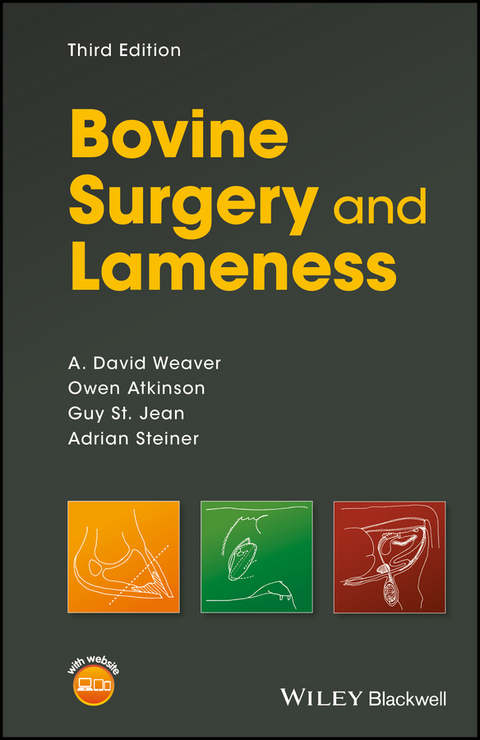
Bovine Surgery and Lameness (eBook)
John Wiley & Sons (Verlag)
9781119040514 (ISBN)
The revised and updated Third Edition of Bovine Surgery and Lameness offers veterinarians a concise text ideal for use in the field.
- Offers a fully revised edition of the popular and well-respected book on bovine surgery and lameness
- Presents a practical quick-reference guide ideal for the field veterinarian
- Covers both common surgical procedures and the latest information on combating lameness
- Written by an expert team of international authors
- Includes access to a companion website offering video clips
The authors
A. David Weaver, BSc, Dr med vet, PhD, FRCVS, Dr hc (Warsaw), is Professor Emeritus at the University of Missouri's College of Veterinary Medicine in Columbia, Missouri, USA and formerly of the University of Glasgow, UK.
Owen Atkinson, BVSc, CertCHP, DCHP, RCVS Recognised Specialist, is Owner, Founder, and Director of Dairy Veterinary Consultancy Ltd, UK.
Guy St. Jean, DMV, MS, Dipl ACVS, is Professor of Surgery and Former Head in the Department of Veterinary Clinical Sciences at Ross University, St. Kitts, West Indies.
Adrian Steiner, Dr med vet, FVH, MS, Dr habil, Dipl ECVS, Dipl ECBHM, is Professor and Head at the Clinic for Ruminants, Vetsuisse-Faculty, University of Bern, Switzerland.
The revised and updated Third Edition of Bovine Surgery and Lameness offers veterinarians a concise text ideal for use in the field. Offers a fully revised edition of the popular and well-respected book on bovine surgery and lameness Presents a practical quick-reference guide ideal for the field veterinarian Covers both common surgical procedures and the latest information on combating lameness Written by an expert team of international authors Includes access to a companion website offering video clips
The authors A. David Weaver, BSc, Dr med vet, PhD, FRCVS, Dr hc (Warsaw), is Professor Emeritus at the University of Missouri's College of Veterinary Medicine in Columbia, Missouri, USA and formerly of the University of Glasgow, UK. Owen Atkinson, BVSc, CertCHP, DCHP, RCVS Recognised Specialist, is Owner, Founder, and Director of Dairy Veterinary Consultancy Ltd, UK. Guy St. Jean, DMV, MS, Dipl ACVS, is Professor of Surgery and Former Head in the Department of Veterinary Clinical Sciences at Ross University, St. Kitts, West Indies. Adrian Steiner, Dr med vet, FVH, MS, Dr habil, Dipl ECVS, Dipl ECBHM, is Professor and Head at the Clinic for Ruminants, Vetsuisse-Faculty, University of Bern, Switzerland.
Bovine Surgery and Lameness 1
Contents 7
Preface 9
Acknowledgements 11
About the Companion Website 13
Chapter 1: General considerations and anaesthesia 15
1.1 Pre-operative assessment 15
Introduction 15
Welfare and quality of life 16
Laboratory tests 17
Congenital defects 17
1.2 Instrumentation 19
Sterilisation 19
Basic instruments for caesarean section or laparotomy 21
1.3 Asepsis 21
Preparation of operative field 23
Hand disinfection 24
1.4 Sutures and suturing 24
Suture materials 25
1.5 Restraint 28
Introduction 28
Techniques 28
1.6 Pre-medication and sedation 30
Xylazine (e.g. Rompun 2%® [Bayer] Sedaxylan [Dechra Veterinary products])
Advantages 31
Disadvantages 31
Dosage and antagonists 32
Chloral hydrate 32
Advantages 32
Disadvantages 33
Dosage 33
Acetylpromazine (ACP) 33
Diazepam 34
Pentobarbitone 34
Atropine sulphate 34
1.7 General anaesthesia 34
Indications 34
Disadvantages of GA 34
Equipment 36
Intravenous anaesthesia (induction) agents 37
Indications and dosage 38
1.8 Local analgesics 39
Lignocaine 39
Procaine 41
Bupivacaine 41
Cinchocaine and Mepivicaine 41
1.9 Regional analgesia 42
Analgesia of the head 42
Cornual nerve block 42
Infratrochlear block 44
Supraorbital block 44
Auriculopalpebral block 45
Retrobulbar block 46
Peterson's block 48
Analgesia of the flank 49
Paravertebral block 50
Line block, T block or inverted L (7) pattern 54
Inverted L block (`reverse 7´ left flank `7´ right flank)
Analgesia of the pelvic and mammary regions 55
Epidural block 55
Caudal (low) block 57
Cranial (high caudal) block 57
Internal pudendal block 58
Block of dorsal nerve of penis 60
Intratesticular block 60
Teat block 61
Analgesia of the distal limbs 63
Intravenous regional analgesia (IVRA) of digit 63
Distal limb local anaesthesia (not IVRA) 66
Chapter 2: Fluid and supportive therapy 67
2.1 General principles of fluid therapy 67
Considerations 67
2.2 Shock 67
2.3 Hydration status 69
2.4 Acid-base status 69
Metabolic alkalosis 69
Metabolic acidosis 70
Estimating acidosis in calves 70
Calculating and correcting base deficits 71
Acidotic neonates 72
2.5 Other electrolytes 72
2.6 Oral fluid therapy 73
Indications 73
Contra-indications 73
Equipment 73
Restraint 73
Method 74
2.7 Intravenous fluid therapy 75
Indications 75
Contra-indications 76
Equipment 76
Restraint 76
Method 77
Hypertonic saline 77
2.8 Blood transfusions 79
Indications 79
Contra-indications 79
Equipment 79
Restraint 79
Method 80
Possible complications 80
2.9 Transfaunation 81
Introduction 81
Indications 81
Equipment 81
Procedure 81
Possible complications 82
2.10 Antimicrobial therapy 82
Introduction 82
Antimicrobial selection 82
2.11 Peri-operative analgesia 84
Introduction 84
Pain assessment 84
Chemotherapeutic approaches to analgesia 85
Alternative therapeutic approaches to analgesia 86
Practical benefits of routine use of post-operative analgesia 86
Chapter 3: Diagnostic techniques and procedures 87
3.1 Abdominocentesis 87
Indications 87
Restraint 87
Equipment 88
Technique 88
Limitations 89
Fluid analysis and diagnostic tests 89
3.2 Rumenocentesis 90
Indications 90
Restraint 90
Equipment 90
Technique 90
Possible complications 90
Animal selection (herd test) 91
Limitations 92
3.3 Liver biopsy 93
Indications 93
Restraint 93
Animal selection 94
Equipment 94
Technique 94
Tissue handling and tests 96
Possible complications 97
3.4 Bronchoalveolar lavage (BAL) 97
Indications 97
Restraint 98
Equipment 98
Technique 98
Sample handling 98
Limitations 99
3.5 Trans-tracheal aspiration 99
Indications 99
Restraint 99
Technique 99
Complications and limitations 99
3.6 Pleurocentesis 100
Indications 100
Technique 100
3.7 Pericardiocentesis 100
Indications 100
Technique 100
3.8 Bladder catheterisation 100
Indications 100
Technique 101
Possible complications 101
3.9 Coccygeal venepuncture 101
Indications 101
Technique 101
Possible complications 103
Chapter 4: Head and neck surgery 104
4.1 Disbudding and dehorning 104
Indications 104
Anaesthesia, analgesia and selection of techniques 104
Chemical cautery 105
Surgical and heat cautery 105
Restraint 106
Technique of disbudding 106
Technique of dehorning 107
Haemostasis 108
Technique of cosmetic dehorning 109
Possible complications of disbudding or dehorning 109
4.2 Trephination of frontal sinus (for empyema) 111
Indication 111
Anatomy (Figures 4.4 and 4.5) 111
Clinical signs of frontal sinus empyema 111
Restraint, anaesthesia and trephination landmarks 112
Technique 113
Post-op care and possible complications 114
4.3 Entropion 114
Introduction and signs 114
Anaesthesia 114
Techniques 114
4.4 Third eyelid flap 115
Indications 115
Techniques (Figure 4.7) 116
Possible complications 116
4.5 Eyelid lacerations 117
Introduction 117
Restraint and clinical signs 117
Technique of repair 117
Possible complications 118
4.6 Ocular foreign body 118
Indications and signs 118
Techniques of removal 118
Prognosis 119
4.7 Neoplasia of eyelids 119
Introduction 119
Clinical signs 119
Treatment 120
(a) Excisional surgery of third eyelid 120
(b) Cryotherapy 120
(c) Other techniques 121
Possible complications 121
4.8 Enucleation (ocular exenteration) 121
Indications 121
Restraint and anaesthesia 121
Technique of ocular exenteration 121
Possible complications 123
4.9 Insertion of a nose ring in a bull 123
Introduction 123
Restraint 124
Technique of insertion 124
Possible complications 125
4.10 Tracheotomy 125
Introduction 125
Clinical signs 125
Anatomy 125
Restraint and anaesthesia 126
Technique 127
Post-operative care 128
Possible complications 129
4.11 Oesophageal obstruction (`choke´) 129
Aetiology and signs 129
Surgical techniques of oesophagotomy 130
Possible complications 131
Chapter 5: Abdominal surgery 132
5.1 Topography 132
The intestinal tract 132
Position and course 134
Abdominal viscera (see also Figure 5.7 later) 136
5.2 Exploratory laparotomy (celiotomy), left flank 139
Indications 139
Technique 139
Visible and palpable features 140
5.3 Exploratory laparotomy, right flank 142
Visible and palpable features (see Figure 5.8) 142
Closure of flank laparotomy incision 144
Intra-abdominal and systemic antimicrobial therapy 145
Possible complications 145
5.4 Rumenotomy 146
Indications 146
Traumatic reticulitis/reticuloperitonits 146
Incidence 146
Aetiology 146
Clinical signs 147
Diagnosis 148
Conservative treatment 149
Signs resulting from sequelae of traumatic reticuloperitonitis 149
Technique of rumenotomy 149
Weingart frame method (Figure ) 150
McLintock cuff method 150
Suture method 151
Closure of ruminal incision 153
Prevention of traumatic reticulitis/reticuloperitonitis 153
Vagal indigestion (Hoflund syndrome) 154
Introduction 154
Anatomy 154
Clinical signs 154
Treatment 155
5.5 Temporary rumen fistulation 156
Indications 156
Chronic recurrent rumen tympany in calves 156
Signs 156
Technique 156
Chronic ruminal tympany in adult cattle 157
Diagnosis 158
Treatment and prognosis 158
5.6 Left displacement of abomasum (LDA) 158
Anatomy 158
Aetiology 158
Signs 159
Diagnosis 160
Differential diagnosis 160
Conservative technique 160
Surgical techniques (LDA) 161
Right flank approach (Dirksen modified omentopexy or pyloropexy Hanover method)
Possible complications 165
Left flank approach (Utrecht technique) 165
Left and right laparotomy approach 167
Right paramedian approach 167
Percutaneous fixation (toggle or bar suture) 169
Endoscopic LDA correction 170
Two-step laparoscopic toggle technique (Janowitz technique) 172
One-step laparoscopic toggle technique (Christiansen technique) 173
Potential complications (of all techniques) 174
5.7 Right dilatation, displacement and volvulus of abomasum (RDA) 174
Signs and diagnosis of RDA 174
Conservative treatment of RDA 175
Signs of abomasal volvulus 175
Surgical treatment of RDA and abomasal volvulus 176
5.8 Other abomasal conditions 179
Abomasal impaction 179
Introduction 179
Treatment 179
Abomasal tympany and volvulus in calves 179
Signs 179
Treatment 180
Abomasal ulceration 180
Introduction 180
Signs 180
Treatment 181
5.9 Caecal dilatation and dislocation 181
Definition and anatomy 181
Incidence and signs 181
Treatment 183
Prognosis 184
5.10 Intestinal intussusception 184
Introduction 184
Signs 184
Diagnosis 185
Treatment 185
5.11 Other forms of intestinal obstruction 186
Signs 188
Treatment 188
5.12 Peritonitis 188
Introduction 188
Signs and diagnosis 188
Treatment 189
5.13 Umbilical hernia and abscess 189
Introduction 189
Signs 189
Diagnosis 190
Indications for surgery 190
Surgical technique 191
Possible complications 193
Treatment of encapsulated umbilical abscessation by surgery 193
5.14 Alimentary conditions involving neoplasia 194
Squamous cell carcinoma (SCC) 195
5.15 Anal and rectal atresia 195
Introduction 195
Diagnosis 195
Surgery 195
Rectal atresia treatment 196
5.16 Rectal prolapse 197
Introduction 197
Aetiology and signs 197
Treatment 197
Submucosal resection 198
Amputation 198
Possible complications 200
Chapter 6: Female urinogenital surgery 201
6.1 Caesarean section (hysterotomy) 201
Indications 201
Contra-indications 202
Flank approach 202
Restraint, preparation and anaesthesia 202
Technique 203
Post-operative care 208
Post-operative complications 208
Alternative surgical techniques 209
6.2 Vaginal and cervical prolapse 210
Introduction 210
Predisposing factors 210
Treatment of pre-parturient chronic case 210
Technique 1. Perivulvar suture using Bühner's method (see Figure 6.3) 210
Technique 2. Transverse sutures 211
Treatment of post-parturient case 211
Technique 3. Modified Caslick's operation 212
Technique 4. Cervicopexy (see Figure 6.4) 212
Introduction 212
Technique 212
6.3 Uterine prolapse 213
Introduction 213
Treatment 213
After care 216
Complications 216
Amputation of the uterus (hysterectomy) 217
Introduction 217
Technique 1 217
Technique 2 217
Post-operative problems 217
6.4 Perineal laceration 218
Classification 218
Clinical signs and indication 218
Technique 218
Possible complications 220
6.5 Episiotomy 220
Indication 220
Technique 220
6.6 Ovariectomy 220
Indications 220
Technique 221
Flank approach 221
Vaginal approach (cows only) (see Figure 6.7) 222
Possible complications 223
6.7 Bladder eversion 223
Signs 223
Repair 223
Possible complications 224
Chapter 7: Teat surgery 225
7.1 Introduction 225
Restraint and anaesthesia 226
Anatomy (see Figures 7.1 and 7.2) 226
7.2 Obstruction of teat orifice, streak canal or Furstenberg's rosette 229
Aetiology 229
Signs 229
Treatment of obstruction of streak canal 230
Treatment of obstruction in the area of Fürstenberg's rosette with theloresectoscope/thelotomy 230
7.3 Milk stones and teat lumen granuloma 231
Introduction 231
Signs 232
Treatment 232
7.4 Teat base membrane obstruction 233
7.5 Traumatic lacerations of teat 233
Introduction 233
Treatment 233
Non-perforating horizontal lacerations with skin flaps 233
Non-perforating longitudinal teat lacerations (not involving teat sinus) 234
Perforating teat lacerations (involving teat sinus) 234
Surgical technique 234
7.6 Imperforate teat 236
7.7 Incompetent teat sphincter 236
7.8 Teat amputation 236
Supernumerary teats 236
Technique 237
Amputation due to disease (cows) 237
Technique 237
Amputation due to injury 237
Technique 238
Chapter 8: Male urinogenital surgery 240
8.1 Preputial prolapse or eversion 240
Introduction 240
Predisposing factors 240
Preputial trauma 241
Conservative treatment 241
Surgical treatment: circumcision 242
1. Resection and anastomosis technique (performed with the penis extended) 242
Technique of surgical amputation (penis not extended) 244
Preputial amputation with ring (penis not extended) 245
Intrapreputial adhesions 245
8.2 Penile haematoma 246
Introduction 246
Signs and pathology 247
Differential diagnosis 248
Conservative treatment 248
Surgical treatment (see Figure 8.4) 249
After-care 250
Possible complications 250
8.3 Urolithiasis 250
Introduction 250
Clinical signs 251
Treatment 251
Urethrotomy 251
Urethrostomy 252
Penile amputation 254
Possible complications 255
8.4 Ruptured bladder 255
Introduction 255
Treatment 256
Surgical repair of bladder 256
Alternative salvage technique relying on spontaneous healing 256
Possible complications of bladder surgery 257
8.5 Prevention of intromission 258
Introduction 258
Penile-prepuce translocation 258
8.6 Vasectomy 260
Introduction 260
Restraint and anaesthesia 260
Standing method 260
Recumbent method 261
Surgical technique 261
Post-op care 263
8.7 Epididymectomy 263
Introduction 263
Restraint and anaesthesia 264
Technique 264
8.8 Congenital penile abnormalities 265
Corkscrew penis or spiral penis 265
Introduction 265
Signs 265
Surgical repair 266
Technique 1. Penile tunica albuginea (see Figure 8.12) 266
Technique 2. Fascia lata graft 268
After-care 268
Persistent frenulum 269
Introduction 269
Surgical treatment 269
Other congenital anomalies of bovine penis 269
8.9 Penile neoplasia 270
Papillomatosis 270
Signs 270
Treatment 270
Malignant squamous cell carcinoma 270
8.10 Castration 271
Introduction 271
Bloodless methods 272
Rubber ring (elastrator) method 272
Burdizzo method 272
Surgical (scalpel) method 274
Technique 274
Emasculator method 275
Torsion method 276
Traction method 276
Newberry castration technique 276
Technique for small bull 276
Possible complications of surgical methods 277
8.11 Cryptorchidism and ectopic testicle 279
Introduction 279
Ectopic testicle 280
Cryptorchidectomy 280
Inguinal testicle 280
Chapter 9: Musculoskeletal conditions and lameness 281
9.1 Introduction and welfare 281
Economic effects 282
9.2 Mobility (lameness) scoring 282
Lameness incidence versus prevalence 284
9.3 Functional foot anatomy 284
9.4 Main foot lesions: terminology and summary 286
Lesions and infectious diseases of digital skin 288
Claw horn lesions 290
Claw zones 291
9.5 Hoof trimming technique: corrective (therapeutic) and preventive trims 292
Trimming variations 295
9.6 Therapeutic trimming of claw horn lesions 297
Complicated claw horn lesions 298
Applying orthopaedic hoof blocks 300
Types of orthopaedic hoof blocks 300
Applying a block successfully 301
Block removal 302
9.7 Interdigital phlegmon (foul of the foot) 303
Synonyms 303
Signs 303
Aetiology and pathology 303
Differential diagnosis 303
Treatment 304
Prophylaxis 304
9.8 Digital dermatitis 305
Synonyms 305
Signs and incidence 305
Lesion classification 305
Bacteriology 307
Differential diagnosis 307
Treatment 307
Prevention 308
9.9 Interdigital hyperplasia 309
Synonyms 309
Signs and pathology 309
Treatment 309
Prevention 310
9.10 Sole ulcer 310
Synonyms 310
Signs 310
Aetiology 312
Complicated sole ulcers 312
Treatment 314
Prevention 314
9.11 White line disease 315
Synonyms 315
Signs 315
Aetiology and risk factors 316
Complicated white line lesions 316
Treatment 316
Prevention 318
9.12 Toe necrosis 318
Synonyms 318
Definition 319
Signs 319
Aetiology 319
Treatment 320
Prevention 322
9.13 Vertical (longitudinal) or horizontal (transverse) wall fissures 322
Synonyms 322
Definition 322
Signs 322
Treatment 324
9.14 Fractured pedal bone 324
Signs 324
Treatment 325
9.15 Punctured sole 325
Synonyms 325
Definition 325
Signs 326
Treatment 326
9.16 Heel bulb haematoma/abscess 326
Definition 326
Signs 326
Aetiology 326
Treatment 327
Possible complications 327
9.17 Deep digital sepsis 327
Definition 327
Signs 327
Aetiology 328
Treatment 328
9.18 Digit amputation 329
Indications 329
Preparation 329
Possible techniques 330
Aftercare 332
Possible complications 333
Advantages of digit amputation 333
Disadvantages of digit amputation 333
Alternative amputation techniques 333
9.19 Resection of flexor tendon 334
Indication 334
Technique 335
9.20 Digit-sparing techniques: curettage and arthrodesis of distal interphalangeal joint 336
Indications 336
Techniques 336
Recommended procedure (technique iv) 336
Variations 337
After-care and possible complications 338
9.21 Osteomyelitis 339
Introduction 339
Signs 340
Treatment and prognosis 340
9.22 Infectious arthritis (`joint ill´) of calves 340
Introduction 340
Signs 340
Treatment and prognosis 341
9.23 Antibiotic therapy of bone and joint infections 341
Management 341
Surgery 342
9.24 Contracted flexor tendons 343
Introduction 343
Signs 343
Treatment 344
Surgery 344
9.25 Tarsal and carpal hygroma 346
Synonyms 346
Definition 346
Signs 346
Treatment and prophylaxis 347
9.26 Patellar luxation 347
Dorsal patellar luxation or fixation 347
Signs 347
Treatment 347
Possible complications 349
Lateral patellar luxation 349
Signs 349
Treatment 349
Medial patellar luxation 350
Signs 350
Treatment 350
9.27 Spastic paresis 350
Introduction 350
Signs 351
Aetiology 351
Treatment 351
Possible complications 353
9.28 Hip luxation 353
Introduction 353
Signs 353
Treatment 354
Craniodorsal dislocation 354
Dislocation in other directions (see Figure 9.34) 355
9.29 Stifle lameness 355
Introduction 355
Signs and gross pathology of traumatic gonitis 355
Treatment 356
9.30 Nerve paralysis of limbs 356
Crushed tail head syndrome 356
9.31 Tail amputation 356
Indications 356
Treatment 359
9.32 Limb fractures 359
Introduction 359
Long bone fractures 360
Signs 360
Treatment 360
Common problems of bovine long bone fractures 363
Physeal separation (Salter-Harris fracture) 363
Introduction 363
Signs and treatment 363
Appendix 365
Further Reading 365
Abbreviations 366
Conversion factors for old and SI units 368
Index 369
End User License Agreement 385
"A great tool for the farm vets of today. The regular boxed discussion points, tips and warnings make it easy to read when you need it most. Invaluable when quickly prepping on the way to a farm so I could assess the case with the benefit of knowledge".
Journal of the Association of Veterinary Students- September 2018
"A must-have for students and new graduates as well as a refresher for the more experienced practitioner. Overall a good combination of anatomy revision and surgical techniques providing good revision material and a quick reference guide when out in the field".
Veterinary Times 2018
"Provides a concise overview to provide readers with a basic understanding of surgical treatment options for various conditions. An easy read, written largely in outline and bulleted formats. Many illustrations help depict various procedures".
Journal of the American Veterinary Medical Association 253, 728 (Sept 15 2018)
"Wide range of diagnostic and surgical techniques described in the dot point form with helpful diagrams. Its up to date too, with both Janowitz and Christiansen techniques for laparoscopic correction of an LDA. I reckon anyone who owned this book would be empowered by it to undertake at least one useful procedure they hadn't even heard of".
Australian Cattle Practitioner 87, 37 (June 2018)
"Text boxes provide a multitude of useful tips and often incorporate animal welfare and ethical implications of the practitioner's decision-making, as well as pain management. A number of high-quality and up-to-date video resources on lameness complement the book on a newly implemented companion website, access through Wiley".
Livestock 25 (5), 250 (September/October 2018)
"Bovine Surgery and Lameness is an accessible aid for anyone with an interest in cattle practice [...] It's surprising such a concise book can contain such a vast amount of information, but it does [...] it makes for an excellent reference to accompany the foundation knowledge that vet students and new graduates already possess."
Vet Record 26 (July 2019)
| Erscheint lt. Verlag | 22.2.2018 |
|---|---|
| Sprache | englisch |
| Themenwelt | Veterinärmedizin ► Klinische Fächer ► Chirurgie |
| Veterinärmedizin ► Großtier ► Rind | |
| Schlagworte | analgesia of the flank of bovines</p> • analgesia of the head of bovines • Asepsis and bovines • Basic instruments for laparotomy or caesarian section in bovines • bovines and congenital defects • Equipment for bovines • General anaesthesia and bovines • Hand disinfection working with bovines • Indications and bovines • Intravenous anaesthesia agents for bovines • laboratory tests for bovines • local analgesics and bovines • <p>Guide to Bovine Surgery and Lameness • Premedication and bovines • Pre-operative assessment of lame bovines • Preparation of operative field for bovines • regional analgesia and bovines • Restraint and bovines • Rinderkrankheit • sedation and bovines • Sterilisation and bovines • Suture materials for bovines • Sutures and suturing of bovines • suture techniques and bovines • Veterinärchirurgie • Veterinärmedizin • Veterinärmedizin / Chirurgie, Orthopädie, Trauma • Veterinärmedizin f. Nutztiere • Veterinary Medicine • Veterinary Medicine - Farm Animals • Veterinary Surgery, Orthopedics & Trauma • Welfare and quality of life of bovines |
| ISBN-13 | 9781119040514 / 9781119040514 |
| Informationen gemäß Produktsicherheitsverordnung (GPSR) | |
| Haben Sie eine Frage zum Produkt? |
 PDF (Adobe DRM)
Kopierschutz: Adobe-DRM
Adobe-DRM ist ein Kopierschutz, der das eBook vor Mißbrauch schützen soll. Dabei wird das eBook bereits beim Download auf Ihre persönliche Adobe-ID autorisiert. Lesen können Sie das eBook dann nur auf den Geräten, welche ebenfalls auf Ihre Adobe-ID registriert sind.
Details zum Adobe-DRM
Dateiformat: PDF (Portable Document Format)
Mit einem festen Seitenlayout eignet sich die PDF besonders für Fachbücher mit Spalten, Tabellen und Abbildungen. Eine PDF kann auf fast allen Geräten angezeigt werden, ist aber für kleine Displays (Smartphone, eReader) nur eingeschränkt geeignet.
Systemvoraussetzungen:
PC/Mac: Mit einem PC oder Mac können Sie dieses eBook lesen. Sie benötigen eine
eReader: Dieses eBook kann mit (fast) allen eBook-Readern gelesen werden. Mit dem amazon-Kindle ist es aber nicht kompatibel.
Smartphone/Tablet: Egal ob Apple oder Android, dieses eBook können Sie lesen. Sie benötigen eine
Geräteliste und zusätzliche Hinweise
Buying eBooks from abroad
For tax law reasons we can sell eBooks just within Germany and Switzerland. Regrettably we cannot fulfill eBook-orders from other countries.
aus dem Bereich


