


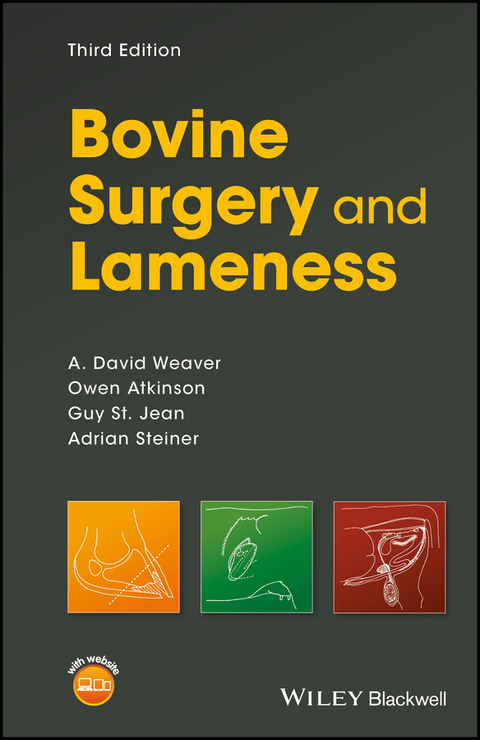
Bovine Surgery and Lameness (eBook)
John Wiley & Sons (Verlag)
9781119040491 (ISBN)
The revised and updated Third Edition of Bovine Surgery and Lameness offers veterinarians a concise text ideal for use in the field.
- Offers a fully revised edition of the popular and well-respected book on bovine surgery and lameness
- Presents a practical quick-reference guide ideal for the field veterinarian
- Covers both common surgical procedures and the latest information on combating lameness
- Written by an expert team of international authors
- Includes access to a companion website offering video clips
The authors
A. David Weaver, BSc, Dr med vet, PhD, FRCVS, Dr hc (Warsaw), is Professor Emeritus at the University of Missouri's College of Veterinary Medicine in Columbia, Missouri, USA and formerly of the University of Glasgow, UK.
Owen Atkinson, BVSc, CertCHP, DCHP, RCVS Recognised Specialist, is Owner, Founder, and Director of Dairy Veterinary Consultancy Ltd, UK.
Guy St. Jean, DMV, MS, Dipl ACVS, is Professor of Surgery and Former Head in the Department of Veterinary Clinical Sciences at Ross University, St. Kitts, West Indies.
Adrian Steiner, Dr med vet, FVH, MS, Dr habil, Dipl ECVS, Dipl ECBHM, is Professor and Head at the Clinic for Ruminants, Vetsuisse-Faculty, University of Bern, Switzerland.
The revised and updated Third Edition of Bovine Surgery and Lameness offers veterinarians a concise text ideal for use in the field. Offers a fully revised edition of the popular and well-respected book on bovine surgery and lameness Presents a practical quick-reference guide ideal for the field veterinarian Covers both common surgical procedures and the latest information on combating lameness Written by an expert team of international authors Includes access to a companion website offering video clips
The authors A. David Weaver, BSc, Dr med vet, PhD, FRCVS, Dr hc (Warsaw), is Professor Emeritus at the University of Missouri's College of Veterinary Medicine in Columbia, Missouri, USA and formerly of the University of Glasgow, UK. Owen Atkinson, BVSc, CertCHP, DCHP, RCVS Recognised Specialist, is Owner, Founder, and Director of Dairy Veterinary Consultancy Ltd, UK. Guy St. Jean, DMV, MS, Dipl ACVS, is Professor of Surgery and Former Head in the Department of Veterinary Clinical Sciences at Ross University, St. Kitts, West Indies. Adrian Steiner, Dr med vet, FVH, MS, Dr habil, Dipl ECVS, Dipl ECBHM, is Professor and Head at the Clinic for Ruminants, Vetsuisse-Faculty, University of Bern, Switzerland.
Preface vii
Acknowledgements ix
About the Companion Website xi
1 General considerations and anaesthesia 1
2 Fluid and supportive therapy 53
3 Diagnostic techniques and procedures 73
4 Head and neck surgery 90
5 Abdominal surgery 118
6 Female urinogenital surgery 187
7 Teat surgery 211
8 Male urinogenital surgery 226
9 Musculoskeletal conditions and lameness 267
Appendix 351
1 Further Reading 351
2 Abbreviations 352
3 Conversion factors for old and SI units 354
Index 355
"A great tool for the farm vets of today. The regular boxed discussion points, tips and warnings make it easy to read when you need it most. Invaluable when quickly prepping on the way to a farm so I could assess the case with the benefit of knowledge".
Journal of the Association of Veterinary Students- September 2018
"A must-have for students and new graduates as well as a refresher for the more experienced practitioner. Overall a good combination of anatomy revision and surgical techniques providing good revision material and a quick reference guide when out in the field".
Veterinary Times 2018
"Provides a concise overview to provide readers with a basic understanding of surgical treatment options for various conditions. An easy read, written largely in outline and bulleted formats. Many illustrations help depict various procedures".
Journal of the American Veterinary Medical Association 253, 728 (Sept 15 2018)
"Wide range of diagnostic and surgical techniques described in the dot point form with helpful diagrams. Its up to date too, with both Janowitz and Christiansen techniques for laparoscopic correction of an LDA. I reckon anyone who owned this book would be empowered by it to undertake at least one useful procedure they hadn't even heard of".
Australian Cattle Practitioner 87, 37 (June 2018)
"Text boxes provide a multitude of useful tips and often incorporate animal welfare and ethical implications of the practitioner's decision-making, as well as pain management. A number of high-quality and up-to-date video resources on lameness complement the book on a newly implemented companion website, access through Wiley".
Livestock 25 (5), 250 (September/October 2018)
"Bovine Surgery and Lameness is an accessible aid for anyone with an interest in cattle practice [...] It's surprising such a concise book can contain such a vast amount of information, but it does [...] it makes for an excellent reference to accompany the foundation knowledge that vet students and new graduates already possess."
Vet Record 26 (July 2019)
Chapter 1
General Considerations and Anaesthesia
- 1.1 Pre-operative assessment
- 1.2 Instrumentation
- 1.3 Asepsis
- 1.4 Sutures and suturing
- 1.5 Restraint
- 1.6 Pre-medication and sedation
- 1.7 General anaesthesia
- 1.8 Local analgesics
- 1.9 Regional analgesia
1.1 Pre-operative Assessment
Introduction
The bovine patient is a stoical animal and modern crushes and physical restraint options allow many techniques to be carried out in the field. However, this should not excuse a thorough clinical and ethical assessment prior to any surgical procedure.
Assessment should include numerous factors apart from the physical condition of the subject:
- welfare implications of the procedure
- potential duration of a productive life
- economic situation including insurance status and economic return on the surgery
- surgical risk regarding complete recovery
- future breeding prospects including heritability of the condition being corrected
- pathology of other body systems directly or indirectly related to the primary condition
General physical examination is essential before emergency or elective surgery to assess risks and concurrent disorders.
Welfare and Quality of Life
Animal welfare may be judged using a number of criteria. Making these judgements is an essential part of the vet's role. Vets must also lead by example. Decisions to perform surgery, and how it is to be done, are complex. Foremost in the process must be the welfare of the cow or calf. The surgeon should ask themselves:
- How necessary is this procedure: will benefits to the animal outweigh any pain or discomfort?
- What will the animal's quality of life be afterwards? Is the procedure likely to lead to a ‘life worth living’ or preferably ‘a good life’ for the animal in question?
- How does this procedure compare with an alternative option of humane slaughter or euthanasia?
- To what extent can pain and discomfort be mitigated during and after the procedure?
- To what extent can fear and distress be mitigated during and after the procedure?
- What can we learn from this situation to make life better for cows and calves in the future?
The last question is vital: sometimes it is easy for the surgeon to focus on the individual animal in question (that is important too) but lose sight of the greater picture. For example: performing surgery on a cow with toe necrosis can greatly improve her quality of life, but what measures can be put in place to prevent further cases? You are asked to dehorn or castrate some yearling cattle: could it be done at a younger age next time?
Warning
Some procedures are deemed to be simply unethical and there is legislation in place preventing them, though there are regional variations. Examples in the UK of illegal procedures include:
- tail docking in calves or adult cattle (except in cases of injury)
- castration over one week by means of an elastrator
- castration without anaesthetic for animals over two months of age
Furthermore, the Veterinary Surgeons Act means that any surgery involving entering a body cavity (e.g. joint spaces; abdomen; thoracic cavity) can only be carried out by a qualified veterinary surgeon in the UK. It is incumbent on the vet to provide suitable anaesthesia and analgesia.
Anaesthesia techniques are described in Section 1.7–1.9. Peri-operative analgesia is discussed in Section 2.11, though there is clearly overlap in these two areas of pharmacology and surgical preparation. The use of a crush/squeeze chute should never replace adequate analgesia and sedation for surgical procedures.
Tip
Learn and practice good communication techniques. Effective communication between farm vet and producer is vital to ensure that pain and suffering are reduced to a minimum among stock. Vets should be the leaders in animal welfare: this leadership requires exact personal skills, which is in addition to any technical abilities or scientific knowledge required of vets.
Laboratory Tests
Under farm practice conditions laboratory tests may not be performed, but major parameters very simply estimated with minimal apparatus are:
- packed cell volume: microcentrifuge, microhaematocrit apparatus
- total protein: refractometer
Normal haematological and biochemical parameters of cattle are listed in Table 1.1.
Table 1.1 Reference ranges (haematology and plasma biochemistry) in cattle.
| Units | Average (%) | Range (± 2SD) |
| Haematology |
| Erythrocytes | ×1012/l | 7.0 | (5–10) |
| Haemoglobin | g/dl | 11.0 | (8–15) |
| PCV (haematocrit) | 1/l | 35.0 | 28–38 |
| Fibrinogen | g/l | 4.0 | (2–7) |
| Leucocytes | ×109/l | 7.0 | (4–12) |
| Neutrophils (non-segmented bands) | ×109/l | 0.02 (0.5%) | 0–1.12 (0–2%) |
| Neutrophils (segmented mature) | ×109/l | 2.0 (28%) | 0.6–4 (25–48%) |
| Lymphocytes | ×109/l | 4.5 (58%) | 2.5–7.5 (45–75%) |
| Monocytes | ×109/l | 0.4 (4%) | 0.02–0.8 (2–7%) |
| Eosinophils | ×109/l | 0.65 (9%) | 0–2.4 (0–20%) |
| Basophils | ×109/l | 0.05 (0.5%) | 0–0.2 (0–2%) |
| Neutrophil: lymphocyte ratio | — | 0.45 : 1 | — |
| Plasma biochemistry |
| Urea | mmol/l | 4.2 | 2.0–6.6 |
| Creatinine | μmol/l | 100 | 44–165 |
| Calcium | mmol/l | 2.5 | 2.0–3.4 |
| Inorganic phosphate | mmol/l | 1.7 | 1.2–2.3 |
| Sodium | mmol/l | 139 | 132–150 |
| Potassium | mmol/l | 4.3 | 3.6–5.8 |
| Chloride | mmol/l | 102 | 90–110 |
| Magnesium | mmol/l | 1.02 | 0.7–1.2 |
| Total protein | g/l | 67 | 51–91 |
| Albumin | g/l | 34 | 21–36 |
| Globulin | g/l | 43 | 30–55 |
| Glucose | mmol/l | 2.5 | 2.0–3.2 |
| Alkaline phosphatase | iu/l | 24 | 20–30 |
| AST SGOT | iu/l | 40 | 20–100 |
| ALT SGPT | iu/l | 10 | 4–50 |
| Lactate dehydrogenase (LDH) | iu/l | 700 | 600–850 |
| Bilirubin | μmol/l | 4.1 | 0–6.5 |
| Cholesterol | mmol/l | 2.6 | 1.0–3.0 |
| Creatine phosphokinase | mmol/l | 3.0 | 0–50 |
| The above values refer to healthy adult (> 3 years old) cattle, and have been compiled from various sources. Interpretation of possible deviations from the above ranges should consider variations due to the laboratory technique, breed, lactational and nutritional status, and should always be related to the presenting signs and symptoms of the individual or group. Units are given as SI units |
In some abdominal conditions (abomasal torsion or volvulus, intestinal obstruction) estimation of plasma electrolytes (e.g. chloride) is valuable in assessing prognosis and calculating requirements for fluid replacement. Fluid therapy is discussed in Chapter 2.
Congenital Defects
Incidence of congenital defects in cattle is 0.2–3%, with 40–50% born dead. Most defects are visible externally. Congenital defects reduce the value of affected calves and economic losses are most severe when combined with embryonic or foetal mortality, particularly if it results in an extended subsequent calving interval. Close collaboration between the vet, farmer and geneticist is essential and good breeding records are vital.
Tip
‘Congenital’ is not synonymous with ‘heritable’ or ‘genetic’. Where it is likely that the condition is inherited, steps should be taken...
| Erscheint lt. Verlag | 23.2.2018 |
|---|---|
| Sprache | englisch |
| Themenwelt | Veterinärmedizin ► Klinische Fächer ► Chirurgie |
| Veterinärmedizin ► Großtier ► Rind | |
| Schlagworte | analgesia of the flank of bovines</p> • analgesia of the head of bovines • Asepsis and bovines • Basic instruments for laparotomy or caesarian section in bovines • bovines and congenital defects • Equipment for bovines • General anaesthesia and bovines • Hand disinfection working with bovines • Indications and bovines • Intravenous anaesthesia agents for bovines • laboratory tests for bovines • local analgesics and bovines • <p>Guide to Bovine Surgery and Lameness • Premedication and bovines • Pre-operative assessment of lame bovines • Preparation of operative field for bovines • regional analgesia and bovines • Restraint and bovines • Rinderkrankheit • sedation and bovines • Sterilisation and bovines • Suture materials for bovines • Sutures and suturing of bovines • suture techniques and bovines • Veterinärchirurgie • Veterinärmedizin • Veterinärmedizin / Chirurgie, Orthopädie, Trauma • Veterinärmedizin f. Nutztiere • Veterinary Medicine • Veterinary Medicine - Farm Animals • Veterinary Surgery, Orthopedics & Trauma • Welfare and quality of life of bovines |
| ISBN-13 | 9781119040491 / 9781119040491 |
| Informationen gemäß Produktsicherheitsverordnung (GPSR) | |
| Haben Sie eine Frage zum Produkt? |
 EPUB (Adobe DRM)
Kopierschutz: Adobe-DRM
Adobe-DRM ist ein Kopierschutz, der das eBook vor Mißbrauch schützen soll. Dabei wird das eBook bereits beim Download auf Ihre persönliche Adobe-ID autorisiert. Lesen können Sie das eBook dann nur auf den Geräten, welche ebenfalls auf Ihre Adobe-ID registriert sind.
Details zum Adobe-DRM
Dateiformat: EPUB (Electronic Publication)
EPUB ist ein offener Standard für eBooks und eignet sich besonders zur Darstellung von Belletristik und Sachbüchern. Der Fließtext wird dynamisch an die Display- und Schriftgröße angepasst. Auch für mobile Lesegeräte ist EPUB daher gut geeignet.
Systemvoraussetzungen:
PC/Mac: Mit einem PC oder Mac können Sie dieses eBook lesen. Sie benötigen eine
eReader: Dieses eBook kann mit (fast) allen eBook-Readern gelesen werden. Mit dem amazon-Kindle ist es aber nicht kompatibel.
Smartphone/Tablet: Egal ob Apple oder Android, dieses eBook können Sie lesen. Sie benötigen eine
Geräteliste und zusätzliche Hinweise
Buying eBooks from abroad
For tax law reasons we can sell eBooks just within Germany and Switzerland. Regrettably we cannot fulfill eBook-orders from other countries.
aus dem Bereich


