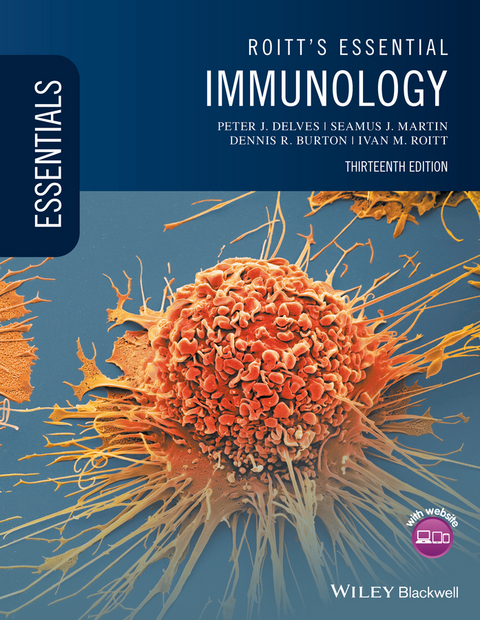
Roitt's Essential Immunology (eBook)
John Wiley & Sons (Verlag)
9781118416068 (ISBN)
Roitt's Essential Immunology - the textbook of choice for students and instructors of immunology worldwide
Roitt's Essential Immunology clearly explains the key principles needed by medical and health sciences students, from the basis of immunity to clinical applications. A brand new introduction sets the scene to section 1, Fundamentals of Immunology, introducing the microbial world and the strategies the body employs to defend itself. Each chapter then guides the reader through a different part of the immune system, and explains the role of each cell or molecule individually, and then as a whole. Section 2, Applied Immunology, discusses what happens when things go wrong, and the role the immune system plays alongside the damaging effects of a disease, including cancer, immunodeficiency, allergies and transplantation and the beneficial effects of vaccines.
The 13th edition continues to be a user-friendly and engaging introduction to the workings of the immune system, whilst supporting those who require a slightly more detailed understanding of the key developments in immunology. The content has been fully updated throughout and includes:
- An expansion on key clinical topics, including: innate immunity, autoimmune conditions, asthma, primary immunodeficiency, and HIV/AIDS
- Beautifully presented with improved artwork and new illustrations
- A range of learning features, including introduction re-cap boxes, end of chapter and section summaries to aid revision, as well as further reading suggestions, and a glossary to explain the most important immunology terms.
Roitt's Essential Immunology is also supported by a companion website at www.roitt.com including:
- An additional online only chapter on immunological methods and applications
- Further interactive multiple choice and single best answer questions for each chapter
- Animations and videos showing key concepts
- Fully downloadable figures and illustrations, further reading and useful links
- Updated extracts from the Encyclopaedia of Life Sciences
- Podcasts to reinforce the key principles explained in the text
Peter J. Delves PhD
Division of Infection and Immunity
UCL, London, UK
Seamus J. Martin PhD, FTCD, MRIA
The Smurfit Institute of Genetics
Trinity College, Dublin, Ireland
Dennis R. Burton PhD
Department of Immunology and Microbial Science
The Scripps Research Institute
La Jolla, California, USA
Ivan M. Roitt MA, DSc(Oxon), FRCPath, Hon FRCP (Lond), FRS
Centre for Investigative and Diagnostic Oncology
Middlesex University, London, UK
Roitt's Essential Immunology - the textbook of choice for students and instructors of immunology worldwide Roitt s Essential Immunology clearly explains the key principles needed by medical and health sciences students, from the basis of immunity to clinical applications. A brand new introduction sets the scene to section 1, Fundamentals of Immunology, introducing the microbial world and the strategies the body employs to defend itself. Each chapter then guides the reader through a different part of the immune system, and explains the role of each cell or molecule individually, and then as a whole. Section 2, Applied Immunology, discusses what happens when things go wrong, and the role the immune system plays alongside the damaging effects of a disease, including cancer, immunodeficiency, allergies and transplantation and the beneficial effects of vaccines. The 13th edition continues to be a user-friendly and engaging introduction to the workings of the immune system, whilst supporting those who require a slightly more detailed understanding of the key developments in immunology. The content has been fully updated throughout and includes: An expansion on key clinical topics, including: innate immunity, autoimmune conditions, asthma, primary immunodeficiency, and HIV/AIDS Beautifully presented with improved artwork and new illustrations A range of learning features, including introduction re-cap boxes, end of chapter and section summaries to aid revision, as well as further reading suggestions, and a glossary to explain the most important immunology terms. Roitt's Essential Immunology is also supported by a companion website at www.roitt.com including: An additional online only chapter on immunological methods and applications Further interactive multiple choice and single best answer questions for each chapter Animations and videos showing key concepts Fully downloadable figures and illustrations, further reading and useful links Updated extracts from the Encyclopaedia of Life Sciences Podcasts to reinforce the key principles explained in the text
Peter J. Delves PhD Division of Infection and Immunity UCL, London, UK Seamus J. Martin PhD, FTCD, MRIA The Smurfit Institute of Genetics Trinity College, Dublin, Ireland Dennis R. Burton PhD Department of Immunology and Microbial Science The Scripps Research Institute La Jolla, California, USA Ivan M. Roitt MA, DSc(Oxon), FRCPath, Hon FRCP (Lond), FRS Centre for Investigative and Diagnostic Oncology Middlesex University, London, UK
Title Page 5
Copyright Page 6
Contents 7
About the authors 8
Acknowledgments 10
Preface 11
Abbreviations 12
How to use your textbook 18
About the companion website 19
Part 1 Fundamentals of immunology 21
Chapter 1 Innate immunity 23
Introduction 24
Knowing when to make an immune response 24
Pattern recognition receptors detect nonself 27
Immune responses are tailored towards particular types of infection 28
Innate versus adaptive immunity 30
External barriers against infection 32
Cells of the immune system 32
The beginnings of an immune response 38
There are several classes of pattern recognition receptors 42
Phagocytic cells engulf and kill microorganisms 49
Phagocytes employ an array of killing mechanisms 50
Complement facilitates phagocytosis and bacterial lysis 54
Humoral mechanisms provide an additional defensive strategy 58
Natural killer cells kill virally infected cells 62
Dealing with large parasites 65
The innate immune system instigates adaptive immunity 65
Summary 68
Further Reading 71
Chapter 2 Specific acquired immunity 72
Just to recap … 73
Introduction 73
Antigens – “shapes” recognized by the immune system 73
Antibody – a specific antigen recognition molecule 73
Clonal selection 76
Immunological memory 78
Antigen specificity 81
Vaccination produces acquired memory 82
Cell-mediated immunity protects against intracellular organisms 82
Integration of the immune response 86
Immunopathology 86
Summary 86
Further Reading 88
Chapter 3 Antibodies 89
Just to recap … 90
Introduction 90
The division of labor 90
Five classes of immunoglobulin 90
The IgG molecule 92
The structure and function of the immunoglobulin classes 97
Genetics of antibody diversity and function 106
Summary 114
Further Reading 115
Chapter 4 Membrane receptors for antigen 117
Just to recap … 118
Introduction 118
The B-cell surface receptor for antigen (BCR) 119
The T-cell surface receptor for antigen (TCR) 122
The generation of diversity for antigen recognition 128
Invariant natural killer T-cell receptors bridge innate and adaptive immunity 133
NK receptors 135
The major histocompatibility complex (MHC) 139
Pathogen recognition receptors provide the first line of detection for microbial antigen 149
Summary 155
Further Reading 157
Chapter 5 Antigen-specific recognition 159
Just to recap … 160
Introduction 160
What antibodies see 160
Identifying B-cell epitopes on a protein 163
Thermodynamics of antibody–antigen interactions 164
Specificity and cross-reactivity of antibodies 168
What the T-cell sees 168
Processing of intracellular antigen for presentation by class I MHC 170
Processing of extracellular antigen for class II MHC presentation follows a different pathway 171
Cross-presentation of antigens 174
The nature of the “groovy” peptide 174
The ?? T-cell receptor binds to a combination of MHC and peptide 176
T-cell recognition of non-protein antigens 178
Antigen recognition by ?? T-cells 179
Superantigens are extremely powerful activators of T-cells 182
Why do ?? T-cells need to recognize antigen in such a complex way? 183
Summary 184
Further Reading 185
Chapter 6 The anatomy of the immune response 187
Just to recap … 188
Introduction 188
The location of the immune system 188
The skin immune system 188
Mucosal immunity 189
The blood and lymphatic systems 191
Organized lymphoid tissue 194
Lymphocyte homing 195
Lymph nodes 197
Spleen 200
Bone marrow is a major site of antibody synthesis 200
The liver contains a variety of immune system cells 201
Immunologically privileged sites 201
The handling of antigen 202
Summary 204
Further Reading 205
Chapter 7 Lymphocyte activation 207
Just to recap … 208
Introduction 208
Clustering of membrane receptors frequently leads to their activation 208
T-lymphocytes and antigen-presenting cells interact through several pairs of accessory molecules 209
The activation of T-cells requires two signals 211
Triggering the T-cell receptor complex 211
Protein tyrosine phosphorylation is an early event in T-cell signaling 212
Downstream events following TCR signaling 212
CD28 co-stimulation amplifies TCR signals and blocks apoptosis 215
Activated T-cells exhibit distinct gene expression signatures 216
Epigenetic control of T-cell activation 219
Activated T-cells undergo an essential metabolic shift 220
Metabolic control of T-cell differentiation 222
Damping T-cell enthusiasm 223
Dynamic interactions at the immunological synapse 225
B-cells respond to three different types of antigen 227
The nature of B-cell activation 230
Dynamic interactions at the BCR synapse 234
Summary 235
Further Reading 237
Chapter 8 The production of effectors 238
Just to recap … 239
Introduction 239
Effector mechanisms of innate and adaptive immunity 240
Cytokines influence the generation and function of effectors within the adaptive immune system 243
Cytokines act as intercellular messengers 244
Chemokines also play important roles in orchestrating immune responses 249
Cytokines and chemokines act through distinct classes of cell surface receptors 254
Cytokine receptor signal transduction cascades 254
Cytokine activities are fine-tuned through a variety of mechanisms 260
Activated T-cells proliferate in response to cytokines 262
Different T-cell subsets can make different cytokine patterns 263
Cells of the innate immune system shape the Th1/Th2/Th17/Tfh response 267
Policing the adaptive immune system 268
CD8+ T-cell effectors in cell-mediated immunity 271
Proliferation and maturation of B-cell responses are mediated by cytokines 275
What is going on in the germinal center? 276
The synthesis of antibody 278
Immunoglobulin class switching occurs in individual B-cells 278
Factors affecting antibody affinity in the immune response 281
Memory cells 282
Summary 287
Further Reading 290
Chapter 9 The regulation of the immune response 292
Just to recap … 293
Introduction 293
Immunogenetics 293
Antigenic competition 296
Complement and antibody help regulate immune responses 296
Activation-induced cell death 297
CD28 superfamily members that negatively regulate the immune response? 299
Immunoregulation by T-cells 301
Regulatory immunoneuroendocrine networks 305
Dietary effects on immunity 307
The influence of gender and aging 307
Summary 309
Further Reading 310
Chapter 10 Development and evolution of the immune response 311
Just to recap … 312
Introduction 312
ONTOGENY 312
CD antigens 312
Hematopoietic stem cells 312
The thymus is required for T-cell development 312
T-cell ontogeny 315
T-cell tolerance 320
B-cells differentiate in the fetal liver and then in bone marrow 324
B-1 and B-2 cells represent two distinct populations 325
Development of B-cell specificity 325
B-cell tolerance 327
Lymphocytes go through antigen-independent and antigen-dependent stages of differentiation 329
Natural killer (NK) cell ontogeny 329
Neonatal immunity 331
PHYLOGENY 332
The evolution of the immune response 332
The evolution of distinct B- and T-cell lineages was accompanied by the development of separate sites for differentiation 334
Cellular recognition molecules exploit the immunoglobulin gene superfamily 334
Summary 336
Further Reading 337
Part 2 Applied immunology 339
Chapter 11 Adversarial strategies during infection 341
Just to recap … 342
Introduction 342
Infection remains a major healthcare problem 342
Inflammation revisited 342
Bacterial survival strategies 346
The host counterattack against bacteria 349
The habitat of intracellular bacteria allows avoidance of many of the host defenses 354
Virus survival strategies 358
The host counterattack against viruses 361
Immunity to fungi 362
Immunity to parasitic infections 364
Prions 369
Summary 370
Further Reading 372
Chapter 12 Vaccines 373
Just to recap … 374
Introduction 374
Passively acquired immunity 374
Principles of vaccination 377
Killed organisms as vaccines 377
Live attenuated organisms have many advantages as vaccines 378
Subunit vaccines 382
Newer approaches to vaccine development 385
Current vaccines 388
Vaccines under development 388
Vaccines against parasitic diseases have proved particularly difficult to develop: malaria 388
Vaccines for protection against bioterrorism 392
Immunization against cancer 393
Other applications for vaccines 393
Adjuvants 393
Summary 395
Further Reading 396
Chapter 13 Immunodeficiency 398
Just to recap … 399
Introduction 399
Deficiencies of pattern recognition receptor signaling 399
Phagocytic cell defects (Table 13.1) 399
Primary immunodeficiency affecting other cells of the innate response 402
Complement system deficiencies (Table 13.2) 402
Cytokine and cytokine receptor deficiencies 404
Primary B-cell deficiency (Table 13.3) 406
Primary T-cell deficiency (Table 13.4) 407
Severe combined immunodeficiency (SCID) 409
Diagnosis of primary immunodeficiencies 410
Treatment of primary immunodeficiencies 411
Secondary immunodeficiency 411
Acquired immunodeficiency syndrome (AIDS) 412
Summary 422
Further Reading 423
Chapter 14 Allergy and other hypersensitivities 425
Just to recap … 426
Introduction 426
Type I hypersensitivity – IgE-mediated mast cell degranulation 427
Type II hypersensitivity – antibody-dependent cytotoxicity 438
Type III hypersensitivity – immune complex-mediated 441
Type IV hypersensitivity – cell-mediated (delayed-type) 446
An addition to the original classification – stimulatory hypersensitivity (“type V”) 450
Innate hypersensitivity reactions 450
Summary 451
Further Reading 453
Chapter 15 Transplantation 455
Just to recap … 456
Introduction 456
Types of graft 456
Types of rejection 456
Genetic control of transplantation antigens 457
Some other consequences of MHC incompatibility 458
Mechanisms of graft rejection 459
Matching the donor and recipient 462
Immunosuppression 465
Is xenografting a practical proposition? 469
Stem cell therapy 469
Clinical experience in grafting 470
The fetus as an allograft 474
Summary 475
Further Reading 476
Chapter 16 Tumor immunology 478
Just to recap … 479
Introduction 479
Cellular transformation and cancer 479
Cell-intrinsic mechanisms of tumor suppression 484
Cell-extrinsic mechanisms of tumor suppression 485
The cancer problem from an immune perspective 487
Inflammation can enhance tumor initiation, promotion, and progression 492
Tumor antigens 497
Classes of tumor antigens 500
Approaches to cancer immunotherapy 503
Passive immunotherapy with monoclonal antibodies 503
Unmasking of latent T-cell responses 506
Antigen-independent cytokine therapy 508
Vaccination approaches 509
Ex vivo expanded lymphocytes or dendritic cells 512
Summary 515
Further Reading 517
Chapter 17 Autoimmune diseases 519
Just to recap … 520
Introduction 520
The spectrum of autoimmune disease 520
What causes autoimmune disease? 523
Mechanisms in autoimmune disease 527
Pathogenic effects of autoantibody 533
Pathogenic effects of complexes with autoantigens 536
T-cell-mediated hypersensitivity as a pathogenic factor in autoimmune disease 539
Some other diseases with autoimmune activity 541
Measurement of autoantibodies 542
Therapeutic options 542
Summary 546
Further Reading 548
Glossary 549
Index 561
EULA 577
| Erscheint lt. Verlag | 15.11.2016 |
|---|---|
| Reihe/Serie | Essentials |
| Essentials | Essentials |
| Sprache | englisch |
| Themenwelt | Medizinische Fachgebiete ► Innere Medizin ► Pneumologie |
| Studium ► Querschnittsbereiche ► Infektiologie / Immunologie | |
| Schlagworte | Allergieforschung u. Klinische Immunologie • Allergy & Clinical Immunology • Immunologie • immunology • immunology, immune system, virus, bacteria, autoimmune conditions, asthma, HIV/Aids, CVID, antibodies, lymphocyte, vaccine, disease, allergy, medical students, biology, allied health, medicine • Medical Science • Medizin |
| ISBN-13 | 9781118416068 / 9781118416068 |
| Informationen gemäß Produktsicherheitsverordnung (GPSR) | |
| Haben Sie eine Frage zum Produkt? |
 PDF (Adobe DRM)
Kopierschutz: Adobe-DRM
Adobe-DRM ist ein Kopierschutz, der das eBook vor Mißbrauch schützen soll. Dabei wird das eBook bereits beim Download auf Ihre persönliche Adobe-ID autorisiert. Lesen können Sie das eBook dann nur auf den Geräten, welche ebenfalls auf Ihre Adobe-ID registriert sind.
Details zum Adobe-DRM
Dateiformat: PDF (Portable Document Format)
Mit einem festen Seitenlayout eignet sich die PDF besonders für Fachbücher mit Spalten, Tabellen und Abbildungen. Eine PDF kann auf fast allen Geräten angezeigt werden, ist aber für kleine Displays (Smartphone, eReader) nur eingeschränkt geeignet.
Systemvoraussetzungen:
PC/Mac: Mit einem PC oder Mac können Sie dieses eBook lesen. Sie benötigen eine
eReader: Dieses eBook kann mit (fast) allen eBook-Readern gelesen werden. Mit dem amazon-Kindle ist es aber nicht kompatibel.
Smartphone/Tablet: Egal ob Apple oder Android, dieses eBook können Sie lesen. Sie benötigen eine
Geräteliste und zusätzliche Hinweise
Buying eBooks from abroad
For tax law reasons we can sell eBooks just within Germany and Switzerland. Regrettably we cannot fulfill eBook-orders from other countries.
aus dem Bereich