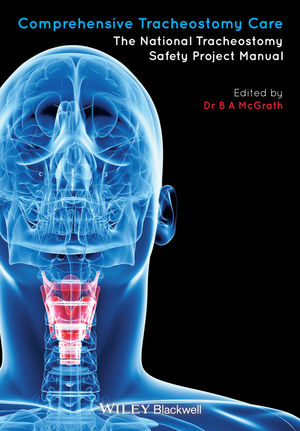
Comprehensive Tracheostomy Care (eBook)
Comprehensive Tracheostomy Care is a resource developed by the UK National Tracheostomy Safety Project (NTSP) to help promote and facilitate the safe management of tracheostomies and laryngectomies. The scope includes hospital in-patient specialist areas such as critical care, head & neck units and specialist wards, but it is also applicable to more general wards, outpatient and community settings. The majority of the content is for adult patients, complemented by a dedicated paediatric chapter developed with colleagues from Great Ormond Street Hospital.
The manual is a 'one stop shop' covering all aspects of tracheostomy and laryngectomy management. It includes multidisciplinary resources from surgical, anaesthetic, nursing, intensive care and allied health backgrounds, along with guidance from key UK stakeholder organisations. Emergency guidance has been reviewed and endorsed by relevant Royal Colleges, national organisations and patient groups.
It takes into account many national and international guidelines, policies and resources. It has been developed by consulting as widely as possible, across traditional professional boundaries using expertise and existing guidance from around the world, including the Global Tracheostomy Collaborative (www.globaltrach.org). Relevant existing resources are brought together coherently, with new resources presented in easy-to-follow text, illustrations, photographs and innovative linked e-learning and interactive resources.
Brendan McGrath is the author of Comprehensive Tracheostomy Care: The National Tracheostomy Safety Project Manual, published by Wiley.
Comprehensive Tracheostomy Care is a resource developed by the UK National Tracheostomy Safety Project (NTSP) to help promote and facilitate the safe management of tracheostomies and laryngectomies. The scope includes hospital in-patient specialist areas such as critical care, head & neck units and specialist wards, but it is also applicable to more general wards, outpatient and community settings. The majority of the content is for adult patients, complemented by a dedicated paediatric chapter developed with colleagues from Great Ormond Street Hospital. The manual is a 'one stop shop' covering all aspects of tracheostomy and laryngectomy management. It includes multidisciplinary resources from surgical, anaesthetic, nursing, intensive care and allied health backgrounds, along with guidance from key UK stakeholder organisations. Emergency guidance has been reviewed and endorsed by relevant Royal Colleges, national organisations and patient groups. It takes into account many national and international guidelines, policies and resources. It has been developed by consulting as widely as possible, across traditional professional boundaries using expertise and existing guidance from around the world, including the Global Tracheostomy Collaborative (www.globaltrach.org). Relevant existing resources are brought together coherently, with new resources presented in easy-to-follow text, illustrations, photographs and innovative linked e-learning and interactive resources.
Brendan McGrath is the author of Comprehensive Tracheostomy Care: The National Tracheostomy Safety Project Manual, published by Wiley.
NTSP Editorial board, vii
Preface, ix
Acknowledgements, xi
Competing interests, xiii
Disclaimer, xv
Contact details and further information, xvii
Executive summary and Key recomendations, xix
1 How the NTSP resources were developed, 1
2 What is a tracheostomy? What is a laryngectomy?, 3
3 Why and how a tracheostomy is performed, 7
4 Different types of tracheostomy tubes, 20
5 Management of the day-to-day needs of the patient with a tracheostomy and laryngectomy, 28
6 Complications, 67
7 Redflags, 72
8 Emergency management of the patient with a tracheostomy or laryngectomy, 74
9 Paediatric tracheostomy care (with Great Ormond Street Hospital, London), 85
10 Infrastructure considerations, 111
11 Competencies for staff caring for patients with tracheostomies or laryngectomies, 117
12 Courses, 122
13 Human factors, 124
Bibliography, 131
Chapter 3
Why and how a tracheostomy is performed
Indications for a tracheostomy
The classical indication for a tracheostomy is upper airway obstruction and this is why the first recorded tracheostomies were performed. However, in modern medical practice, the indications have widened both for temporary and permanent tracheostomy. Indications can be considered as
- to secure and maintain a patent airway in upper airway obstruction (actual or potential);
- to secure and maintain a safe airway in patients with injuries to the face, head or neck and following certain types of surgery to the head and neck;
- to facilitate the removal of bronchial secretions where there is poor cough effort with sputum retention;
- in an attempt to protect the airway of patients who are at high risk of aspiration, that is, patients with incompetent laryngeal and tongue movement on swallowing, for example, neuromuscular disorders, unconsciousness, head injuries and stroke.
- to enable long-term mechanical ventilation of patients, either in an acute intensive care unit (ICU) setting or sometimes chronically in hospitals or in the community;
- to facilitate weaning from artificial ventilation in acute respiratory failure and prolonged ventilation.
Because of the nature of the underlying medical conditions that often lead to a tracheostomy, patients who receive a tracheostomy often have poor survival prospects. A review of over 23 000 American inpatient records where a tracheostomy was performed demonstrated that only 80% survived to hospital discharge, with as few as 60% surviving if they had significant co-morbidities (Shah et al., 2012).
There is no convincing data that can guide clinicians as to the timing of a tracheostomy. For specific circumstances, such as extensive elective head and neck surgery, the decision is straightforward. However, balancing the risks of managing an airway with prolonged endotracheal tube (ETT) intubation versus the risks of tracheostomy (procedural and post-placement) is difficult and must be made on an individual basis (Box 3.1).
Anatomy relevant to tracheostomy
A tracheostomy is an artificial opening made into the trachea through the neck. This may be temporary or permanent. A tracheostomy tube is usually inserted, providing a patent opening. The tube enables airflow to enter the trachea and lungs directly, bypassing the nose, pharynx and larynx.
There are a variety of tracheostomy techniques but they all aim to enter the trachea around the gap between the second and third tracheal rings. Emergency access to the airway can be achieved through the relatively avascular cricothyroid membrane. This is reasonably anterior in the neck, close to the surface and can be identified by feeling for the ‘dent’ below the ‘Adam’s apple' or thyroid cartilage (Figures 3.1 and 3.2). The further down the neck towards the chest you palpate, the deeper into the neck the trachea goes. In some patients it is difficult to feel the trachea at all.
Figure 3.1 Anterior tracheal anatomy showing tracheostomy site.
Reproduced with permission of HEE eLfH.
Figure 3.2 Surface anatomy of the anterior neck.
Reproduced with permission of HEE eLfH.
There are many important structures that lie in the neck in close proximity to the trachea (Figure 3.3). These can be damaged, or cause haemorrhage, while performing a tracheostomy.
Figure 3.3 Important structures surrounding potential tracheostomy sites.
Reproduced with permission of HEE eLfH.
Figure 3.3 highlights some of the important structures relevant to tracheostomy. These are shown in the lateral views in Figure 3.4(a) and (b). The thyroid isthmus is often resected during a surgical tracheostomy, but this is not possible during a percutaneous procedure. Similarly, bleeding vessels are more amenable to ligation and diathermy using a surgical technique. The percutaneous technique probably causes less tissue trauma and may make bleeding less likely, but the only way to stop any resultant bleeding is by applying pressure. This can be externally applied or caused by a tamponading effect from the tube within the newly dilated tissues.
Figure 3.4 Lateral view of the upper airway (a) without and (b) with a tracheostomy in situ.
Reproduced with permission of HEE eLfH.
Note the position of the flange of the tracheostomy tube [Figure 3.4(b)]. This should be flush with the skin on the front of the neck. In large or obese patients, it can be seen that the distance between the skin and the trachea can be significant. This may require specialist tracheostomy tubes to ensure a safe and correct ‘fit’.
The anatomy relevant for laryngectomy is similar, except that the result is an end stoma: the trachea terminates at the front of the neck and is no longer in continuity with the upper airways. Figure 3.5(a) shows a patient with a tracheostomy tube in a tracheostomy stoma, while Figure 3.5(b) shows a newly created, open laryngectomy stoma, with no tube in situ. It can be very difficult to tell the difference, especially if you are not familiar with laryngectomies. Bedhead signs have an important role here.
Figure 3.5 Patients with (a) a tracheostomy tube in a tracheostomy stoma and (b) an open laryngectomy stoma with no tube in situ.
Types of tracheostomy
Tracheostomy may be temporary or long term/permanent, and may be performed electively or as an emergency procedure. They may also be classified by their method of initial insertion – either surgical or percutaneous.
Temporary
Temporary tracheostomies will be performed when patients require short-term respiratory support or cannot maintain the patency of their own airway. They can also provide a degree of ‘protection’ of the airways against aspiration if the swallowing or neurological control mechanisms of the larynx or pharynx are damaged (commonly in head injuries or neurological diseases). Certain maxillofacial or ENT surgical procedures require a temporary tracheostomy to facilitate the procedure. These tubes will be removed if and when the patient recovers.
Long term/permanent
Long term/permanent tracheostomies are used when the underlying condition is chronic, permanent or progressive. This includes carcinoma of the naso-oropharynx or larynx. Dependent on the stage of the disease, either a tracheostomy or a laryngectomy will be performed. Some patients need chronic respiratory support or long-term airway protection and this requires a long-term/permanent tracheostomy.
Techniques for inserting a tracheostomy
Introduction
Tracheostomy is one of the oldest recorded surgical procedures, depicted on Egyptian tablets dated from around 3600 bc. The earliest publication is in the Rigveda, a sacred Hindu book published around 2000 bc. Asclepiades of Persia (100 bc) and Alexander the Great (350 bc) are described as early practitioners, with other sporadic anecdotal accounts, including Hippocrates concluding that they were dangerous.
Antonio Musa Brasavola, an Italian physician, is widely credited with performing the first (well-documented) successful tracheotomy (Figure 3.6). He published his account in 1546. The patient, who suffered from a laryngeal abscess, recovered from the procedure. The same cannot be said for George Washington who died in 1799, probably from upper airway obstruction due to epiglottitis or an abscess. His physicians considered a tracheostomy but were reportedly reluctant to ‘have a go’ on someone so eminent! The famous surgeon Chevalier Jackson described modification to the procedure in 1909, making it safe to perform with markedly reduced long-term complications, especially for children. A video can be viewed here (http://vimeo.com/38704374) (Figure 3.7) showing Chevalier Jackson demonstrating a tracheostomy on a rag doll in his car, around 1925.
Figure 3.6 Antonio Musa Brasavola. Courtesy of the US National Library of Medicine.
Figure 3.7 Chevalier Jackson demonstrating a tracheostomy on a rag doll in his car.
The 1952 polio epidemic saw tracheostomies used in the first ICUs in Copenhagen, Denmark (Figure 3.8). Bjørn Ibsen pioneered this technique and thus allowed positive pressure ventilation to be delivered to patients and thereby reduced mortality from bulbar polio from around 85% to less than 15%.
Figure 3.8 A patient from the Copenhagen polio epidemic being ventilated via a tracheostomy.
Lassen (1953). Reproduced with...
| Erscheint lt. Verlag | 4.2.2014 |
|---|---|
| Sprache | englisch |
| Themenwelt | Medizin / Pharmazie ► Allgemeines / Lexika |
| Medizin / Pharmazie ► Gesundheitswesen | |
| Medizin / Pharmazie ► Medizinische Fachgebiete ► Chirurgie | |
| Medizinische Fachgebiete ► Innere Medizin ► Pneumologie | |
| Schlagworte | Care • Contact • daytoday needs • developed • Different • editorial • Emergency Medicine & Trauma • Great • Information • Laryngectomy • medical education • Medical Science • Medizin • Medizinstudium • Notfallmedizin u. Traumatologie • NTSP • Patient • tracheostomy • Tubes • Types |
| ISBN-13 | 9781118792841 / 9781118792841 |
| Informationen gemäß Produktsicherheitsverordnung (GPSR) | |
| Haben Sie eine Frage zum Produkt? |
 EPUB (Adobe DRM)
Kopierschutz: Adobe-DRM
Adobe-DRM ist ein Kopierschutz, der das eBook vor Mißbrauch schützen soll. Dabei wird das eBook bereits beim Download auf Ihre persönliche Adobe-ID autorisiert. Lesen können Sie das eBook dann nur auf den Geräten, welche ebenfalls auf Ihre Adobe-ID registriert sind.
Details zum Adobe-DRM
Dateiformat: EPUB (Electronic Publication)
EPUB ist ein offener Standard für eBooks und eignet sich besonders zur Darstellung von Belletristik und Sachbüchern. Der Fließtext wird dynamisch an die Display- und Schriftgröße angepasst. Auch für mobile Lesegeräte ist EPUB daher gut geeignet.
Systemvoraussetzungen:
PC/Mac: Mit einem PC oder Mac können Sie dieses eBook lesen. Sie benötigen eine
eReader: Dieses eBook kann mit (fast) allen eBook-Readern gelesen werden. Mit dem amazon-Kindle ist es aber nicht kompatibel.
Smartphone/Tablet: Egal ob Apple oder Android, dieses eBook können Sie lesen. Sie benötigen eine
Geräteliste und zusätzliche Hinweise
Buying eBooks from abroad
For tax law reasons we can sell eBooks just within Germany and Switzerland. Regrettably we cannot fulfill eBook-orders from other countries.
aus dem Bereich