


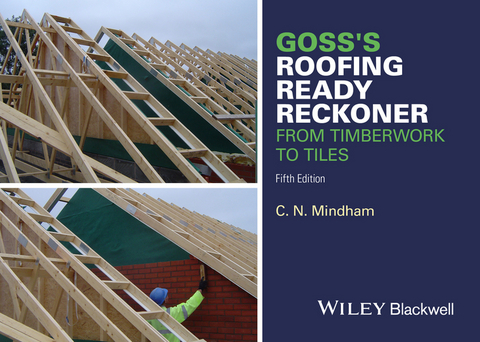
Goss's Roofing Ready Reckoner (eBook)
John Wiley & Sons (Verlag)
9781119077657 (ISBN)
Goss's Roofing Ready Reckoner provides cutting angle and lengths for traditional 'cut' roofs and design tables for timber sizing, based on BS5268 'Structural use of timber' and now including a comparison of timber sizes using Eurocode 5 'Design of Timber Structures'. Additional information is provided on wall plate and gable strapping, wind bracing, truss clips and other roofing metalwork, plus information on tools, equipment and health and safety matters. Detailed drawings for tiling, slating and other roof coverings are included, with fixing requirements revised to BS 5534:2014. Information on lead substitutes and roofing putties is also provided. Design of warm and cold roofs is fully covered, including ventilation and insulation requirements. The fifth edition also includes new chapters on engineered timber roofing components, solar panel fixing and outbuilding roofs.
C.N. Mindham BSc has had a wide experience in the construction industry. After working at TRADA as Eastern Regional Officer, he developed a timber engineering business to become one of the country's largest producers of trussed rafters. He has subsequently run his own consultancy and been Managing Director of companies manufacturing trussed rafters, joinery and prefabricated timber buildings, and architectural metal work.
Goss s Roofing Ready Reckoner provides cutting angle and lengths for traditional cut roofs and design tables for timber sizing, based on BS5268 Structural use of timber and now including a comparison of timber sizes using Eurocode 5 Design of Timber Structures . Additional information is provided on wall plate and gable strapping, wind bracing, truss clips and other roofing metalwork, plus information on tools, equipment and health and safety matters. Detailed drawings for tiling, slating and other roof coverings are included, with fixing requirements revised to BS 5534:2014. Information on lead substitutes and roofing putties is also provided. Design of warm and cold roofs is fully covered, including ventilation and insulation requirements. The fifth edition also includes new chapters on engineered timber roofing components, solar panel fixing and outbuilding roofs.
C.N. Mindham BSc has had a wide experience in the construction industry. After working at TRADA as Eastern Regional Officer, he developed a timber engineering business to become one of the country's largest producers of trussed rafters. He has subsequently run his own consultancy and been Managing Director of companies manufacturing trussed rafters, joinery and prefabricated timber buildings, and architectural metal work.
1 Introduction and acknowledgements 1
Acknowledgements 2
2 Roofing terminology 3
3 Calculating the size of timber members 9
Strength and section size calculations 11
How do we calculate the loading on the roof? 11
Timber member sizing design: an example 12
Cost consideration 19
4 Calculating the length and cutting angles of timber members: data tables 5 -75 20
The pitch 23
Using the tables to cut a common rafter 23
Hip jack rafters 28
Hip rafters 30
Valley jack rafters 32
The ridge 32
Purlins 34
5 Wall plates - strapping and gable strapping 109
6 Wind bracing and openings for dormers and roof windows 111
Openings for dormers and roof windows 113
7 Roofing metalwork and fixings 119
Nails, bolts and screws 121
8 Engineered timber roofing components and prefabricated roofs 123
Trussed rafters 123
Spandrel panels 125
Crane-on roof assemblies - trussed rafters 127
Crane-on roofs - structural panels 128
Crane-on roof assemblies - structural insulated panels 128
Attic to room-in-the-roof conversion 130
9 Roof coverings - underlay, battens and tiles 134
Underlay 134
Battens 138
Insulation and ventilation 140
Choosing the roof covering 154
Building regulations - thermal performance 162
10 Roof coverings - building detail drawings 179
The new BS 5534:2014 179
Manufacturer's specification 180
Hips, ridges, verges and valleys - traditional and new methods of construction 180
Roofing putties 187
Natural slates 189
Concrete interlocking tiles 192
Plain and peg tiles 193
Asphalt shingles 198
Metal tiles 201
Lead substitutes 202
11 Solar panels 205
Planning and roof suitability 205
Roof construction 206
Fixing the panels 207
Possible improved fixing 208
Variations on panel design 211
12 Sheds and outbuildings 212
Permitted development 212
Types of permitted building 212
Design 215
The structure 215
The mono-pitch roof 216
The dual-pitch roof 216
Roof coverings 218
Make your new building save money! 220
13 Tools and equipment 221
Obtaining information from the drawing 221
To cut the roof 222
Setting up the roof structure 222
Roof coverings 223
14 Health & safety considerations 224
Access to the roof 224
Basic principles 225
Restoration and renovation of existing roof structures 225
Newly constructed roofs 226
The roof covering 226
Conclusion 227
Bibliography 229
Index 243
"The revised fifth edition of Goss's Roofing Ready Reckoner provides much needed practical guidance on the timberwork supporting tile and slate roofs. The book will be of assistance to both carpenters and tilers in providing guidance to the latest standards and new products.... It is recommended that a copy is available on site to carpenters and tilers, and kept in the van or tool bag."
--Keith Roberts, RCI Technical Note Number 241, September 2016
3
Calculating the size of timber members
Knowing the overall dimensions of the roof, that is, the span over the wall plates, pitch of the rafters, length between the gables or hips, any internal supporting walls and the specification of the roof covering, the following data will help to design the size and strength specification of the individual roof members themselves.
Roof structure design must satisfy the requirements of the building regulations for the individual countries of the UK. Currently (at the time of writing this edition), the building regulations can be satisfied by designing either with the British Standard BS 5268-2 2002 ‘Code of Practice for Structural Timber Design. Permissible stress design materials and workmanship’ or BSEN 1995-1-1 ‘Eurocode 5 Design of timber structures’. Common rules and rules for building, the UK National Annex to EC5 and Published Document PD6693-1 ‘Recommendations for the design of timber structures to Eurocode 5’, as above. Clearly, at some time in the future the building regulations will be amended to allow only the EC5 design standards. A limbo situation exists in the timber design industry at present, with some trussed rafters being designed on BS5268-2 and some on EC5. For individual timber roofing members, Trada have two sets of span tables available, one on each of the design methods above. These cover rafters, purlins, ceiling joists and ceiling binders, plus floor joists and trimmers as well as flat roof joists. Designs based on either of these design documents should satisfy local building control. The Trada Technology Ltd documents are:-
- SPAN TABLES for solid timber members in floors, ceilings and roofs of dwellings, 2nd edition.
- Eurocode 5 SPAN TABLES for solid timber members in floors, ceilings and roofs for dwellings.
The first document is based on BS5268-2 and the second on EC5 (see Bibliography for full contact details to obtain the publications). The term ‘solid timber’ describes natural sawn timber from logs, and not engineered timber components such as Ply Box beams, or ‘I’ beams.
A brief word on timber size design considerations. The loads to be supported by the roof structure are made up of a number of elements:
- The roof covering: tiles, slates, etc.
- The self weight of the structure: timber, felt, battens, insulation, and ceiling if an attic structure, plus water tanks as necessary.
- Snow load.
- Wind load.
Referring to the above:
- is a statistic relating to the roof covering type and can be obtained from the product manufacturer.
- is calculated from the known weight of individual members.
- is a variable with the roof shape and pitch and height above ground and sea level, and is also a variable depending on the location of the building geographically within the UK.
- this is also a variable based on geographically variable information and is also affected by exposure, that is, the altitude of the building and its proximity to coastal or other areas of high wind exposure.
For the above reasons, any calculation for designing the roof member size, must take all of the above into consideration. Thus, most standard timber sizing data has geographical limitations to its use. The tables reproduced in this book have been designed to illustrate the process to be used when sizing timber members in the following worked example. The Trada tables referred to above are more comprehensive in terms of different loadings, different spacings, and give data for both C16 and C24 stress class timber.
STRENGTH AND SECTION SIZE CALCULATIONS
The load-bearing capacity of a timber member is a function not only of its cross-section, but also of its strength class. Readily available timbers are classified from strength class C16 and C24; these include a range of European-, UK-, Canadian- and USA-produced timbers. Whilst section size savings can be achieved using the higher-grade timbers, there is a cost premium to pay, and on small-scale projects the economy of timber section is not great (more detail will be given on this later). The C16 timber, being of less strength than the C24, results in a larger section, and in some cases the greater width of the timber can be of benefit to the non-professional, giving a greater width of timber in some instances to which to fix both battens and plasterboard ceilings and so on, whilst the tables shown below are based on C24 strength class timber and design method BS5268 (a comparison has been given in C16). For further comparison, sizes based on EC5 in both C16 and C24 have also been shown in Figure 3.6.
Figure 3.1 Dimensions of a roof in a worked example.
HOW DO WE CALCULATE THE LOADING ON THE ROOF?
The dead load – that is, that of the roof covering itself – can be obtained from the roof covering manufacturer as the ‘as laid weight’; an indication of the weights of various tiles and slates can be seen in Figure 9.10. Whilst the tile loading will be expressed in kg/m2 the dead load forces for design purposes are expressed in kN/m2. The conversion is approximately 1/100; that is a tile weighing 75 kg/m2 exerts a force of 0.75 kN/m2.
The imposed load is that for snow lying on the roof; this varies, as has been stated, with geography, altitude and indeed with the roof pitch, but the latter factor is taken into account within the calculations for preparation of the tables. Snow loading is mainly related to altitude, that is, the location of the building above sea level, but also to exposure. Thus, south western counties which generally are at a lower altitude would have a snow loading of 0.75 kN/m2, whereas more eastern and higher-altitude (not exceeding 200 m) locations vary between 0.75 kN/m2 and 1.0 kN/m2. The extreme north-east of England can be up to 1.07 kN/m2 and the part of Scotland below 200 m, up to 1.25 kN/m2. For more exact data, see snow loading maps are provided in the Trada publications described above.
TIMBER MEMBER SIZING DESIGN: AN EXAMPLE
The roof to be designed is located in the highlands of Scotland, but below 100 m altitude. The snow loading is 1.02 kN/m2.
The ceiling joists are to carry normal loft storage only, not flooring loads. The ceiling would be considered as 12 mm plasterboard, with a load of 0.25 kN/m2.
-
Ceiling Joists (Ref. Fig. 3.1)
The spacing of the ceiling joists is 400 mm, the span is 2.33 m.
-
Ceiling Tie Binders (Ref. Fig. 3.1)
The longest span is 2.7 m between supports, and the spacing is 2.33 m.
-
Purlins (Ref. Fig. 3.1)
The maximum span of the purlin between supports is 2.7 m, and the spacing of the purlins is also 2.4 m.
-
Rafters (Ref. Fig. 3.1)
The rafter spacing is 400 mm and maximum span is 2.4 m.
We now have all the information to find the size of timber cross-section to carry the loads imposed upon it. Refer now to the tables in Figures 3.2–3.5 below.
| Size of ceiling joist | Maximum clear span (m) |
| Breadth × Depth (mm) |
| 47 × 97 | 2.00 |
| 47 × 120 | 2.61 |
| 47 × 145 | 3.29 |
| 47 × 170 | 3.69 |
| 47 × 195 | 4.64 |
| 47 × 220 | 5.32 |
Figure 3.2 Span tables for ceiling joists. The above table is reprinted from Guild to Building Control by Anthony Gwynne with the permission of Wiley Blackwell.
Minimum ceiling joist bearing 35 mm.
Imposed load: 0.25 kN/m2 (concentrated load 0.9 kN).
Dead load: 0.50 kN/m2 excluding self-weight of joist.
The above values have been compiled for guidance table by Geomex Ltd Structural Engineers: www.geomex.co.uk.
Span tables for C16- and C24-strength class solid timber members in floors, ceilings and roofs for dwellings are available from TRADA Technology at: www.trada.co.uk/bookshop.
| Spacing of binders (mm) |
| Size of binder (mm) | 1200 | 1500 | 1800 | 2100 | 2400 | 2700 |
| Breadth × Depth | Maximum clear span or hanger spacing (m) |
| 47 × 175 | 2.88 | 2.69 | 2.54 | 2.421 | 2.321 | 2.231 |
| 47 ×... |
| Erscheint lt. Verlag | 7.3.2016 |
|---|---|
| Sprache | englisch |
| Themenwelt | Technik ► Bauwesen |
| Weitere Fachgebiete ► Handwerk | |
| Schlagworte | Attic Roofs • Battens • Bauausführung • Bauausführung • Bauingenieur- u. Bauwesen • BS5268 • BS 5534:2014 • Building Maintenance & Services • Building regulation requirements for roofs • Calculating the length and cutting angles of timber roof members • Calculating the size of timber members for roof construction • Civil Engineering & Construction • Cold roofs • Concrete interlocking tiles • Condensation control in roofs • Construction • Crane-on roofs • cut roofs • cutting angles for roof construction • cutting lengths for roof construction • Dach • Design of Timber Structures • design tables for roof construction • dormers • dry fixed ridge • dry methods of fixing hips, valleys and ridges • Engineered timber roofing components • Eurocode 5 • fixing requirements for roofs • gable strapping for roofs • Gebäudeunterhaltung, Dienstleistungen • Gebäudeunterhaltung, Dienstleistungen • Hip jack rafters • Hip rafters • Lead substitutes for flashings • <p>Asphalt shingles • Metal tiles • Natural slates • openings for dormers • outbuilding roofs • peg tiles • Plain tiles • prefabricated roofs • Purlins • renovation of existing roof structures • Restoration of existing roof structures • Roof Coverings • Roofing Battens • roofing metalwork • Roofing metalwork fixings • roofing putties • Roofing terminology • Roofing Underlay • Roof Insulation • Roof tile fixing • Roof tiles • roof tiling • roof truss clips • Roof wind bracing • roof windows • Sheds roofs • SIPS (Structural Insulated Panel Systems) • slate fixing • Slating • Solar panel fixing • Solar Panel fixings to roof structure • Spandrel panels • Strength and section size calculations for roof construction • structural panels • Structural use of timber • Thermal Performance of Roofs • Timber member sizing design for roof construction • timber sizing for roof construction • Traditional fixing of hips, valleys and ridges • traditional roof • Trussed rafters • Valley jack rafter • wall plate for roofs • warm roofs </p> |
| ISBN-13 | 9781119077657 / 9781119077657 |
| Informationen gemäß Produktsicherheitsverordnung (GPSR) | |
| Haben Sie eine Frage zum Produkt? |
 EPUB (Adobe DRM)
Kopierschutz: Adobe-DRM
Adobe-DRM ist ein Kopierschutz, der das eBook vor Mißbrauch schützen soll. Dabei wird das eBook bereits beim Download auf Ihre persönliche Adobe-ID autorisiert. Lesen können Sie das eBook dann nur auf den Geräten, welche ebenfalls auf Ihre Adobe-ID registriert sind.
Details zum Adobe-DRM
Dateiformat: EPUB (Electronic Publication)
EPUB ist ein offener Standard für eBooks und eignet sich besonders zur Darstellung von Belletristik und Sachbüchern. Der Fließtext wird dynamisch an die Display- und Schriftgröße angepasst. Auch für mobile Lesegeräte ist EPUB daher gut geeignet.
Systemvoraussetzungen:
PC/Mac: Mit einem PC oder Mac können Sie dieses eBook lesen. Sie benötigen eine
eReader: Dieses eBook kann mit (fast) allen eBook-Readern gelesen werden. Mit dem amazon-Kindle ist es aber nicht kompatibel.
Smartphone/Tablet: Egal ob Apple oder Android, dieses eBook können Sie lesen. Sie benötigen eine
Geräteliste und zusätzliche Hinweise
Buying eBooks from abroad
For tax law reasons we can sell eBooks just within Germany and Switzerland. Regrettably we cannot fulfill eBook-orders from other countries.
aus dem Bereich


