


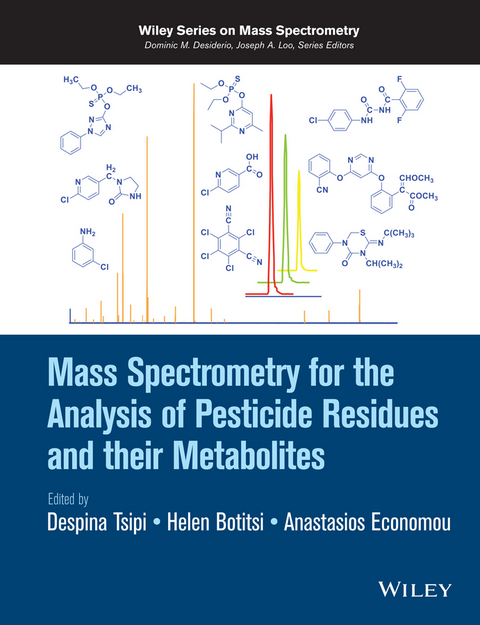
Mass Spectrometry for the Analysis of Pesticide Residues and their Metabolites (eBook)
- Presents state of the-art MS techniques for the identification of pesticides and their transformation products in food and environment
- Covers important advances in MS techniques including MS instrumentation and chromatographic separations (e.g. UPLC, HILIC, comprehensive GCxGC) and applications
- Illustrates the main sample preparation techniques (SPE, QuEChERS, microextraction) used in combination with MS for the analysis of pesticides
- Describes various established and new ionization techniques as well as the main MS platforms, software tools and mass spectral libraries
Despina Tsipi is the Director of Food Safety & Quality Laboratories (including the Pesticide Residues Laboratory) of the General Chemical State Laboratory, Athens, Greece. She holds a B.Sc. in Chemistry and a Ph.D in Photochemistry from the University of Athens, after a doctoral fellowship in NRSC Demokritos. She works in the field of pesticide residues analysis in foodstuffs and environment using hyphenated MS techniques for over 20 years. Between 2003-2006, she joined the Panel of Plant Protection Products and their Residues (PPR-Panel) of the European Food Safety Authority. She is a founding member and current president of the Hellenic Mass Spectrometry Society.
Helen Botitsi is the Head of the Pesticide Residues Laboratory, a National Reference Laboratory of EU for pesticide residues analysis in foods of plant and animal origin of the General Chemical State Laboratory, Athens, Greece. She holds a B.Sc. in Chemistry and a Ph.D in Biochemistry from the University of Athens. Her main field of expertise is method development for pesticide and pharmaceutical residues analysis in foodstuffs and environmental samples using GC-MS and LC-MS techniques as well as method validation and quality control.
Anastasios Economou is Associate Professor at the Laboratory of Analytical Chemistry, University of Athens, Greece. He holds a B.Sc. in Chemistry from the University of Athens, a M.Sc. and a Ph.D in Analytical Science and Chemical Instrumentation from the University of Manchester. His research interests are focused on the development of electrochemical, spectroscopic and chromatographic analytical methods as well as the development of automated analytical systems.
Provides an overview of the use of mass spectrometry (MS) for the analysis of pesticide residues and their metabolites. Presents state of the-art MS techniques for the identification of pesticides and their transformation products in food and environment Covers important advances in MS techniques including MS instrumentation and chromatographic separations (e.g. UPLC, HILIC, comprehensive GCxGC) and applications Illustrates the main sample preparation techniques (SPE, QuEChERS, microextraction) used in combination with MS for the analysis of pesticides Describes various established and new ionization techniques as well as the main MS platforms, software tools and mass spectral libraries
Despina Tsipi is the Director of Food Safety & Quality Laboratories (including the Pesticide Residues Laboratory) of the General Chemical State Laboratory, Athens, Greece. She holds a B.Sc. in Chemistry and a Ph.D in Photochemistry from the University of Athens, after a doctoral fellowship in NRSC Demokritos. She works in the field of pesticide residues analysis in foodstuffs and environment using hyphenated MS techniques for over 20 years. Between 2003-2006, she joined the Panel of Plant Protection Products and their Residues (PPR-Panel) of the European Food Safety Authority. She is a founding member and current president of the Hellenic Mass Spectrometry Society. Helen Botitsi is the Head of the Pesticide Residues Laboratory, a National Reference Laboratory of EU for pesticide residues analysis in foods of plant and animal origin of the General Chemical State Laboratory, Athens, Greece. She holds a B.Sc. in Chemistry and a Ph.D in Biochemistry from the University of Athens. Her main field of expertise is method development for pesticide and pharmaceutical residues analysis in foodstuffs and environmental samples using GC-MS and LC-MS techniques as well as method validation and quality control. Anastasios Economou is Associate Professor at the Laboratory of Analytical Chemistry, University of Athens, Greece. He holds a B.Sc. in Chemistry from the University of Athens, a M.Sc. and a Ph.D in Analytical Science and Chemical Instrumentation from the University of Manchester. His research interests are focused on the development of electrochemical, spectroscopic and chromatographic analytical methods as well as the development of automated analytical systems.
1
PESTICIDE CHEMISTRY AND RISK ASSESSMENT
Despina Tsipi,1 Helen Botitsi,1 and Anastasios Economou2
1 Pesticide Residues Laboratory, General Chemical State Laboratory, Athens, Greece
2 Laboratory of Analytical Chemistry, Department of Chemistry, National and Kapodistrian University of Athens, Athens, Greece
1.1 INTRODUCTION
And he gave it for his opinion that whoever could make two ears of corn or two blades of grass to grow upon a spot of ground where only one grew before, would deserve better of mankind, and do more essential service to his country, than the whole race of politicians put together.
Jonathan Swift, 1667–1745
Plant protection, worldwide, has a very important role in the food production. One of the most important ways of protecting plants and plant products against harmful organisms, including weeds, and of improving agricultural production is the use of plant protection products (pesticides). Pesticides have brought to the world the most abundant, safe, and cheap food in its history. Pesticides, like pharmaceuticals, are the most thoroughly tested chemicals in the world, and only those that pass strict government testing are authorized for use. Active substances (pesticides) should only be included in plant protection products where it has been demonstrated that they present a clear benefit for plant production and they are not expected to have any harmful effect on human or animal health or any unacceptable effects on the environment, especially if placed on the market without having been officially tested and authorized or if incorrectly used.
Human exposure to pesticides and their metabolites through the food chain could be direct, through the consumption of treated foods, or indirect, through the transfer of residues into products of animal origin from treated feed items. Regulatory agencies, internationally, have provided pesticide regulations increasingly stringent in terms of establishment of the maximum residue limits (MRLs) for pesticides in food of plant and animal origin. Monitoring studies are organized annually by national authorities to enforce compliance with MRLs and to ensure food safety for consumers.
The unlimited number of pesticides and their metabolites, in conjunction with their low concentration levels in various food commodities and environmental matrices, makes the analysis of pesticide residues one of the most challenging and complex areas of analytical chemistry. Pesticide residue methods have been developed worldwide using hyphenated confirmatory techniques, such as gas chromatography–mass spectrometry (GC–MS) and liquid chromatography–mass spectrometry (LC–MS) for the determination of trace concentration levels.
Mass spectrometry (MS) platforms are widely applied in pesticide residues for (i) the determination of pesticide residues and their metabolites in food to ensure safety of the food supply, (ii) the investigation of the contamination of water resources from pesticides and their relevant metabolites, and (iii) the structure elucidation of unknown metabolites or degradation/transformation products (TPs) that sometimes can be more toxic than the parent pesticides.
This chapter provides information regarding the chemistry and toxicity of pesticides, their metabolites, and TPs. Risk assessment topics are discussed. Definitions and explanations in various topics of pesticides are also included.
1.2 PESTICIDE CHEMISTRY
1.2.1 Historical Perspective
The International Union of Pure and Applied Chemistry (IUPAC) defines a pesticide as any substance or mixture of substances intended for preventing, destroying, or controlling any pest (Holland, 1996). Looking back over the years, the modern pesticide history begins in 1939 with the synthesis of dichlorodiphenyltrichloroethane (DDT) from Paul Muller in Geigy (Switzerland). In 1948, after the successful widespread use of DDT as insecticide to protect human health from diseases (like malaria) and also in agriculture practice, Paul Muller was awarded the Nobel Prize (The History of Pesticides, 2008).
After the synthesis of DDT, a plethora of organic chemical compounds with insecticide, herbicide, and fungicide action started to be synthesized. Later in the 1960s, laboratory studies in the United States proved that some chemical compounds belonging to the class of organochlorine insecticides such as dieldrin, endrin, and aldrin are not degraded in the environment and bioaccumulate in living organisms. In the same time period, DDT residues have been detected in river waters in the United States, while in 1963, the phenomenon of dead fish in Mississippi was attributed to the presence of aldrin in river water (Delaplane, 2000). In 1972, mainly due to their high environmental persistence and bioaccumulation, organochlorine insecticides were banned first in the United States and later in Europe.
Nowadays, more than 1600 pesticides belonging to more than 100 chemical classes are in use worldwide for food production. Information on synthetic and commercially available pesticides is readily found at “The Pesticide Manual” (The Pesticide Manual, 2012). Furthermore, the electronic Compendium of Pesticide Common Names (http://alanwood.net/pesticides/) contains data sheets for more than 1700 different active ingredients and for more than 350 ester and salt derivatives used in pesticide formulations.
The challenge of providing new molecules to control pests is a straightforward task with high rates of scientific success and considerable commercial reward. In no other field of chemistry has been such a diversity of structures arising from the application of the principles of chemistry to the mechanisms of action in pests to develop selectivity and sensitivity in agents toward certain species while reducing toxicity to other forms of life. The dramatic advances and the rapid changes in pesticide chemistry are presented, over the past 50 years, in the conferences in pesticide chemistry of the IUPAC taking place at 4-year intervals.
1.2.2 Identity and Physicochemical Properties of Pesticides
The systematic names of chemicals are derived from the IUPAC and the Chemical Abstracts Service (CAS). In addition to a systematic name, CAS assigns a registry number to each chemical. Since systematic names of pesticides are not convenient for general use, the widely accepted common names have been assigned by standard bodies. The Technical Committee 81 of the International Organization for Standardization (ISO) has devised a system for naming pesticides, with the aim of ensuring that common names indicate similarities between related compounds, do not conflict with any other names, and are suitable for use in many languages. New common names of chemicals for pest control are provisionally approved each year by the committee and are then used in the literature and on product labels. The ISO standards related to the selection of common names for pesticides are ISO 257:2004 (Pesticides and other agrochemicals—Principles for the selection of common names), ISO 765:1976 (Pesticides considered not to require common names), and ISO 1750:1981 (Pesticides and other agrochemicals—Common name) and its amendments.
Evaluation of pesticides begins with clear identification of their physical and chemical properties. Knowledge of the physical and chemical properties of a substance is a necessary prerequisite to understanding its general behavior in metabolism, analytical methods, formulations, and the environment.
Residues of pesticides on/in food commodities are also a function of many factors, which are mainly linked to the physicochemical properties of active ingredients. In the study performed by Thorbek and Hyder (2006), the relationship between physicochemical properties of the active ingredients and residue limits in foodstuffs was explored for fungicides, herbicides, and insecticides, using artificial neural networks. The authors concluded that the physicochemical properties of the active ingredients and crop type explained up to 50% of the variation in residue limits.
Pesticides currently used worldwide belonging to different chemical classes have different physicochemical properties. Physicochemical parameters of pesticides are usually measured according to well-established protocols recognized by national and international agencies (US Environmental Protection Agency (EPA) guidelines, Organization for Economic Co-Operation and Development (OECD), European Union (EU) protocols, etc.). Most of the physicochemical data are measured in the laboratory under well-defined experimental conditions. The main physicochemical data—water solubility, vapor pressure, volatility, stability in water, photodegradation, water–octanol partition coefficient, and acid–base properties—are characteristic of the single pesticide molecule. Short definitions of physicochemical properties are presented here with a commentary aspect on their relevance to various domains like the pesticide–environment interactions, its mode of application, and its analytical determination.
1.2.2.1 Water Solubility
The water solubility of a pesticide is defined as its maximum concentration dissolved in water when that water is both in contact and at equilibrium with the pure chemical. Data on pesticides’ water solubility reported are usually measured in mg/1 at 20°C (PPDB IUPAC, 2014, Stephenson et al., 2006). Pesticides with high water solubility will be transported away from the application site by runoff or irrigation water to reach the surface water...
| Erscheint lt. Verlag | 12.5.2015 |
|---|---|
| Reihe/Serie | Wiley-Interscience Series on Mass Spectrometry |
| Wiley-Interscience Series on Mass Spectrometry | Wiley Series on Mass Spectrometry |
| Sprache | englisch |
| Themenwelt | Naturwissenschaften ► Chemie ► Analytische Chemie |
| Technik | |
| Weitere Fachgebiete ► Land- / Forstwirtschaft / Fischerei | |
| Schlagworte | agricultural engineering • Agriculture • Chemie • Chemistry • Food Science & Technology • Landwirtschaft • Landwirtschaftstechnik • Lebensmittelforschung u. -technologie • Massenspektrometrie • Mass Spectrometry • Mass spectrometry, tandem mass spectrometry, pesticides, metabolites, transformation products, pesticide residues analysis, GC-MS, LC-MS, matrix effects, TOF, QqTOF, Orbitrap, UPLC, DART, target and non-target screening, high througput screening, food, environment |
| ISBN-13 | 9781119070009 / 9781119070009 |
| Informationen gemäß Produktsicherheitsverordnung (GPSR) | |
| Haben Sie eine Frage zum Produkt? |
 EPUB (Adobe DRM)
Kopierschutz: Adobe-DRM
Adobe-DRM ist ein Kopierschutz, der das eBook vor Mißbrauch schützen soll. Dabei wird das eBook bereits beim Download auf Ihre persönliche Adobe-ID autorisiert. Lesen können Sie das eBook dann nur auf den Geräten, welche ebenfalls auf Ihre Adobe-ID registriert sind.
Details zum Adobe-DRM
Dateiformat: EPUB (Electronic Publication)
EPUB ist ein offener Standard für eBooks und eignet sich besonders zur Darstellung von Belletristik und Sachbüchern. Der Fließtext wird dynamisch an die Display- und Schriftgröße angepasst. Auch für mobile Lesegeräte ist EPUB daher gut geeignet.
Systemvoraussetzungen:
PC/Mac: Mit einem PC oder Mac können Sie dieses eBook lesen. Sie benötigen eine
eReader: Dieses eBook kann mit (fast) allen eBook-Readern gelesen werden. Mit dem amazon-Kindle ist es aber nicht kompatibel.
Smartphone/Tablet: Egal ob Apple oder Android, dieses eBook können Sie lesen. Sie benötigen eine
Geräteliste und zusätzliche Hinweise
Buying eBooks from abroad
For tax law reasons we can sell eBooks just within Germany and Switzerland. Regrettably we cannot fulfill eBook-orders from other countries.
aus dem Bereich


