Equine Neck and Back Pathology (eBook)
John Wiley & Sons (Verlag)
9781118974575 (ISBN)
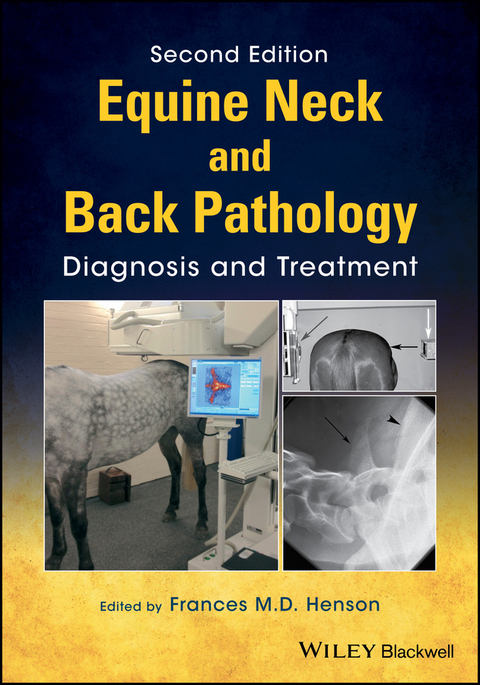
A unique reference dedicated to the diagnosis and treatment of problems of the equine neck and back
Building on the strength of the first edition, Equine Neck and Back Pathology: Diagnosis and Treatment, Second Edition explores conditions and problems of the horse's back and pelvis, and has been expanded to include coverage of the neck as well. This book is a vital tool for all those engaged in improving the diagnosis and management of horses with neck or back problems.
The only book devoted to the conditions and problems of the equine neck, back and pelvis, it provides comprehensive coverage by international specialists on how to diagnose and treat problems in these areas. This updated and revised edition covers normal anatomy and kinematics, neck and back pathology, diagnosis and treatment of specific conditions, and complementary therapy and rehabilitation.
Equine Neck and Back Pathology: Diagnosis and Treatment, Second Edition is a valuable working resource for equine practitioners, specialists in equine surgery, veterinary nurses and allied professionals involved in treating horses. It is also an excellent supplementary text for veterinary students with a keen interest in horses.
Frances M.D. Henson is a Senior Lecturer in Equine Studies and Head of the Comparative Musculoskeletal Biology Group at the University of Cambridge, UK. Specialising in horses with back problems and poor performance, she takes referral cases from all over the country, and lectures to other equine veterinary surgeons on the back. Dr Henson is a RCVS Specialist in Equine Surgery (Orthopaedics).
A unique reference dedicated to the diagnosis and treatment of problems of the equine neck and back Building on the strength of the first edition, Equine Neck and Back Pathology: Diagnosis and Treatment, Second Edition explores conditions and problems of the horse s back and pelvis, and has been expanded to include coverage of the neck as well. This book is a vital tool for all those engaged in improving the diagnosis and management of horses with neck or back problems. The only book devoted to the conditions and problems of the equine neck, back and pelvis, it provides comprehensive coverage by international specialists on how to diagnose and treat problems in these areas. This updated and revised edition covers normal anatomy and kinematics, neck and back pathology, diagnosis and treatment of specific conditions, and complementary therapy and rehabilitation. Equine Neck and Back Pathology: Diagnosis and Treatment, Second Edition is a valuable working resource for equine practitioners, specialists in equine surgery, veterinary nurses and allied professionals involved in treating horses. It is also an excellent supplementary text for veterinary students with a keen interest in horses.
Frances M.D. Henson is a Senior Lecturer in Equine Studies and Head of the Comparative Musculoskeletal Biology Group at the University of Cambridge, UK. Specialising in horses with back problems and poor performance, she takes referral cases from all over the country, and lectures to other equine veterinary surgeons on the back. Dr Henson is a RCVS Specialist in Equine Surgery (Orthopaedics).
List of Contributors ix
1 The Normal Anatomy of the Neck 1
David Bainbridge
2 The Normal Anatomy of the Osseous and Soft Tissue Structures of the Back and Pelvis 9
Leo B. Jeffcott, Jessica A. Kidd and David Bainbridge
2.1 Normal Anatomy of the Osseous Structures 9
2.2 Normal Anatomy of the Soft Tissue Structures of the Back 21
2.3 Normal Anatomy of the Soft Tissue Structures of the Pelvis 30
3 The Normal Anatomy of the Nervous System 39
Constanze Fintl
4 Kinematics 49
Rene van Weeren
5 Neurological Examination of the Back and Pelvis 73
Constanze Fintl
6 Clinical Examination 81
Graham A. Munroe
7 Radiography of the Cervical Spine 95
Marianna Biggi, Gabriel Manso-Díaz and Renate Weller
8 Radiography of the Back 107
Frances M.D. Henson
9 Nuclear Scintigraphy and Computed Tomography of the Neck, Back and Pelvis 121
Sarah Powell
10 Ultrasonography 143
Mary Beth Whitcomb, Luis P. Lamas and Marcus Head
10.1 Ultrasonography of the Thoracic Spine 143
10.2 Ultrasonography of the Pelvis, Lumbar Spine and SacroIliac Region 149
11 Thermography 165
Tracy Turner
12 Neck Pathology 175
Richard Hepburn
13 Back Pathology 195
Adam Driver, Frances M.D. Henson, Jessica A. Kidd, Luis P. Lamas and Rob Pilsworth
13.1 Traumatic damage 195
13.2 Over Riding Dorsal Spinous Processes ('Kissing Spines') 208
13.3 Miscellaneous Osseous Pathology 216
13.4 Pathology of the Supraspinous and Dorsal Sacroiliac Ligaments 224
14 Sacroiliac Dysfunction 239
Leo B. Jeffcott
15 Muscular Disorders 249
Richard J. Piercy and Renate Weller
16 Integrative and Physical Therapies 265
Joyce Harman and Mimi Porter
16.1 Integrative Therapies 265
16.2 Physical Therapies 278
17 Rehabilitation 283
Mary Bromiley
Index 297
1
The Normal Anatomy of the Neck
David Bainbridge
Introduction
The neck is a common derived characteristic of land vertebrates, not shared by their aquatic ancestors. In fish, the thoracic fin girdle, the precursor of the scapula, coracoid and clavicle, is frequently fused to the caudal aspect of the skull. In contrast, as vertebrates emerged on to the dry land, the forelimb separated from the head and the intervening vertebrae specialised to form a relatively mobile region – the neck – to allow the head to be freely steered in many directions.
With the exception of the tail, the neck remains the most mobile region of the spinal column in modern-day horses. It permits a wide range of sagittal plane flexion and extension to allow alternating periods of grazing and predator surveillance, as well as frontal plane flexion to allow the horizon to be scanned, and rotational movement to allow nuisance insects to be flicked off. Among domestic animals the equine neck is relatively long and the head relatively heavy, and so the neck has become strong, muscular and massive. This is enhanced by the fact that regular, forceful movements of this region must also occur to maintain balance when horses are running [1]. However, the length and flexible nature of the neck may also cause problems in the passage of foals through the birth canal.
In this chapter I will briefly review the anatomy of bones, joints, ligaments and muscles of the equine neck. The ‘locomotor component’ of the neck is a common site of pathology, and the diverse forms of neck disease reflect the sometimes complex and conflicting regional variations and functional constraints so evident in this region [2].
Unlike the abdomen and thorax, there is no coelomic cavity in the neck, yet its ventral part is taken up by a relatively small ‘visceral compartment’, containing the larynx, trachea, oesophagus and many important vessels, nerves and endocrine glands. However, I will not review these structures, as they do not represent an extension of the equine ‘back’ in the same way that the more dorsal locomotor region does.
Cervical Vertebrae 3–7
Almost all mammals, including the horse, possess seven cervical vertebrae, C1 to C7 (Figure 1.1). While C1 and C2 are extremely modified for their particular functions, C3 to C7 are more homogenous in structure. C3, C4 and C5 in particular are usually thought of as the ‘typical’ cervical vertebrae (Figure 1.2).
Figure 1.1 Lateral view of an articulated osteological preparation of the neck of a young horse.
Figure 1.2 (A) Lateral view of equine C4 vertebra and (B) cranial view of C5.
Vertebrae C3–C7 consist of an approximately cylindrical body or centrum, a structure present in all jawed vertebrates to resist longitudinal compression of the spinal column. The centra of the equine neck are the longest in the body, but become progressively smaller caudally. Those of C3–C7 possess a distinctively convex cranial surface, the head, and a correspondingly concave caudal surface, the fossa. Thus the intervertebral joints, which are far more mobile than in the trunk, may be thought of functionally as ball-and-socket joints, although their constituent parts are very structurally different from those of synovial ball-and-socket joints.
Dorsal to the centrum is the neural arch, formed from bilateral bony laminae, which surrounds and protects the spinal cord and its associated structures. The vertebral canal formed by successive arches is relatively wide in the neck, especially cranially, to allow the spinal cord, which is wide in this region, to flex freely. The vertebrae C3–C7 each develop from three primary centres of ossification – one in the centrum and one in each of the two laminae. Formation of cervical neural arches, which are either statically or dynamically stenotic, is thought to be a cause of equine cervical ‘wobbler syndrome’ [3].
The centrum and arch are adorned with a variety of bony processes for the attachment of ligaments and muscles, and which often develop as secondary centres of ossification. These vertebral processes are a feature evolved by land vertebrates to permit complex movements in three dimensions and resist torsional forces.
- The single dorsal midline spinous process is distinctively short in equine C3–C5.
- In contrast, all equine cervical vertebrae bear a characteristically large ventral crest, often with a pronounced caudal tubercle.
- The bilateral transverse processes are large but squat, and thought to incorporate vestigial ribs, sometimes yielding the name ‘costotransverse processes’. In C3–6, the processes are bifid and slanted, with a cranial ventral tubercle and caudal dorsal tubercle. The transverse processes of C1–6 are perforated by a large transverse foramen, which conveys the vertebral artery and vein.
- Lateral to the neural arch lie the large, irregular articular processes, with their smooth ovoid articular surfaces. The caudal facets are directed ventrolaterally, and the complementary cranial facets dorsomedially. Ventral to the caudal process lies a notch for passage of the laterally coursing spinal nerve.
The sixth cervical vertebra (Figure 1.3) differs from its cranial neighbours in that it bears pronounced paired bony sheets, the ventral laminae, which act as a site of attachment and force redirection of muscles, especially longus colli. In the horse these laminae are elaborated into cranial and caudal tubercles. C6 also possesses a longer spinous process than C3, 4 and 5 – a reflection of a gradual transition to a more ‘thoracic’ morphology.
Figure 1.3 (A) Lateral view of equine C6 vertebra and (B) cranial view of C7.
This trend continues in C7 (Figure 1.3), which has an even longer spinous process, non-bifid transverse processes, and no transverse foramen – the vertebral arteries arise too far cranially to pass through C7. However, C7 does possess a caudal notch for the passage of a spinal nerve, but it should be emphasised that the nomenclature of the spinal nerves in inconsistent. Unlike the rest of the body, cervical spinal nerves emerge cranial to the vertebra of the same number, and the nerves emerging caudal to vertebra C7 are named C8, even though there is no corresponding C8 vertebra. Finally, the centra of C7 caudally bear unconvincing costal facets for the articulation of the cranial extremities of the capitula of the first ribs [4].
Atlas and Axis, C1 and C2
The anatomy of the caudal part of the axis, C2 (Figure 1.4), is similar to that of the more caudal cervical vertebrae – with centrum and neural arch formed from the same three centres of ossification, as well as the spinous process, ventral crest and tubercle, caudal articular facets and dorsal tubercle of the transverse process. However, the cranial part of the bone is markedly aberrant to allow the unique rotational, trochoid, ‘head-shaking’ movement of the atlanto-axial joint. Its unusual shape results from the incorporation of embryonic elements of C1.
Figure 1.4 (A) Lateral view of equine C2 vertebra, and (B) ventral and (C) cranial views of C1.
A fourth primary centre of ossification, actually the annexed centrum of C1, forms the dens (‘tooth’) or odontoid process of C2. This cranially directed process is attached ventrally to the main centrum of C2 by a base formed from a further, secondary centre, which represents the cranial epiphysis of C2. The dens articulates closely with the ventral part of C1, and thus is smooth on its ventral surface, but is roughened dorsally with a midline gutter to allow attachment of stabilising ligaments. The smooth articular region of the dens is continuous with the large bilateral saddle-shaped cranial articular surfaces, which slide across reciprocal surfaces on C1 to allow rotation of the joint. These surfaces also develop from their own secondary ossification centres.
The axis contains a relatively large amount of trabecular bone compared to the other cervical vertebrae, and is also characterised by a large spinous process. Equine C2 is also distinctive in possessing bilateral foramina for the passage of the second pair of spinal nerves, which do not emerge between adjacent vertebrae, as all the more caudal spinal nerves do. In some texts these are called ‘intervertebral foramina’, which seems illogical, so the name lateral foramina is perhaps preferable.
The atlas, C1 (Figure 1.4), is the most bizarre of all the vertebrae, due to it performing specialised movements with both the skull (sagittal plane flexion and extension/‘nodding’/‘yes’ movement) and the axis (rotation about the long axis of the spine/‘shaking head’/‘no’ movement).
The atlas has no centrum and no neural spine, but is instead constituted by one large hollow cylinder formed by dorsal and ventral arches of bone. The dorsal arch is equivalent to the neural arches of other vertebrae, but the thicker ventral arch is a unique structure probably derived from paired cranial epiphyseal developmental elements. The absence of a centrum means that, unlike C2, C1 contains an...
| Erscheint lt. Verlag | 27.11.2017 |
|---|---|
| Sprache | englisch |
| Themenwelt | Veterinärmedizin ► Vorklinik |
| Veterinärmedizin ► Klinische Fächer ► Pathologie | |
| Veterinärmedizin ► Pferd | |
| Schlagworte | equine alternative therapies • equine anatomy • equine back anatomy • equine back conditions • equine back diagnosis • equine back imaging • equine back muscle disorders • equine back pathologies • equine back problems • equine back surgery • equine back treatment • equine complementary therapy • equine health • equine kinematics • equine neck anatomy • equine neck conditions • equine neck diagnosis • equine neck imaging • equine neck muscle disorders • equine neck pathologies • equine neck problems • equine neck surgery • equine neck treatment • equine orthopaedics • equine pathology • equine pelvic muscle disorders • equine pelvis anatomy • equine pelvis conditions • equine pelvis diagnosis • equine pelvis imaging • equine pelvis pathologies • equine pelvis problems • equine pelvis surgery • equine pelvis treatment • equine physiotherapy • equine rehabilitation • equine veterinary problems • Pferdemedizin • Veterinäranatomie u. -physiologie • Veterinärmedizin • Veterinärmedizin / Chirurgie, Orthopädie, Trauma • Veterinärmedizin f. Pferde • Veterinary Anatomy & Physiology • Veterinary Medicine • Veterinary Medicine - Equine • Veterinary Surgery, Orthopedics & Trauma |
| ISBN-13 | 9781118974575 / 9781118974575 |
| Informationen gemäß Produktsicherheitsverordnung (GPSR) | |
| Haben Sie eine Frage zum Produkt? |
 EPUB (Adobe DRM)
Kopierschutz: Adobe-DRM
Adobe-DRM ist ein Kopierschutz, der das eBook vor Mißbrauch schützen soll. Dabei wird das eBook bereits beim Download auf Ihre persönliche Adobe-ID autorisiert. Lesen können Sie das eBook dann nur auf den Geräten, welche ebenfalls auf Ihre Adobe-ID registriert sind.
Details zum Adobe-DRM
Dateiformat: EPUB (Electronic Publication)
EPUB ist ein offener Standard für eBooks und eignet sich besonders zur Darstellung von Belletristik und Sachbüchern. Der Fließtext wird dynamisch an die Display- und Schriftgröße angepasst. Auch für mobile Lesegeräte ist EPUB daher gut geeignet.
Systemvoraussetzungen:
PC/Mac: Mit einem PC oder Mac können Sie dieses eBook lesen. Sie benötigen eine
eReader: Dieses eBook kann mit (fast) allen eBook-Readern gelesen werden. Mit dem amazon-Kindle ist es aber nicht kompatibel.
Smartphone/Tablet: Egal ob Apple oder Android, dieses eBook können Sie lesen. Sie benötigen eine
Geräteliste und zusätzliche Hinweise
Buying eBooks from abroad
For tax law reasons we can sell eBooks just within Germany and Switzerland. Regrettably we cannot fulfill eBook-orders from other countries.
aus dem Bereich