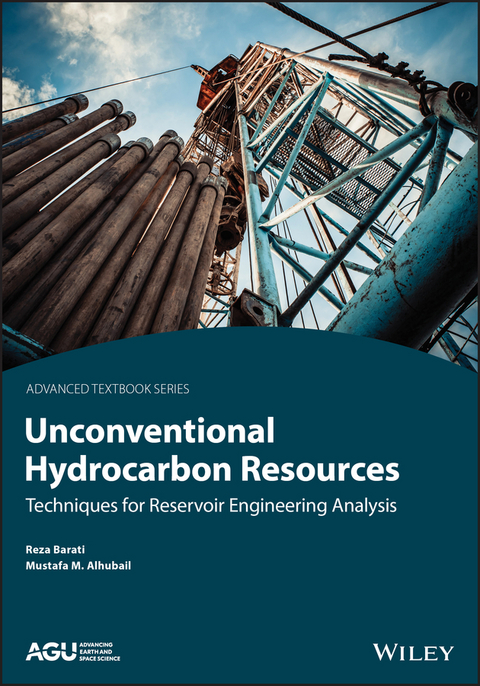
Unconventional Hydrocarbon Resources (eBook)
A comprehensive textbook presenting techniques for the analysis and characterization of shale plays
Significant reserves of hydrocarbons cannot be extracted using conventional methods. Improvements in techniques such as horizontal drilling and hydraulic fracturing have increased access to unconventional hydrocarbon resources, ushering in the 'shale boom' and disrupting the energy sector.
Unconventional Hydrocarbon Resources: Techniques for Reservoir Engineering Analysis covers the geochemistry, petrophysics, geomechanics, and economics of unconventional shale oil plays. The text uses a step-by-step approach to demonstrate industry-standard workflows for calculating resource volume and optimizing the extraction process.
Volume highlights include:
- Methods for rock and fluid characterization of unconventional shale plays
- A workflow for analyzing wells with stimulated reservoir volume regions
- An unconventional approach to understanding of fluid flow through porous media
- A comprehensive summary of discoveries of massive shale resources worldwide
- Data from Eagle Ford, Woodford, Wolfcamp, and The Bakken shale plays
- Examples, homework assignments, projects, and access to supplementary online resources
- Hands-on teaching materials for use in petroleum engineering software applications
The American Geophysical Union promotes discovery in Earth and space science for the benefit of humanity. Its publications disseminate scientific knowledge and provide resources for researchers, students, and professionals.
Reza Barati, University of Kansas, USA
Mustafa M. Alhubail, University of Kansas, USA
Reza Barati, University of Kansas, USA Mustafa M. Alhubail, University of Kansas, USA
1
Introduction to Unconventional Hydrocarbon Resources
Mustafa M. Alhubail and Reza Barati Ghahfarokhi
The University of Kansas, Lawrence, Kansas, USA
1.1 Background
To better define the term unconventional resources, and to understand why they have been called unconventional, the history of oil should be reviewed.
Petroleum seeps are one of the earliest sources of oil, along with wood and coal, used for heating and illumination. Another source of oil for illumination was whales. Whaling, which is the term that describes hunting of whales, became a competitive industry in the eighteenth century. Factories were built to make ships, and well‐equipped fleets were sent for one purpose and one purpose only: hunting whales. Whale oil was mainly used in oil lamps (Jackson, 1998). The amount of oil from the above two sources was not sufficient enough for the high demand. With the industrial revolution, the need for an alternative source of energy, other than wood and coal, to maintain machinery and for transportation, had never been greater. Coal mining was a very dangerous occupation, and it resulted in a high number of casualties (Natgas, 2013). Hence, in the nineteenth century, oil exploration began, and it has changed the way the world operates in all aspects of life.
People started to dig wells using basic percussion tools, and the rubble was carried out by loading it into baskets and pulling it up to the surface. The drilling process improved a bit by using the cable‐tool drilling method, which helped drill wells faster. In the early twentieth century, rotary drilling was employed with the ability of cleaning the wellbore while drilling by using fluids. Rotary drilling has changed the whole petroleum industry and, over time, rotary drilling technology has been improved drastically (Hogg, 2016). With the ability to drill wells more conveniently using rotary drilling technology, there still exists a more challenging mission, which is where to drill. To this day, with the advancement in imaging the Earth's strata by using seismic waves, there is still uncertainty about whether hydrocarbon exists in a new area or not, and drilling is the only way to find out for sure.
The global demand for oil surged, and thousands of wells were drilled both onshore and offshore. Keep in mind that this whole process is an investment, and profit is the main motivation. To recover oil faster and without the need of drilling new wells from the start, horizontal drilling and directional drilling were employed. In addition to that, horizontal drilling also helped decrease the drilling footprint, which greatly helped minimizing the environmental impact from the drilling process. With directional drilling technique and the secondary and enhanced oil recovery methods (conventional methods), more hydrocarbons became accessible. However, even with directional drilling and the well‐established recovery methods, there is way more hydrocarbons that are trapped in certain reservoirs, and those hydrocarbons cannot be recovered by the conventional methods because of complex petrophysical properties of the reservoirs. Hence, the question now is how to extract the hydrocarbons that are trapped in those reservoirs. Those reservoirs are called unconventional reservoirs, and the hydrocarbons that are trapped in them are called unconventional resources. Thus, in general, the unconventional reservoirs can be defined as the reservoirs that contain a huge quantity of hydrocarbons that cannot be extracted by the conventional methods due to their petrophysical properties, which will be discussed in detail in Chapter 2. The unconventional resources are classified into different categories, and they will be discussed later in this chapter.
1.2 Overview of Shale Revolution
The shale boom primarily occurred in the United States. The unconventional resources have changed the energy sector and, in 2012, the number of wells that were brought back online in the United States alone exceeded those that were put online in the rest of the world excluding Canada (Maugeri, 2013). Figure 1.1 shows the number of the issued drilling permits just for the Eagle Ford play. Furthermore, other countries (e.g., Argentina and Colombia) are currently working on attracting talented workers, petroleum engineering experts, and foreign investments in order to replicate the U.S. shale boom to become independent on energy imports from other countries, and to become energy exporters as well (Kuuskraa et al., 2013). Therefore, it is fair to say that the shale boom is a U.S. phenomenon that is spreading all over the world. However, that is easier said than done.
Figure 1.1 Drilling permits issued for Eagle Ford play, 2008 through November 2018 (Railroad Commission of Texas).
It is true that advanced technology (i.e., horizontal drilling and multistage fracturing) had existed for more than a decade. However, advanced technology is just a tool to unlock the unconventional resources and help develop them. Hence, advanced technology by itself is not practically sufficient for large‐scale unconventional resources development. For instance, even though advanced technology exists today, the commercial development of the shale gas resources in China is more complex than one would think, and that is due to the lack of knowledge and experience in exploration and development of such resources in China in addition to the remote location of some of the resources (Dong, et al., 2016). Furthermore, conducting effective hydraulic fractures, in terms of hydrocarbon productivity and profitability, is a difficult task in China due to complex tectonic stress (Xie et al., 1993; Wang & Wang, 2016; Yong, et al., 2018).
The development of shale resources in the United States started in the early 1980s, and it has undergone intensive academic and industrial research as well as pilot testing before the breakthrough of a revolutionary technology of drilling and hydraulic fracturing in the late 1990s. After years of research and testing, this advanced technology was fully employed in large‐scale unconventional resources field development in 2005, and since then, thousands of wells have been drilled. The amount of knowledge and information that has been gathered through the years (e.g., subsurface strata database), the experience in exploration and development, and the delicate implementation of such advanced technologies cannot be passed on to other nations. This is due not only to economic and national security reasons but also because those technologies might not be applicable there, or they might require further enhancements in order to become feasible in those nations (Ning et al., 2015; Dong, et al., 2016). To show how well the technology is developed in the United States, one can compare the number of the completed horizontal wells in the Eagle Ford play (3,560 wells), after the first 6 years of development, with the number of the completed horizontal wells in Vaca Muerta in Argentina (140 wells), after the first 6 years of development. Figure 1.2 shows the number of the completed horizontal wells in Eagle Ford play, Permian‐Midland basin, and the Vaca Muerta play after the first 6 years of development.
1.2.1 What Led to the Shale Phenomenon?
It may be well known that hydrocarbons exist in unconventional reservoirs, but is it possible to extract those unconventional resources economically? This question is actually a very complicated one because of the word economically. Advancements in the petroleum industry have surely made extracting the most difficult unconventional resources possible. However, these developments have to be economically viable for producers. Improvements in horizontal drilling and hydraulic fracturing techniques made multistage fracturing a standard practice in the industry. Multistage fracturing is the process of dividing the horizontal section of the well into subsections that are fractured independently in stages, hence the name multistage fracturing. Multistage fracturing will be discussed further in Chapter 6. One major factor that led to the shale boom is the ability to extract hydrocarbons from source rocks (i.e., shale rocks) (Brown & Yücel, 2013). The other major factor that led to the shale phenomenon is the spike in oil prices due to high demands in Asia and other regions of the world (Brown & Yücel, 2013).
The high oil prices attracted investors to the oil and gas sector. Hundreds of millions of dollars were invested in research and development, and those investments resulted in an innovative technology that lowered the cost of extracting the unconventional resources. For instance, by integrating lab work and modeling, researchers have developed more efficient fracturing fluids and designed sophisticated pumping schedules that yield a significant increase in production from the unconventional reservoirs, minimizing the cost of hydraulic fracturing treatments and reducing environmental impact from the fracturing treatments. Those innovations have made production from the unconventional resources feasible and profitable even at low oil prices. For instance, in 2008, the average cost of a horizontal well with multistage fracturing in some plays was approximately 16 million U.S. dollars; however, the average cost in 2016 was 8 million U.S. dollars. This huge reduction in cost became possible because of the...
| Erscheint lt. Verlag | 5.11.2020 |
|---|---|
| Reihe/Serie | AGU Advanced Textbooks | AGU Advanced Textbooks |
| Sprache | englisch |
| Themenwelt | Naturwissenschaften ► Geowissenschaften ► Geologie |
| Technik ► Bauwesen | |
| Schlagworte | Bauingenieur- u. Bauwesen • Civil Engineering & Construction • Decline Curve Analysis • earth sciences • environmental aspects of unconventional resources • Environmental Engineering • fluid flow through nanopores • Geologie • Geologie u. Geophysik • Geology & Geophysics • Geophysics • Geophysik • Geowissenschaften • hydraulic fracture modeling and design • Kohlenwasserstoffe • Multi-Stage Fracturing • Phase Behavior • rate transient time analysis • rock image analysis • Rock Mechanics • shale economics • Shale Gas • shale geochemistry • Shale Geomechanics • Shale oil • shale petrophysics • shale reservoir engineering analysis • shale SRV • Umwelttechnik • Unconventional Hydrocarbon Resources • unconventional reservoir engineering analysis • Unconventional Resources • unconventional shale plays |
| ISBN-13 | 9781119420675 / 9781119420675 |
| Informationen gemäß Produktsicherheitsverordnung (GPSR) | |
| Haben Sie eine Frage zum Produkt? |
 EPUB (Adobe DRM)
Kopierschutz: Adobe-DRM
Adobe-DRM ist ein Kopierschutz, der das eBook vor Mißbrauch schützen soll. Dabei wird das eBook bereits beim Download auf Ihre persönliche Adobe-ID autorisiert. Lesen können Sie das eBook dann nur auf den Geräten, welche ebenfalls auf Ihre Adobe-ID registriert sind.
Details zum Adobe-DRM
Dateiformat: EPUB (Electronic Publication)
EPUB ist ein offener Standard für eBooks und eignet sich besonders zur Darstellung von Belletristik und Sachbüchern. Der Fließtext wird dynamisch an die Display- und Schriftgröße angepasst. Auch für mobile Lesegeräte ist EPUB daher gut geeignet.
Systemvoraussetzungen:
PC/Mac: Mit einem PC oder Mac können Sie dieses eBook lesen. Sie benötigen eine
eReader: Dieses eBook kann mit (fast) allen eBook-Readern gelesen werden. Mit dem amazon-Kindle ist es aber nicht kompatibel.
Smartphone/Tablet: Egal ob Apple oder Android, dieses eBook können Sie lesen. Sie benötigen eine
Geräteliste und zusätzliche Hinweise
Buying eBooks from abroad
For tax law reasons we can sell eBooks just within Germany and Switzerland. Regrettably we cannot fulfill eBook-orders from other countries.
aus dem Bereich