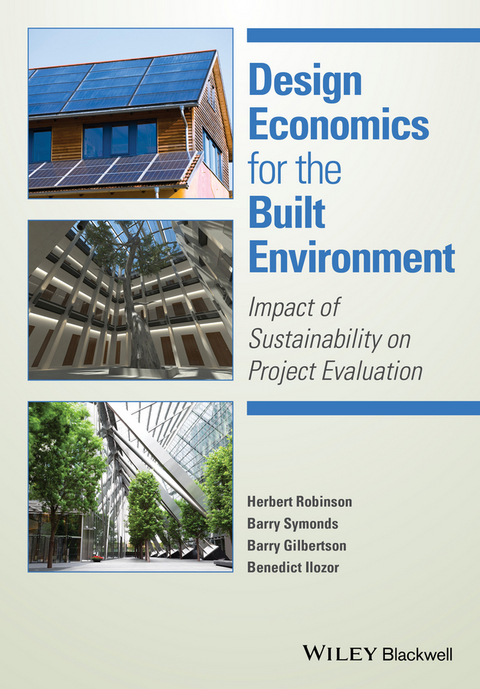
Design Economics for the Built Environment (eBook)
The drive towards environmentally friendly buildings and infrastructure has led to a
growing interest in providing design solutions underpinned by the core principles of sustainability to balance economic, social and environmental factors.
Design Economics for the Built Environment: Impact of sustainability on project evaluation presents new directions, reflecting the need to recognise the impact of climate change and the
importance of sustainability in project evaluation. The aim is to provide a new approach to
understanding design economics in the context of the changing policy
environment, legislative and regulatory framework, and increasing economic,
environmental and social pressure as result of the sustainability agenda.
The book follows a structured approach from theories and principles in the earlier chapters,
to the practical applications and emerging techniques focusing on value and
social, economic and environmental considerations in making design decisions. It
starts with the policy context, building on various theories and principles
such as, capital cost, value of design and resource-based theories, the new rules of measurement (NRM) to explore cost planning, the relationship between height and costs, key
socio-economic and environmental variables for design appraisal, eco-cost/value ratio (EVR), whole life theory
and the treatment of carbon emission as external costs, productivity and
efficiency, fiscal drivers and legal framework for carbon reduction, procurement and allocation of risks in contracts.
Case studies, practical examples and frameworks throughout reinforce theories and
principles and relate them to current practice. The book is essential reading
for postgraduate students in architecture, building and quantity surveying and
is also a valuable resource for academics, consultants and policy-makers in the
built environment.
The Editors
Professor Herbert Robinson, is currently a Regional Adviser and Head of Training Division at the United Nations African Institute for Economic Development and Planning (IDEP), part of United Nations Regional Economic Commission for Africa. He was Professor of Construction Economics at London South Bank University and a Senior Research Associate at Loughborough University, UK.
Barry Symonds, Senator h.c. Biberach an der Riss, is Managing Director of Symonds Konsult International and Associate Director for Rapid5D (BIM Solutions UK). He was the Head of Property, Surveying and Construction at London South Bank University,UK. As a chartered quantity surveyor, he worked as a partner and consultant for practices in the UK and New Zealand. He held academic advisory roles and has been visiting professor, and external examiner in the UK and abroad.
Professor Barry Gilbertson is a Visiting Professor at the University of Northumbria in Newcastle and was a partner at PricewaterhouseCoopers for 15 years. Barry was the first chartered surveyor to become a partner in a firm of chartered accountants, anywhere in the world, and the 123rd President of RICS in 2004/5. Barry was a member of the United Nations Real Estate Advisory Group and a member of the Bank of England's Property Forum.
Professor Benedict D. Ilozor teaches construction management, architecture, facilities planning, design & management at the School of Engineering Technology, Eastern Michigan University, where he is Research & Graduate Assistants Coordinator. He previously taught in Australian universities, and was head of Facilities Management for the Built Environment Research Group at the School of Architecture & Building, Deakin University.
The drive towards environmentally friendly buildings and infrastructure has led to a growing interest in providing design solutions underpinned by the core principles of sustainability to balance economic, social and environmental factors. Design Economics for the Built Environment: Impact of sustainability on project evaluation presents new directions, reflecting the need to recognise the impact of climate change and the importance of sustainability in project evaluation. The aim is to provide a new approach to understanding design economics in the context of the changing policy environment, legislative and regulatory framework, and increasing economic, environmental and social pressure as result of the sustainability agenda. The book follows a structured approach from theories and principles in the earlier chapters, to the practical applications and emerging techniques focusing on value and social, economic and environmental considerations in making design decisions. It starts with the policy context, building on various theories and principles such as, capital cost, value of design and resource-based theories, the new rules of measurement (NRM) to explore cost planning, the relationship between height and costs, key socio-economic and environmental variables for design appraisal, eco-cost/value ratio (EVR), whole life theory and the treatment of carbon emission as external costs, productivity and efficiency, fiscal drivers and legal framework for carbon reduction, procurement and allocation of risks in contracts. Case studies, practical examples and frameworks throughout reinforce theories and principles and relate them to current practice. The book is essential reading for postgraduate students in architecture, building and quantity surveying and is also a valuable resource for academics, consultants and policy-makers in the built environment.
The Editors Professor Herbert Robinson, is currently a Regional Adviser and Head of Training Division at the United Nations African Institute for Economic Development and Planning (IDEP), part of United Nations Regional Economic Commission for Africa. He was Professor of Construction Economics at London South Bank University and a Senior Research Associate at Loughborough University, UK. Barry Symonds, Senator h.c. Biberach an der Riss, Managing Director of Symonds Konsult International and Associate Director for Rapid5D (BIM Solutions UK). He was the Head of Property, Surveying and Construction at London South Bank University, UK. As a chartered quantity surveyor, he worked as a partner and consultant for practices in the UK and New Zealand. He held academic advisory roles and has been visiting professor, and external examiner in the UK and abroad. Professor Barry Gilbertson is a Visiting Professor at the University of Northumbria in Newcastle and was a partner at PricewaterhouseCoopers for 15 years. Barry was the first chartered surveyor to become a partner in a firm of chartered accountants, anywhere in the world, and the 123rd President of RICS in 2004/5. Barry was a member of the United Nations Real Estate Advisory Group and a member of the Bank of England's Property Forum. Professor Benedict D. Ilozor teaches construction management, architecture, facilities planning, design & management at the School of Engineering Technology, Eastern Michigan University, where he is Research & Graduate Assistants Coordinator. He previously taught in Australian universities, and was head of Facilities Management for the Built Environment Research Group at the School of Architecture & Building, Deakin University.
Editors and Contributors
Editors
Prof. Herbert Robinson
Herbert Robinson, the lead editor, has over 20 years experience in research, consultancy, training and capacity building. He is currently a Regional Adviser and Head of Training Division at the United Nations African Institute for Economic Development and Planning (IDEP), which is part of United Nations Regional Economic Commission for Africa. Prior to joining the UN, he was Professor of Construction Economics and Project Management, and the Director of Research at the Department of the Built Environment at London South Bank University. He was also the Course Director for over 7 years of the highly reputable postgraduate Quantity Surveying programme at the University. He has held previous positions as a Senior Research Associate at Loughborough University, Research Scholar and as a UN National Expert. After graduating from the University of Reading (UK), he worked with leading international consultants Arup (UK) and in the UNDP Institutional Strengthening Project/World Bank funded project in The Gambia. He has a significant publication record including the co-authorship of several books such as Infrastructure for the Built Environment: Global Procurement Strategies and Governance and Knowledge Management in Public Private Partnerships. He is a member of the Editorial Boards of the Journal of Financial Management for Property and Construction and Journal of Industrial Engineering.
Barry Symonds
Barry Symonds, Senator h.c. (Biberach an der Riss), graduated from University College London with an MSc in Building Economics. He holds several professional qualifications (FRICS, FCIOB, FBEng, ACIAT), and is currently Managing Director of Symonds Konsult International Ltd (Education Consultants) and Associate Director for Rapid5D (BIM Solutions UK). He was previously the Head of Property, Surveying and Construction (2004–2010) at London South Bank University, UK. He is a chartered quantity surveyor and construction economist, and has worked as a partner and consultant for practices in the UK and New Zealand. He has held academic advisory roles and has been visiting professor, lecturer, and external examiner in the UK, peninsular Malaysia, Sabah, Sarawak, Brunei, New Zealand, China, Singapore, Hong Kong, Jamaica and Germany. He is founding member of the successful MBA in International Real Estate (established 2001) at the University of Science, Biberach an der Riss. Barry has written and presented conference papers in the EU and SE Asia. He has served on many RICS committees, and held the positions of Chair of the RICS Essex Branch and QS Division and member of RICS Divisional Council. Barry is a Liveryman of the Worshipful Company of Constructors (City of London), where he is a member of the Scholarship & Awards Committee.
Prof. Barry Gilbertson
Barry Gilbertson now serves as a non-executive director for three listed companies and one private company after 15 years as a partner at PricewaterhouseCoopers (working on cases such as Canary Wharf, Wembley Stadium, Enron and Lehman Bros). An acknowledged expert in interpreting real estate markets, Barry specialises in strategic solutions for real estate within a business context, and focuses on corporate strategy and risk. Barry has a successful track record in ‘borrower advocacy’ cases, restoring trust between lender and borrower. Barry was the first chartered surveyor to become a partner in a firm of chartered accountants, anywhere in the world, and the 123rd RICS President in 2004/5 (inaugurating The President’s Commission on Sustainability). Barry was a member of the United Nations Real Estate Advisory Group for 5 years, a member of the Bank of England's Property Forum for 10 years and a Trustee at the College of Estate Management for 8 years. He has been Visiting Professor at the University of Northumbria in Newcastle for 11 years and Visiting Professor at the Royal Agricultural University for 1 year. Barry has also been Visiting Lecturer at 20 universities around the world a member of the Council (and Court) of the University of Bath, and lead/worked on projects, or spoken at conferences, in 31 countries.
Prof. Benedict Ilozor
Benedict Ilozor teaches construction management, architecture, facilities planning, and design & management at the School of Engineering Technology, Eastern Michigan University, where he is Research & Graduate Assistants Coordinator. His teaching and research are cutting edge, and he currently works on Bendors Air Power System for electricity generation. He previously taught in Australian universities, and was Management Discipline Coordinator for Architecture and Construction Management, and head of Facilities Management for the Built Environment Research Group at the School of Architecture & Building, Deakin University. He was also Australian Coordinator for the Master of Real Estate distance education collaboration between Deakin University and University of Greenwich. He has over 100 publications (books, refereed papers and articles) on design and construction, energy, facilities space planning & management, and organisational performance. He is Regional Editor for the Journal of Management Development, and he is on the editorial board of several international journals.
Contributors
John Adriaanse
John Adriaanse lectures and researches in Construction Law at London South Bank University. Before qualifying as a Barrister he had 25 years of practical experience in the construction industry in South Africa, Namibia and in the UK. His last post before joining academia was as a legal adviser for a company active in many jurisdictions which gave him exposure to different legal systems. His research interests focuses on the relationship between the Common Law and the Standard Forms of Contract, the interaction between the law of tort, the law of contract and that of restitution based on the reversal of unjust enrichment. He is the author of Construction Contract Law, now in its third edition. He is also a Fellow of the Chartered Institute of Arbitrators.
Aviad Almagor
Aviad Almagor is the Director of Product Design at Vico Software. For the past decade, he has been deeply involved in developing cutting edge software solutions for the building industry. He played a vital role in the development of Vico Office – the first integrated 5D environment for the construction industry. Aviad is enthusiastic about process integration and multidisciplinary collaboration as tools to improve the efficiency and quality of the construction industry. In addition to his work on software development, Aviad has over 10 years experience in architectural design using Building Information Modelling technologies. Aviad received his Bachelor of Architecture degree from the Israel Institute of Technology and his Master of Business Administration degree from Edinburgh Business School, Heriot-Watt University.
Arthlene Amos
Arthlene Amos is a Quantity Surveyor working in the oil and gas industry in Trinidad. Her present assignment is through a secondment with bpTT where she is involved in one of the major turnaround projects for bpTT and Trinidad. She was previously a lecturer in quantity surveying and construction economics at Kingston University, London. Arthlene has experience with major UK contractors working on diverse projects including rail, building and tunnelling. She was involved in a number of major joint ventures between Costain, Veolia Water and MWH in Brighton, the most significant of these were the construction of an 11 km new sewer tunnel in Brighton, UK. She was part of the team in Costain, Laing O’Rourke, Bachy and Emcor Rail Joint Venture to upgrade St Pancras Station better known as the Channel Tunnel Rail Link project, where 13 new platforms were constructed and the existing deck extended to facilitate the Eurostar trains.
Peter Barnes
Peter Barnes is a Director of Blue Sky ADR Ltd, and has been actively involved in the construction industry for almost 40 years. In the early part of his career, Peter was a chief quantity surveyor for a building contractor, and then became head of a building contractor’s construction division. After that he moved into consultancy work, specialising in contract and commercial advice, and dispute avoidance and resolution in relation to the construction industry. Peter has an MSc in Construction Law and Arbitration and is a Chartered Conservationist. Peter sits on the JCT Council, and partly as a result of that, but also because of his involvement with various other related committees, has developed a particular interest in the application of Building Information Modelling (BIM) and how the use of BIM will have an ever increasing influence on building practices over the coming years. He holds the following professional qualifications: FCIOB, MICE, MRICS, FCIArb, and MCInstCES.
Dr. Ina Colombo
Ina Colombo is the Deputy Director of the International Institute of Refrigeration based in Paris, France. She was previously a senior researcher and lecturer in the field of sustainable refrigeration and the reduction of the greenhouse gases at London South Bank University. She is a Domestic Energy Assessor Consultant and has developed expertise in reducing the environmental and economic impact of using carbon dioxide refrigeration in retail applications. She specialised in the field of electromechanical engineering including building services, renewable energy and refrigeration to address climate change and...
| Erscheint lt. Verlag | 27.3.2015 |
|---|---|
| Sprache | englisch |
| Themenwelt | Technik ► Architektur |
| Technik ► Bauwesen | |
| Schlagworte | Baubetrieb • Bauingenieur- u. Bauwesen • Bauökonomie • built • Civil Engineering & Construction • Climate • Construction Management • Construction: Sustainability • ConText • Design • Directions • Drive • Economics • Environment Impact • Evaluation • friendly • growing • Impact • importance • Infrastructure • Interest • Massenermittlung u. Bauökonomie • Nachhaltiges Bauen • New • providing • Quantity Surveying & Construction Economics • Solutions • towards • underpinned |
| ISBN-13 | 9781118944868 / 9781118944868 |
| Informationen gemäß Produktsicherheitsverordnung (GPSR) | |
| Haben Sie eine Frage zum Produkt? |
 EPUB (Adobe DRM)
Kopierschutz: Adobe-DRM
Adobe-DRM ist ein Kopierschutz, der das eBook vor Mißbrauch schützen soll. Dabei wird das eBook bereits beim Download auf Ihre persönliche Adobe-ID autorisiert. Lesen können Sie das eBook dann nur auf den Geräten, welche ebenfalls auf Ihre Adobe-ID registriert sind.
Details zum Adobe-DRM
Dateiformat: EPUB (Electronic Publication)
EPUB ist ein offener Standard für eBooks und eignet sich besonders zur Darstellung von Belletristik und Sachbüchern. Der Fließtext wird dynamisch an die Display- und Schriftgröße angepasst. Auch für mobile Lesegeräte ist EPUB daher gut geeignet.
Systemvoraussetzungen:
PC/Mac: Mit einem PC oder Mac können Sie dieses eBook lesen. Sie benötigen eine
eReader: Dieses eBook kann mit (fast) allen eBook-Readern gelesen werden. Mit dem amazon-Kindle ist es aber nicht kompatibel.
Smartphone/Tablet: Egal ob Apple oder Android, dieses eBook können Sie lesen. Sie benötigen eine
Geräteliste und zusätzliche Hinweise
Buying eBooks from abroad
For tax law reasons we can sell eBooks just within Germany and Switzerland. Regrettably we cannot fulfill eBook-orders from other countries.
aus dem Bereich