


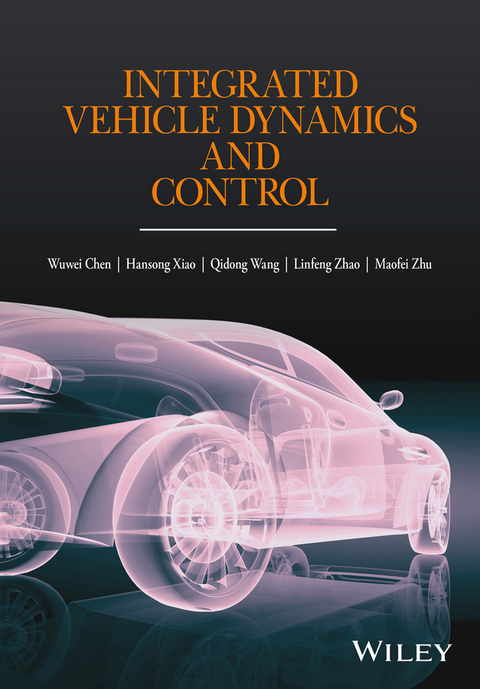
Integrated Vehicle Dynamics and Control (eBook)
400 Seiten
Wiley (Verlag)
9781118380024 (ISBN)
A comprehensive overview of integrated vehicle system dynamics exploring the fundamentals and new and emerging developments
This book provides a comprehensive coverage of vehicle system dynamics and control, particularly in the area of integrated vehicle dynamics control. The book consists of two parts, (1) development of individual vehicle system dynamic model and control methodology; and (2) development of integrated vehicle dynamic model and control methodology. The first part focuses on investigating vehicle system dynamics and control according to the three directions of vehicle motions, including longitudinal, vertical, and lateral. Corresponding individual control systems, e.g. Anti-lock Brake System (ABS), Active Suspension, Electric Power Steering System (EPS), are introduced and developed respectively.
Particular attention is paid in the second part of the book to develop integrated vehicle dynamic control system. Integrated vehicle dynamics control system is an advanced system that coordinates all the chassis control systems and components to improve the overall vehicle performance including safety, comfort, and economy. Integrated vehicle dynamics control has been an important research topic in the area of vehicle dynamics and control over the past two decades. The research topic on integrated vehicle dynamics control is investigated comprehensively and intensively in the book through both theoretical analysis and experimental study. In this part, two types of control architectures, i.e. centralized and multi-layer, have been developed and compared to demonstrate their advantages and disadvantages.
- Integrated vehicle dynamics control is a hot topic in automotive research; this is one of the few books to address both theory and practice of integrated systems
- Comprehensively explores the research area of integrated vehicle dynamics and control through both theoretical analysis and experimental study
- Addresses a full range of vehicle system topics including tyre dynamics, chassis systems, control architecture, 4 wheel steering system and design of control systems using Linear Matrix Inequality (LMI) Method
Wuwei Chen is a Professor at the School of Mechanical and Automotive Engineering, Hefei University of Technology, China. Dr. Chen has been working in the area of vehicle system dynamics, particularly in integrated control of vehicle dynamic systems, for more than 20 years. He has been recognized as a leading researcher in developing integrated vehicle dynamic control systems through both theoretical analysis and experimental investigation. Dr. Chen was a guest editor of International Journal of Vehicle Design for a special issue on "Vehicle Control Systems". He is also a member of the editorial boards of Journal of Vibration Engineering (in Chinese) and Transactions of the Chinese Society for Agricultural Machinery. Dr. Chen has authored and co-authored over 150 journal and conference papers, and has made numerous presentations at scientific and engineering conferences. Hansong Xiao is now working with Hanergy Product Development Group, China. He received his Ph.D.in Mechanical Engineering at the University of Toronto, Canada. His current research interests include Engineering Optimization, Dynamic Analysis, and Automotive Electronic Control. Qidong Wang, Ph.D, Professor at School of Mechanical and Automotive Engineering, Hefei University of Technology. Wang has been doing research in the field of vehicle dynamics and control for over 20 years and has published over 80 papers. Linfeng Zhao, Ph.D, Associate Professor at School of Mechanical and Automotive Engineering, Hefei University of Technology. Zhao's interest is vehicle dynamics and control technologies, he has published over 10 journal papers. Maofei Zhu, Hefei Institutes of Physical Science, Chinese Academy of Sciences.
1
Basic Knowledge of Vehicle System Dynamics
1.1 Traditional Methods of Formulating Vehicle Dynamics Equations
Traditional methods of formulating vehicle dynamics equations are based on the theories of Newtonian mechanics and analytical mechanics. Some of the definitions used in dynamics are presented first.
- Generalized coordinates
Any set of parameters that uniquely define the configuration (position and orientation) of the system relative to the reference configuration is called a set of generalized coordinates. Generalized coordinates may be dependent or independent. To a system in motion, the generalized coordinates that specify the system may vary with time. In this text, column vector is used to designate generalized coordinates, where n is the total number of generalized coordinates.
In Cartesian coordinates, to describe a planar system which consists of b bodies, coordinates are needed. For a spatial system with b bodies, (or ) coordinates are needed.
The overall vector of coordinates of the system is denoted by , where vector qi is the vector of coordinates for the ith body in the system.
- Constraints and constraint equations
Normally, a mechanical system that is in motion can be subjected to some geometry or movement restrictions. These restrictions are called constraints. When these restrictions are expressed as mathematical equations, they are referred to as constraint equations. Usually these constraint equations are denoted as follows:
(1.1)If the time variable appears explicitly in the constraint equations, they are expressed as:
(1.2) - Holonomic constraints and nonholonomic constraints
Holonomic and nonholonomic constraints are classical mechanics concepts that are used to classify constraints and systems. If constraint equations do not contain derivative terms, or the derivative terms are integrable, these constraints are said to be called holonomic. They are geometric constraints. However, if the constraint equations contain derivative terms that are not integrable in closed form, these constraints are said to be nonholonomic. They are movement constraints, such as the velocity or acceleration conditions imposed on the system.
- Degrees of freedom
The generalized coordinates that satisfy the constraint equations in a system may not be independent. Thus, the minimum number of coordinates required to describe the system is called the number of degrees of freedom (DOF).
- Virtual displacement
Virtual displacement is an assumed infinitesimal displacement of a system at a certain position with constraints satisfied while time is held constant. Conditions imposed on the virtual displacement by the constraint equations are called virtual displacement equations. A virtual displacement may be a linear or an angular displacement, and it is normally denoted by the variational symbol δ. Virtual displacement is a different concept from actual displacement. Actual displacement can only take place with the passage of time; however, virtual displacement has nothing to do with any other conditions but the constraint conditions.
1.1.1 Newtonian Mechanics
The train of thought used to establish the vehicle dynamics equations using Newton’s law can be summarized in a few steps. According to the characteristics of the problem at hand, first, we need to simplify the system and come up with a suitable mathematical model by representing the practical system with rigid bodies and lumped masses which are connected to each other by springs and dampers. Then, we isolate the masses and bodies and draw the free-body diagrams. Finally, we apply the following formulas to the masses and bodies shown by free-body diagrams.
The dynamic equations of a planar rigid body are:
where m is the mass of the body, r is the displacement of the center of gravity, Fi is the ith force acting on the body, J is the mass moment of inertia of the body about the axis through the center of gravity, ω is the angular velocity of the body, and Mi is the moment of the ith force acting on the center of gravity of the body.
1.1.2 Analytical Mechanics
In solving the dynamics problems of simple rigid body systems, Newtonian mechanics theories have some obvious advantages; however, the efficiency will be low if dealing with constrained systems and deformable bodies. Analytical mechanics theories have been proven to be a useful method in solving these problems. This theory contains mainly the methods of general equations of dynamics, the Lagrange equation of the first kind, and the Lagrange equation of the second kind; the latter being the most widely used.
For a system with b particles (or bodies), and n DOF, q1, q2, …, qn is a set of generalized coordinates. Then, the Lagrange equation of the second kind can be expressed as
where T is the kinetic energy, and V the potential energy of the system.
1.2 Dynamics of Rigid Multibody Systems
1.2.1 Birth and Development
The history of the development of classical mechanics goes back more than 200 years. In the past two centuries, classical mechanics has been successfully used in the theoretical study and engineering practice of relatively simple systems. However, most modern practical engineering problems are quite complicated systems consisting of many parts. Since the middle of the 20th century, the rapid development of aerospace, robotics, automotive and other industries has brought new challenges to classical mechanics. The kinematics and dynamics analysis of complicated systems becomes difficult. Thus, there was an urgent need to develop new theories to accomplish this task.
In the late 1960s and early 1970s, Roberson[1], Kane[2], Haug[3], Witternburg[4], Popov[5] and other scholars put forward methods of their own to solve the dynamic problems of complex systems. Although there were some differences between these methods in describing the position and orientation of the systems, and formulating and solving the equations, one characteristic was common among them: recurring formularization was adopted in all these methods. Computers, which help engineers to model, form, and solve differential equations of motion, were used analyze and synthesize complex systems. Thus, a new branch of mechanics called multibody dynamics was born. This developing and crossing discipline arises from the combination of rigid mechanics, analytical mechanics, elastic mechanics, matrix theory, graph theory, computational mathematics, and automatic control. It is one of the most active fields in applied mechanics, machinery, and vehicle engineering.
Multibody systems are composed of rigid and/or flexible bodies interconnected by joints and force elements such as springs and dampers. In the last few decades, remarkable advances have been made in the theory of multibody system dynamics with wide applications. An enormous number of results have been reported in the fields of vehicle dynamics, spacecraft control, robotics, and biomechanics. With the development and perfection of the multibody formalisms, multibody dynamics has received growing attention and a considerable amount of commercial software is now available. The first International Symposium on multibody system dynamics was held in Munich in 1977 by IUTAM. The second was held in Udine in 1985 by IUTAM/IFTOMM. After the middle of the 1980s, multibody dynamics entered a period of fast development. A wealth of literature has been published[6,7].
The first book about multibody system dynamics was titled Dynamics of System of Rigid Bodies[4] written by Wittenburg, was published in 1977. Dynamics: Theory and applications by Kaneand Levinson came out in 1985. In Dynamics of Multibody System[8], printed in 1989, Shabanacomprhensively discusses many aspects of multibody system dynamics, with a second edition of this book appearing in 1998. In Computer-aided Analysis of Mechanical Systems[9], Nikravesh introduces theories and numerical methods for use in computational mechanics. These theories and methods can be used to develop computer programs for analyzing the response of simple and complex mechanical systems. Using the Cartesian coordinate approach, Haug presented basic methods for the analysis of the kinematics and dynamics of planar and spatial mechanical systems in Computer Aided Kinematics and Dynamics of Mechanical Systems[3].
The work of three scholars will also be reviewed in the following section.
- Schiehlen, from the University of Stuttgart, published his two books in 1977 and 1993 respectively. Multibody System Handbook[10] was an international collection of programs and software which included theory research results and programs from 17 research groups. Advanced Multibody Dynamics[11] collected research achievements of the project supported by The German Research Council from 1987 to 1992, and the latest developments in the field of multibody system dynamics worldwide at that time. The content of this book was of an interdisciplinary nature.
- In Computational Methods in Multibody Dynamics[12], Amirouche Farid offered an in-depth...
| Erscheint lt. Verlag | 31.3.2016 |
|---|---|
| Sprache | englisch |
| Themenwelt | Technik ► Elektrotechnik / Energietechnik |
| Technik ► Fahrzeugbau / Schiffbau | |
| Technik ► Maschinenbau | |
| Schlagworte | automotive engineering • Control Systems Technology • Electrical & Electronics Engineering • Elektrotechnik u. Elektronik • Fahrzeugtechnik • Maschinenbau • Maschinenbau - Entwurf • mechanical engineering • Mechanical Engineering - Design • Regelungstechnik |
| ISBN-13 | 9781118380024 / 9781118380024 |
| Informationen gemäß Produktsicherheitsverordnung (GPSR) | |
| Haben Sie eine Frage zum Produkt? |
 EPUB (Adobe DRM)
Kopierschutz: Adobe-DRM
Adobe-DRM ist ein Kopierschutz, der das eBook vor Mißbrauch schützen soll. Dabei wird das eBook bereits beim Download auf Ihre persönliche Adobe-ID autorisiert. Lesen können Sie das eBook dann nur auf den Geräten, welche ebenfalls auf Ihre Adobe-ID registriert sind.
Details zum Adobe-DRM
Dateiformat: EPUB (Electronic Publication)
EPUB ist ein offener Standard für eBooks und eignet sich besonders zur Darstellung von Belletristik und Sachbüchern. Der Fließtext wird dynamisch an die Display- und Schriftgröße angepasst. Auch für mobile Lesegeräte ist EPUB daher gut geeignet.
Systemvoraussetzungen:
PC/Mac: Mit einem PC oder Mac können Sie dieses eBook lesen. Sie benötigen eine
eReader: Dieses eBook kann mit (fast) allen eBook-Readern gelesen werden. Mit dem amazon-Kindle ist es aber nicht kompatibel.
Smartphone/Tablet: Egal ob Apple oder Android, dieses eBook können Sie lesen. Sie benötigen eine
Geräteliste und zusätzliche Hinweise
Buying eBooks from abroad
For tax law reasons we can sell eBooks just within Germany and Switzerland. Regrettably we cannot fulfill eBook-orders from other countries.
aus dem Bereich


