


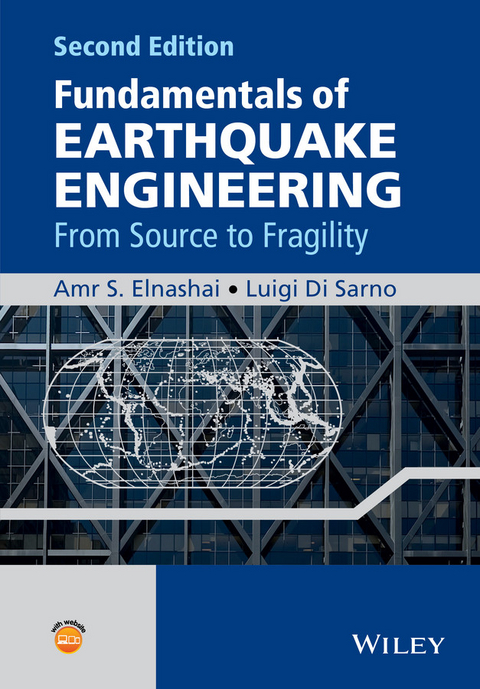
Fundamentals of Earthquake Engineering (eBook)
John Wiley & Sons (Verlag)
9781118700464 (ISBN)
Fundamentals of Earthquake Engineering: From Source to Fragility, Second Edition combines aspects of engineering seismology, structural and geotechnical earthquake engineering to assemble the vital components required for a deep understanding of response of structures to earthquake ground motion, from the seismic source to the evaluation of actions and deformation required for design, and culminating with probabilistic fragility analysis that applies to individual as well as groups of buildings. Basic concepts for accounting for the effects of soil-structure interaction effects in seismic design and assessment are also provided in this second edition.
The nature of earthquake risk assessment is inherently multi-disciplinary. Whereas this book addresses only structural safety assessment and design, the problem is cast in its appropriate context by relating structural damage states to societal consequences and expectations, through the fundamental response quantities of stiffness, strength and ductility.
This new edition includes material on the nature of earthquake sources and mechanisms, various methods for the characterization of earthquake input motion, effects of soil-structure interaction, damage observed in reconnaissance missions, modeling of structures for the purposes of response simulation, definition of performance limit states, fragility relationships derivation, features and effects of underlying soil, structural and architectural systems for optimal seismic response, and action and deformation quantities suitable for design.
Key features:
- Unified and novel approach: from source to fragility
- Clear conceptual framework for structural response analysis, earthquake input characterization, modelling of soil-structure interaction and derivation of fragility functions
- Theory and relevant practical applications are merged within each chapter
- Contains a new chapter on the derivation of fragility
- Accompanied by a website containing illustrative slides, problems with solutions and worked-through examples
Fundamentals of Earthquake Engineering: From Source to Fragility, Second Edition is designed to support graduate teaching and learning, introduce practising structural and geotechnical engineers to earthquake analysis and design problems, as well as being a reference book for further studies.
Amr S. Elnashai Pennsylvania State University, USA
Luigi Di Sarno University of Sannio, Italy
Fundamentals of Earthquake Engineering: From Source to Fragility, Second Edition combines aspects of engineering seismology, structural and geotechnical earthquake engineering to assemble the vital components required for a deep understanding of response of structures to earthquake ground motion, from the seismic source to the evaluation of actions and deformation required for design, and culminating with probabilistic fragility analysis that applies to individual as well as groups of buildings. Basic concepts for accounting for the effects of soil-structure interaction effects in seismic design and assessment are also provided in this second edition. The nature of earthquake risk assessment is inherently multi-disciplinary. Whereas this book addresses only structural safety assessment and design, the problem is cast in its appropriate context by relating structural damage states to societal consequences and expectations, through the fundamental response quantities of stiffness, strength and ductility. This new edition includes material on the nature of earthquake sources and mechanisms, various methods for the characterization of earthquake input motion, effects of soil-structure interaction, damage observed in reconnaissance missions, modeling of structures for the purposes of response simulation, definition of performance limit states, fragility relationships derivation, features and effects of underlying soil, structural and architectural systems for optimal seismic response, and action and deformation quantities suitable for design. Key features: Unified and novel approach: from source to fragility Clear conceptual framework for structural response analysis, earthquake input characterization, modelling of soil-structure interaction and derivation of fragility functions Theory and relevant practical applications are merged within each chapter Contains a new chapter on the derivation of fragility Accompanied by a website containing illustrative slides, problems with solutions and worked-through examples Fundamentals of Earthquake Engineering: From Source to Fragility, Second Edition is designed to support graduate teaching and learning, introduce practising structural and geotechnical engineers to earthquake analysis and design problems, as well as being a reference book for further studies.
Amr S. Elnashai Pennsylvania State University, USA Luigi Di Sarno University of Sannio, Italy
| Erscheint lt. Verlag | 21.7.2015 |
|---|---|
| Sprache | englisch |
| Themenwelt | Naturwissenschaften ► Physik / Astronomie ► Mechanik |
| Technik ► Bauwesen | |
| Schlagworte | Bauingenieur- u. Bauwesen • Civil Engineering & Construction • Deformation • derivations • Design • Earthquake • Earthquake Engineering • Earthquake input characterization • earthquakes • Engineering • Erdbebensicherheit • Erdbebensicherung • formulations • fragility • Fragility Curve • Fragility Functions • geotechnical • Maschinenbau • mechanical engineering • Mechanical Engineering Special Topics • Mech Engineering Special Topics • Optimal • Seismic Analysis • seismic assessment • Seismic risk • Seismic risk assessment • Seismology • Simulation • Soil-structure-interaction • Spezialthemen Maschinenbau • Structural • Structural & Building Engineering • Structural Modelling • Structural response analysis • structural vulnerability • Tief- u. Hochbau / Massivbau |
| ISBN-13 | 9781118700464 / 9781118700464 |
| Informationen gemäß Produktsicherheitsverordnung (GPSR) | |
| Haben Sie eine Frage zum Produkt? |
 PDF (Adobe DRM)
Kopierschutz: Adobe-DRM
Adobe-DRM ist ein Kopierschutz, der das eBook vor Mißbrauch schützen soll. Dabei wird das eBook bereits beim Download auf Ihre persönliche Adobe-ID autorisiert. Lesen können Sie das eBook dann nur auf den Geräten, welche ebenfalls auf Ihre Adobe-ID registriert sind.
Details zum Adobe-DRM
Dateiformat: PDF (Portable Document Format)
Mit einem festen Seitenlayout eignet sich die PDF besonders für Fachbücher mit Spalten, Tabellen und Abbildungen. Eine PDF kann auf fast allen Geräten angezeigt werden, ist aber für kleine Displays (Smartphone, eReader) nur eingeschränkt geeignet.
Systemvoraussetzungen:
PC/Mac: Mit einem PC oder Mac können Sie dieses eBook lesen. Sie benötigen eine
eReader: Dieses eBook kann mit (fast) allen eBook-Readern gelesen werden. Mit dem amazon-Kindle ist es aber nicht kompatibel.
Smartphone/Tablet: Egal ob Apple oder Android, dieses eBook können Sie lesen. Sie benötigen eine
Geräteliste und zusätzliche Hinweise
Buying eBooks from abroad
For tax law reasons we can sell eBooks just within Germany and Switzerland. Regrettably we cannot fulfill eBook-orders from other countries.
aus dem Bereich


