


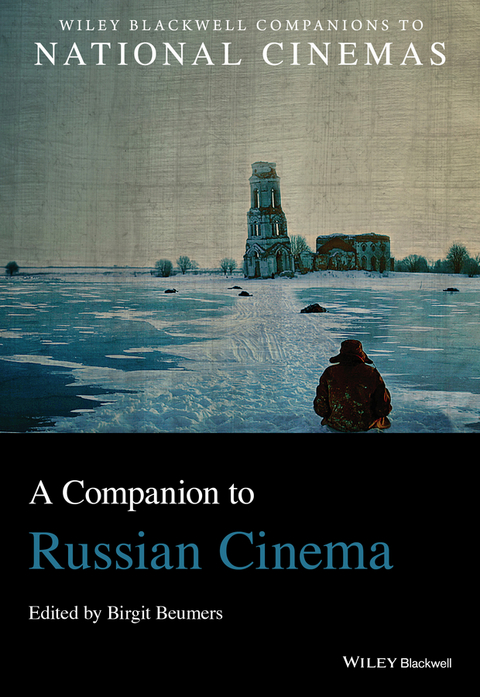
- The most up-to-date and thorough coverage of Russian, Soviet and post-Soviet cinema, which also effectively fills gaps in the existing scholarship in the field
- This is the first volume on Russian cinema to explore specifically the history of movie theatres, studios, and educational institutions
- The editor is one of the most established and knowledgeable scholars in Russian cinema studies, and contributions come from leading experts in the field of Russian Studies, Film Studies and Visual Culture
- Chapters consider the arts of scriptwriting, sound, production design, costumes and cinematography
- Provides five portraits of key figures in Soviet and Russia film history, whose works have been somewhat neglected
A Companion to Russian Cinema provides an exhaustive and carefully organised guide to the cinema of pre-Revolutionary Russia, of the Soviet era, as well as post-Soviet Russian cinema, edited by one of the most established and knowledgeable scholars in Russian cinema studies. The most up-to-date and thorough coverage of Russian, Soviet and post-Soviet cinema, which also effectively fills gaps in the existing scholarship in the field This is the first volume on Russian cinema to explore specifically the history of movie theatres, studios, and educational institutions The editor is one of the most established and knowledgeable scholars in Russian cinema studies, and contributions come from leading experts in the field of Russian Studies, Film Studies and Visual Culture Chapters consider the arts of scriptwriting, sound, production design, costumes and cinematography Provides five portraits of key figures in Soviet and Russia film history, whose works have been somewhat neglected
Birgit Beumers is Professor of Film Studies at Aberystwyth University (UK). She specialises in Russian culture, especially cinema and theatre. Her most recent publications include A History of Russian Cinema (2009) and Performing Violence (with Mark Lipovetsky, 2009); she has edited Directory of World Cinema: Russia (2010; 2014), The Cinema of Alexander Sokurov (with N. Condee, 2011), Russia's New Fin de Siècle (2013), and Cinema in Central Asia: Rewriting Cultural Histories (with M. Rouland and G. Abikeyeva, 2013). She is editor of KinoKultura and of Studies in Russian and Soviet Cinema.
Acknowledgments xv
Notes on Transliteration and References xvi
Introduction 1
Birgit Beumers
Part I Structures of Production, Formation, and Exhibition 21
1 The Film Palaces of Nevsky Prospect: A History of St Petersburg's Cinemas, 1900-1910 23
Anna Kovalova
2 (V)GIK and the History of Film Education in the Soviet Union, 1920s-1930s 45
Masha Salazkina
3 Lenfilm: The Birth and Death of an Institutional Aesthetic 66
Robert Bird
4 The Adventures of the Kulturfilm in Soviet Russia 92
Oksana Sarkisova
5 Soiuzdetfilm: The Birth of Soviet Children's Film and the Child Actor 117
Jeremy Hicks
Part II For the State or For the Audience? Auteurism, Genre, and Global Markets 137
6 The Stalinist Musical: Socialist Realism and Revolutionary Romanticism 139
Richard Taylor
7 Soviet Film Comedy of the 1950s and 1960s: Innovation and Restoration 158
Seth Graham
8 Auteur Cinema during the Thaw and Stagnation 178
Eugénie Zvonkine
9 The Blokbaster: How Russian Cinema Learned to Love Hollywood 202
Dawn Seckler and Stephen M. Norris
10 The Global and the National in Post?]Soviet Russian Cinema (2004-2012) 224
Maria Bezenkova and Xenia Leontyeva
Part III Sound - Image - Text 249
11 The Literary Scenario and the Soviet Screenwriting Tradition 251
Maria Belodubrovskaya
12 Ideology, Technology, Aesthetics: Early Experiments in Soviet Color Film, 1931-1945 270
Phil Cavendish
13 Learning to Speak Soviet: Soviet Cinema and the Coming of Sound 292
Lilya Kaganovsky
14 Cinema and the Art of Being: Towards a History of Early Soviet Set Design 314
Emma Widdis
15 Stars on Screen and Red Carpet 337
Djurdja Bartlett
16 Revenge of the Cameramen: Soviet Cinematographers in the Director's Chair 364
Peter Rollberg
Part IV Time and Space, History and Place 389
17 Soldiers, Sailors, and Commissars: The Revolutionary Hero in Soviet Cinema of the 1930s 391
Denise J. Youngblood
18 Defending the Motherland: The Soviet and Russian War Film 409
Stephen M. Norris
19 Shooting Location: Riga 427
Kevin M. F. Platt
20 Capital Images: Moscow on Screen 452
Birgit Beumers
Part V Directors' Portraits 475
21 Boris Barnet: "This doubly accursed cinema" 477
Julian Graffy
22 Iulii Raizman: Private Lives and Intimacy under Communism 500
Jamie Miller
23 The Man Who Made Them Laugh: Leonid Gaidai, the King of Soviet Comedy 519
Elena Prokhorova
24 Aleksei Gherman: The Last Soviet Auteur 543
Anthony Anemone
25 Knowledge (Imperfective): Andrei Zviagintsev and Contemporary Cinema 565
Nancy Condee
Appendix Chronology of Events in Russian Cinema and History 585
Bibliography 614
Index 631
Notes on Contributors
Anthony Anemone is a literary historian and film critic who writes about modern Russian literature and cinema. Educated at Columbia University and The University of California, Berkeley, he has taught at Colby College, The College of William and Mary, and, since 2007, at The New School. His essays and reviews have been published in Slavic Review, The Slavic and East European Journal, The Russian Review, The Tolstoy Studies Journal, Revue des Etudes Slaves, Wiener Slawistischer Almanach, and in numerous books. The editor of Just Assassins: The Culture of Terrorism in Russia (2010) and, with Peter Scotto, the translator and editor of "I am a Phenomenon Quite out of the Ordinary" The Notebooks, Diaries and Letters of Daniil Kharms (2013), which was named the Best Literary Translation by the Association of Teachers of Slavic and East European Languages. At present, he is at work on a monograph about the life and career of Mikhail Kalatozov.
Djurdja Bartlett is Reader in the Histories and Cultures of Fashion at the London College of Fashion, University of the Arts London. She has widely published and lectured on the theme of fashion during socialism and post-socialism. Bartlett is author of FashionEast: The Spectre that Haunted Socialism (2010); FashionEast: prizrak brodivshii po vostochnoi Evrope (2011), and editor of the volume on East Europe, Russia, and the Caucasus in the Berg Encyclopedia of World Dress and Fashion (2010). Bartlett’s new monograph European Fashion Geographies: Style, Society and Politics (2016) has been funded by an Arts and Humanities Research Council Fellowship grant.
Maria Belodubrovskaya is Assistant Professor of Film at the University of Wisconsin–Madison. She has published articles in Cinema Journal, Slavic Review, Studies in Russian and Soviet Cinema, and KinoKultura and is completing a book on the Soviet film industry during the Stalin period.
Birgit Beumers is Professor in Film Studies at Aberystwyth University. She completed her DPhil at St Antony’s College, Oxford and from 1994 to 2012 worked in the Russian Department at the University of Bristol. She specializes on cinema in Russia and Central Asia, as well as Russian culture. Her publications include A History of Russian Cinema (2009) and, with Mark Lipovetsky, Performing Violence (2009). She has edited a number of volumes, including Directory of World Cinema: Russia 1 and 2 (2010, 2015) and The Cinema of Alexander Sokurov (2011, with Nancy Condee). She is the editor of the online journal KinoKultura and of the journal Studies in Russian and Soviet Cinema, as well as co-editor of Zeitschrift für Slavische Philologie. With Richard Taylor, she is General Editor of the KINO series and of the KinoSputniks series. She is currently working on contemporary Russian cinema and on early Soviet animation.
Maria Bezenkova holds a PhD (kandidat) in arts. She is Associate Professor at the Russian State Institute of Cinema (VGIK), head of Nevafilm Emotion (distribution of alternative content in Russia), program director of Transbaikalia International Film Festival. She is the author of many articles on the film market, film theory and history, and contemporary Russian cinema for the journals Russian Film Business Today, Cinemascope, Vestnik VGIKa, Film Sense, and film critic for Iskusstvo kino, and online journals.
Robert Bird is Associate Professor in the departments of Slavic Languages and Literatures and Cinema Media Studies at the University of Chicago. His main area of interest is the aesthetic practice and theory of Russian modernism. His first full-length book Russian Prospero (2006) is a comprehensive study of the poetry and thought of Russian poet and theorist Viacheslav Ivanov. He is the author of two books on the filmmaker Andrei Tarkovsky: Andrei Rublev (2004) and Andrei Tarkovsky: Elements of Cinema (2008). In 2012 he published Fyodor Dostoevsky, a brief, critical biography. His translations of Russian religious thought include On Spiritual Unity: A Slavophile Reader (1998) and Viacheslav Ivanov’s Selected Essays (2001). Recent publications include essays on Soviet wartime poetry and the work in film of Aleksandr Sokurov and Olga Chernysheva. He is presently at work on a book manuscript “Soul Machine: Socialist Realism as Model, 1932–1941.”
Phil Cavendish is Reader in Russian Literature and Film at the School of Slavonic and East European Studies, University College London. He is author of Mining for Jewels: Evgenii Zamiatin and the Literary Stylization of Rus′ (2000) and Soviet Mainstream Cinematography: The Silent Era (2007), followed by the monograph on the visual aesthetic of Soviet avant-garde films of the silent era, The Men with the Movie Camera (2013). He is the author of scholarly articles on the poetics of the camera in pre-revolutionary Russian cinema (2004); the theory and practice of camera operation within the units of the Soviet avant-garde (2007); and the poetics of the photo-film in Andrei Zviagintsev’s The Return (2013).
Nancy Condee is Professor of Slavic and Film Studies at the University of Pittsburgh. Recent publications include The Cinema of Alexander Sokurov, (ed. with Birgit Beumers, 2011); and The Imperial Trace: Recent Russian Cinema (2009), which won the 2011 MLA Scaglione Slavic Prize and the 2010 Kovács Book Award from the Society for Cinema and Media Studies. Other volumes include Antinomies of Art and Culture: Modernity, Postmodernity, Contemporaneity (ed. with Terry Smith and Okwui Enwezor, 2008) and Soviet Hieroglyphics (1995). Her articles have appeared in The Nation, The Washington Post, October, New Left Review, PMLA, Sight and Sound, as well as Russian journals.
Julian Graffy is Professor Emeritus of Russian Literature and Cinema at University College London. He has written widely on Russian film and is the author of Bed and Sofa: The Film Companion (2001) and Chapaev: The Film Companion (2010). He is currently completing a study of the representation of foreign characters in a century of Russian film.
Seth Graham is Senior Lecturer in Russian at SSEES, University College London, where he teaches courses on Russian literature and language, cultural studies, and gender studies. Before coming to UCL in 2006, he taught at Stanford University and the University of Washington. His publications include numerous articles and chapters on Russian cinema, Central Asian cinema, and Russian humour. His monograph Resonant Dissonance: The Russian Joke in Cultural Context was published in 2009. He is co-editor of the online journal KinoKultura.
Jeremy Hicks is a Reader in Russian Culture and Film at Queen Mary University of London. He is the author of Dziga Vertov: Defining Documentary Film (2007) and First Films of the Holocaust: Soviet Cinema and the Genocide of the Jews, 1938–46 (2012), which won the ASEEES Wayne C. Vucinich Prize, for most important contribution to the field of Slavic, East European and Eurasian Studies. The research for this book has informed a number of documentary films, including André Singer’s Night Will Fall. He has also published various articles on Russian and Soviet film, literature, and journalism in Russian Review, History, Studies in Russian and Soviet Cinema, Kinovedcheskie zapiski, Iskusstvo kino, Revolutionary Russia, and Historical Journal of Film, Radio and Televison. He is a co-editor of KinoKultura, as well as an advisor on the editorial board of Vestnik VGIKa, and Studies in Russian and Soviet Cinema.
Lilya Kaganovsky is Associate Professor of Slavic, Comparative Literature, and Media & Cinema Studies, and the Director of the Program in Comparative and World Literature at the University of Illinois, Urbana-Champaign. Her publications include How the Soviet Man was Unmade (2008); articles on gender and sexuality in Soviet and post-Soviet cinema; and two co-edited volumes: Mad Men, Mad World: Sex, Politics, Style and the 1960s (with Lauren M. E. Goodlad and Robert A. Rushing, 2013), and Sound, Speech, Music in Soviet and post-Soviet Cinema (with Masha Salazkina, 2014). She serves on the editorial board of the journal Studies in Russian and Soviet Cinema, and contributes film reviews to Slavic Review and KinoKultura. She is currently completing a book on Soviet cinema’s transition to sound.
Anna Kovalova graduated from the philological faculty of St Petersburg State University (2007). From 2005 to 2008 she worked as editor for local television. From 2009 until 2015 she was a researcher at the philological faculty of St Petersburg State University. Since 2015 she is an assistant professor of philology at the Higher School of Economics (Moscow). She has published in the journals Seans, Kinovedcheskie zapiski, Russian Review and Studies in Russian and Soviet Cinema; she is the author of Dovlatov (with L. Lur'e, 2009), Kinematograf v Peterburge 1896–1917 (with Yuri Tsivian, 2011) and Kinematograf v Peterburge 1907–1917. Kinoproizvodstvo i fil'mografiia (2012). She is editor of a volume of...
| Erscheint lt. Verlag | 17.5.2016 |
|---|---|
| Reihe/Serie | CNCZ - The Wiley-Blackwell Companions to National Cinemas |
| CNCZ - The Wiley-Blackwell Companions to National Cinemas | Wiley Blackwell Companions to National Cinemas |
| Sprache | englisch |
| Themenwelt | Kunst / Musik / Theater ► Film / TV |
| Sozialwissenschaften ► Kommunikation / Medien ► Journalistik | |
| Sozialwissenschaften ► Kommunikation / Medien ► Medienwissenschaft | |
| Wirtschaft | |
| Schlagworte | ?A Chance Encounter • Aleksandr Dovzhenko • Aleksandr Shorin • Alexei German • Andrei Konchalovskii • ?Andrei Rublev • Andrei Tarvkoskii • Andrei Zviagintsev • auteur cinema • ?Battleship Potemkin • Blockbuster • Boris Barnet • ?Boris Shumiatsky • ?Brother • ?By the Bluest of Seas • ?Carnival Night • ?Chapaev • Cinematography • Cold War • costume design • Cultural Studies • Dmitri Shostakovich • Eduard Tisse • Elem Klimov • Film • Filmforschung • Film Studies • Fridrikh Ermler • Gorky Studio • Grigorii Aleksandrov • ?Hard to be a God • ?Hipsters • ?House on Trubnaya • Igor Savchenko • ?Ilyich's Gates • Iulii Raizman.?Kidnapping Caucasian Style • Iurii Zheliabuzhskii • Ivan Pyriev • Kino • Kira Muratova • ?Kuban Cossacks • Kulturfilm • Kulturwissenschaften • Lenfilm • Leonid Gaidai • ?Leviathan • Lev Kuleshov • ?Lovey-Dovey • Marlen Khutsive • Mikhail Kalatozov • Mikhail Romm • ?My Friend Ivan Lapshin • Nadezhda Lamanova • ?New Moscow • ?Night Watch • or No Trespassing • Pavel Tager • Post-Soviet cinema • pre-revolutionary russia • Production Design • russian cinema • Russian identity • Russischer Film • Russland /Film • ?Secret Mission • Sergei Bondarchuk • ?Seventeen Moments of Spring • ?Shchors • ?She Defends the Motherland • Soviet Cinema • Soviet musical • Soviet screenplay • St Petersburg movie theatres • Technicolor • ?The Brest Fortress • ?The Circus • ?The Cranes are Flying • ?The Diamond Arm • ?The Girl with a Hatbox • ?The Return • ?The Unsent Letter • ?They Fought for the Motherland • ?Tractor Drivers • ?Trial on the Road • VGIK Film Institute • War Film • ?We are from Kronstadt • ?Welcome • Yakov Protazanov |
| ISBN-13 | 9781118424704 / 9781118424704 |
| Informationen gemäß Produktsicherheitsverordnung (GPSR) | |
| Haben Sie eine Frage zum Produkt? |
 EPUB (Adobe DRM)
Kopierschutz: Adobe-DRM
Adobe-DRM ist ein Kopierschutz, der das eBook vor Mißbrauch schützen soll. Dabei wird das eBook bereits beim Download auf Ihre persönliche Adobe-ID autorisiert. Lesen können Sie das eBook dann nur auf den Geräten, welche ebenfalls auf Ihre Adobe-ID registriert sind.
Details zum Adobe-DRM
Dateiformat: EPUB (Electronic Publication)
EPUB ist ein offener Standard für eBooks und eignet sich besonders zur Darstellung von Belletristik und Sachbüchern. Der Fließtext wird dynamisch an die Display- und Schriftgröße angepasst. Auch für mobile Lesegeräte ist EPUB daher gut geeignet.
Systemvoraussetzungen:
PC/Mac: Mit einem PC oder Mac können Sie dieses eBook lesen. Sie benötigen eine
eReader: Dieses eBook kann mit (fast) allen eBook-Readern gelesen werden. Mit dem amazon-Kindle ist es aber nicht kompatibel.
Smartphone/Tablet: Egal ob Apple oder Android, dieses eBook können Sie lesen. Sie benötigen eine
Geräteliste und zusätzliche Hinweise
Buying eBooks from abroad
For tax law reasons we can sell eBooks just within Germany and Switzerland. Regrettably we cannot fulfill eBook-orders from other countries.
aus dem Bereich


