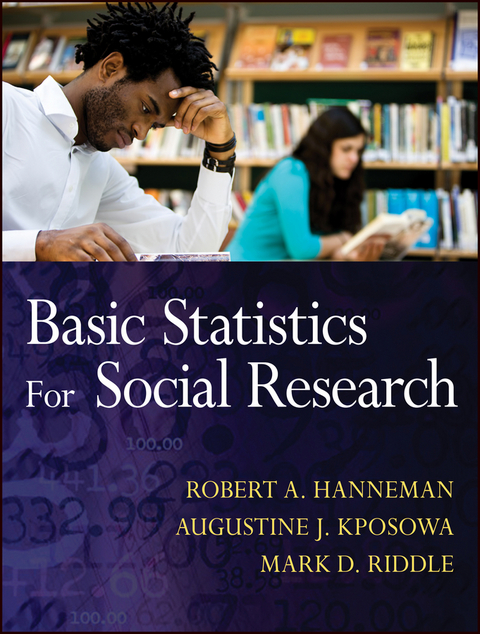
A core statistics text that emphasizes logical inquiry, not math
Basic Statistics for Social Research teaches core general statistical concepts and methods that all social science majors must master to understand (and do) social research. Its use of mathematics and theory are deliberately limited, as the authors focus on the use of concepts and tools of statistics in the analysis of social science data, rather than on the mathematical and computational aspects. Research questions and applications are taken from a wide variety of subfields in sociology, and each chapter is organized around one or more general ideas that are explained at its beginning and then applied in increasing detail in the body of the text.
Each chapter contains instructive features to aid students in understanding and mastering the various statistical approaches presented in the book, including:
- Learning objectives
- Check quizzes after many sections and an answer key at the end of the chapter
- Summary
- Key terms
- End-of-chapter exercises
- SPSS exercises (in select chapters)
Ancillary materials for both the student and the instructor are available and include a test bank for instructors and downloadable video tutorials for students.
ROBERT A. HANNEMAN is a professor of sociology at the University of California, Riverside.
AUGUSTINE J. KPOSOWA is a professor of sociology at the University of California, Riverside.
MARK D. RIDDLE is the Director of Institutional Research at Antioch University Los Angeles.
A core statistics text that emphasizes logical inquiry, not math Basic Statistics for Social Research teaches core general statistical concepts and methods that all social science majors must master to understand (and do) social research. Its use of mathematics and theory are deliberately limited, as the authors focus on the use of concepts and tools of statistics in the analysis of social science data, rather than on the mathematical and computational aspects. Research questions and applications are taken from a wide variety of subfields in sociology, and each chapter is organized around one or more general ideas that are explained at its beginning and then applied in increasing detail in the body of the text. Each chapter contains instructive features to aid students in understanding and mastering the various statistical approaches presented in the book, including: Learning objectives Check quizzes after many sections and an answer key at the end of the chapter Summary Key terms End-of-chapter exercises SPSS exercises (in select chapters) Ancillary materials for both the student and the instructor are available and include a test bank for instructors and downloadable video tutorials for students.
ROBERT A. HANNEMAN is a professor of sociology at the University of California, Riverside. AUGUSTINE J. KPOSOWA is a professor of sociology at the University of California, Riverside. MARK D. RIDDLE is the Director of Institutional Research at Antioch University Los Angeles.
Tables and Figure
Preface
Acknowledgements
The Authors
Part 1 Univariate Description
Chapter 1: Statistics and the Research Process
Chapter 2: Frequency Distribution
Chapter 3: Central Tendency
Chapter 4: Dispersion
Chapter 5: Distribution Shape
Part 2 Inference and Hypothesis Testing
Chapter 6: The Normal Distribution
Chapter 7: Basic Ideas of Statistical Inference
Chapter 8: Hypothesis Testing for One Sample
Chapter 9: Hypothesis Testing for Two Samples
Chapter 10: Multiple Group Tests for Proportions: Chi-square
Chapter 11: Multiple Sample Tests for Means: One-way ANOVA
Part 3 Association and Prediction
Chapter 12: Association with Categorical Variables
Chapter 13: Association with Interval/Ratio Variables
Chapter 14: Prediction for Interval/Ratio Outcomes
Chapter 15: Prediction for Categorical Outcomes
Appendices
Index
| Erscheint lt. Verlag | 15.11.2012 |
|---|---|
| Reihe/Serie | Research Methods for the Social Sciences |
| Research Methods for the Social Sciences | Research Methods for the Social Sciences |
| Sprache | englisch |
| Themenwelt | Schulbuch / Wörterbuch |
| Mathematik / Informatik ► Mathematik ► Angewandte Mathematik | |
| Mathematik / Informatik ► Mathematik ► Statistik | |
| Sozialwissenschaften ► Pädagogik | |
| Sozialwissenschaften ► Politik / Verwaltung | |
| Sozialwissenschaften ► Soziologie ► Empirische Sozialforschung | |
| Schlagworte | Evaluation & Research Methods • Evaluierung u. Researchmethoden • General statistical concepts, General statistical methods, application of statistical methods, application of statistical methods for data-description, application of statistical methods hypothesis-testing, application of statistical methods distributions, application of statistical methods tabulations, application of statistical methods central tendency, application of statistical methods variability, application of statistical methods independence, application of statistical methods correlation, applica • Methoden der Daten- u. Stichprobenerhebung • Research Methodologies • Sociology • Sozialwissenschaften • Soziologie • Soziologische Forschungsmethoden • Statistics • Statistik • Survey Research Methods & Sampling |
| ISBN-13 | 9781118234150 / 9781118234150 |
| Informationen gemäß Produktsicherheitsverordnung (GPSR) | |
| Haben Sie eine Frage zum Produkt? |
 EPUB (Adobe DRM)
Kopierschutz: Adobe-DRM
Adobe-DRM ist ein Kopierschutz, der das eBook vor Mißbrauch schützen soll. Dabei wird das eBook bereits beim Download auf Ihre persönliche Adobe-ID autorisiert. Lesen können Sie das eBook dann nur auf den Geräten, welche ebenfalls auf Ihre Adobe-ID registriert sind.
Details zum Adobe-DRM
Dateiformat: EPUB (Electronic Publication)
EPUB ist ein offener Standard für eBooks und eignet sich besonders zur Darstellung von Belletristik und Sachbüchern. Der Fließtext wird dynamisch an die Display- und Schriftgröße angepasst. Auch für mobile Lesegeräte ist EPUB daher gut geeignet.
Systemvoraussetzungen:
PC/Mac: Mit einem PC oder Mac können Sie dieses eBook lesen. Sie benötigen eine
eReader: Dieses eBook kann mit (fast) allen eBook-Readern gelesen werden. Mit dem amazon-Kindle ist es aber nicht kompatibel.
Smartphone/Tablet: Egal ob Apple oder Android, dieses eBook können Sie lesen. Sie benötigen eine
Geräteliste und zusätzliche Hinweise
Buying eBooks from abroad
For tax law reasons we can sell eBooks just within Germany and Switzerland. Regrettably we cannot fulfill eBook-orders from other countries.
aus dem Bereich