


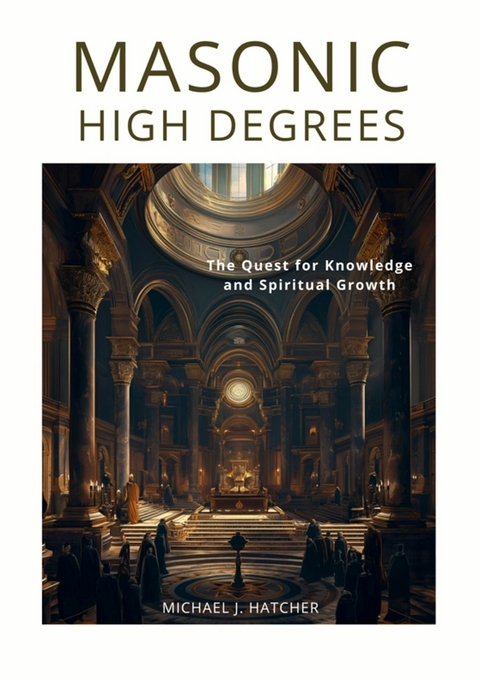
Masonic High Degrees (eBook)
276 Seiten
tredition (Verlag)
978-3-384-13349-6 (ISBN)
Part I: Fundamentals of Freemasonry
The origins of Freemasonry
It is of utmost importance to conduct research into the historical roots and origins of Freemasonry in order to acquire a solid understanding of the development of the freemasonry organization and its current form. The origins of Freemasonry can be traced back to the medieval building lodges and stonemason brotherhoods. Freemasonry has a long history and is closely connected to these organizations.
Freemasonry can be traced back to the 14th and 15th centuries, to the time when it was first established. During this time period, the first organized associations of craftsmen came into existence. These associations specialized in the construction of significant buildings such as cathedrals and other important structures. Not only did these associations, which are also referred to as building lodges, place a significant emphasis on craftsmanship, but they also placed a strong emphasis on ethical values and moral principles.
In addition to working together, the members of the building lodges shared their knowledge and experiences with one another, which contributed to the strong community that existed within the communities. The work that they did and the rituals that they performed both reflected the symbolism that they had developed. This symbolism, which included things like the angle ruler and the hammer, played a role in the members' ability to identify with one another and in the transmission of traditions and values.
Over the course of time, the building lodges started to introduce non-craftsmen into their ranks and open their doors to them. As a result of this change, Freemasonry that we are familiar with today came into existence. Over the course of the 17th century, the first documented lodges, also known as Freemasons assemblies, were established. One of the oldest written records of a lodge that has survived to this day dates back to the year 1599 in Scotland.
It is impossible to understate the significance of important historical events and influences that played a role in the development of Freemasonry. Specifically, the Enlightenment, which was a period of intellectual activity that occurred during the 18th century, had a significant influence on Freemasonry.
Reason, freedom, and tolerance were the defining characteristics of the Enlightenment during its time period. Not only did these values resonate strongly with Freemasonry, but they also had an impact on the organization's goals and principles.
The modern practise of Freemasonry is derived from these historical origins and has developed over the course of time. It is a global fraternity that is founded on the principles of brotherhood, tolerance, assistance to those in need, and personal growth. The historical roots of Freemasonry are therefore intricately connected to the meaning and structure of the organization as it exists today.
We will delve into the historical roots and origins of Freemasonry in this section of the book, which will be covered in great detail. In this section, we will investigate the occurrences and factors that played a role in the formation of Freemasonry, and we will emphasize the significance of these historical aspects to the organization's current form. By delving deeply into the past of Freemasonry, we will be able to improve our comprehension of the organization's origins as well as the ways in which it has developed over time.
The symbolism of the building lodges and stonemasons in Freemasonry
The rich symbolism that Freemasonry draws from is closely associated with the building lodges and stonemasons that existed in the past. When it comes to comprehending High Degree Freemasonry and the rituals that it incorporates, this symbolism is of utmost significance. In the following section, we will demonstrate the connection between the craft and the spiritual by elaborating on the symbolic significance of stonemasons and the construction of lodges within the Freemasonry organization.
An extensive history that dates back to the Middle Ages can be traced back to the builders' lodges and stonemasons. They were skilled artisans who devoted their lives to the endeavor of constructing magnificent cathedrals and other significant structures. Stonemasons were organized into building lodges, which served as organizational units where they shared their expertise, learned from one another, and collaborated on the construction of buildings. There were opportunities for education, collaboration, and the further development of craftsmanship in these places.
Freemasonry employs the metaphorical use of the symbolism of building lodges and stonemasons in order to convey a spiritual meaning to its members. In a symbolic sense, Freemasons consider themselves to be "master builders" or "master builders," and they view their mission as not only the construction of material buildings but also the cultivation of their own personal growth. The construction of the "temple of the soul," which is usually interpreted as a metaphor for the spiritual journey of an individual, is the primary focus today.
One of the most important aspects of Freemasonry is the connection that exists between the creative process and the spiritual realm. Similar to the pursuit of personal growth and spiritual insight, the art of stonemasonry requires precision, patience, and mastery in order to be accomplished. In order to emphasize the significance of self-discipline, self-awareness, and the pursuit of ethical values, Freemasons use the metaphor of applying the craftsmanship of stonemasons to their own personal spiritual journey.
One of the most well-known symbols in Freemasonry is the "Masonic Hammer and Chisel," which is closely connected to the symbolism of the building lodges and masons. On the other hand, the hammer is symbolic of the power that we use to work on ourselves in order to overcome our shortcomings and develop our abilities. Our ability to shape our own nature and liberate ourselves from imperfections in order to develop our true potential is represented by the chisel, which is a symbol of the tool.
Not only does the construction of lodges and masons in Freemasonry symbolize the development of the individual, but it also symbolizes the development of the community. Freemasons work toward the establishment of a harmonious community in which each individual contributes their own set of skills in order to accomplish shared objectives. Freemasons collaborate to make the world a better place, much like stonemasons did when they built lodges, which were impressive structures that were created through their collaborative efforts.
The fact that the symbolic meaning of the building lodges and masons is still alive and well in Freemasonry today is a fascinating realization. The fact that we should not only construct material structures but also work on our own spiritual development is brought to our attention by this observation. Not only does the symbolism of the Building Lodges and Stonemasons encourage us to connect with the values of precision, patience, mastery, and cooperation, but it also encourages us to grow as individuals and to have a positive impact on the community as a whole.
For the purpose of guiding its members on their individual and spiritual journeys, Freemasonry employs the symbolism of building lodges and masons. It offers a platform for personal development, the development of ethical principles, and the creation of a better society by establishing a connection between the craft and the spiritual. The symbolism of the Building Lodges and Stonemasons serves as a constant reminder of the values and principles that shape Freemasonry. These values and principles make Freemasonry a fascinating journey through history, currents, and practices.
Freemasonry today
Over the course of its history, Freemasonry has developed into a worldwide community that comprises members from a variety of nations and cultural backgrounds. Within this section, we will examine contemporary developments and the expansion of Freemasonry, with a particular emphasis on the significance of rituals and symbols in the practice of Freemasonry at the present time.
Numerous regions of the world now have access to Freemasonry as a result of the developments that have taken place in recent times. In spite of the fact that it has been historically subject to restrictions in certain countries, it has found widespread acceptance in other countries. In particular, Freemasonry is a vocation that is widely practiced in both North America and Europe. However, there are also Masonic communities in other parts of the world, such as Australia, Africa, Asia, and Latin America, which are contributing to the growing globalization of Freemasonry.
The modern Freemasonry movement has made significant progress by placing a greater emphasis on the rituals and symbols that are practiced. The Masonic tradition is built on rituals, which serve to instill values, elevate the spirit, and guide members on their spiritual journey. Rituals are central elements throughout the Masonic tradition. Masonic rituals are a means of fostering a sense of belonging to the Masonic community as well as creating shared experiences.
There is a common association between rituals and symbolic actions that have a more profound significance. Freemasonry makes use of symbols to illustrate abstract concepts and to represent particular values and ideals with regard to the organization. As an illustration, the angular yardstick is regarded as a symbol of equilibrium and measurement, whereas the compass is regarded as a symbol of the cycle of life and the constraints that are associated with human...
| Erscheint lt. Verlag | 30.1.2024 |
|---|---|
| Verlagsort | Ahrensburg |
| Sprache | englisch |
| Themenwelt | Sachbuch/Ratgeber ► Gesundheit / Leben / Psychologie ► Esoterik / Spiritualität |
| Geisteswissenschaften ► Philosophie ► Geschichte der Philosophie | |
| Geisteswissenschaften ► Religion / Theologie ► Islam | |
| Medizin / Pharmazie ► Allgemeines / Lexika | |
| Sozialwissenschaften ► Soziologie ► Spezielle Soziologien | |
| Technik | |
| Schlagworte | Chapters • Freemasonry • grand lodge • High Degree • Holy Grail • knights of malta • Knights Templar • Malta • Martinists • masonic • Memphis Misraum • Misraim • Red Cross • Rites • Rosicrucians • Royal Arch • Symbolism • Templar • York Rite |
| ISBN-10 | 3-384-13349-8 / 3384133498 |
| ISBN-13 | 978-3-384-13349-6 / 9783384133496 |
| Informationen gemäß Produktsicherheitsverordnung (GPSR) | |
| Haben Sie eine Frage zum Produkt? |
 EPUB (Wasserzeichen)
DRM: Digitales Wasserzeichen
Dieses eBook enthält ein digitales Wasserzeichen und ist damit für Sie personalisiert. Bei einer missbräuchlichen Weitergabe des eBooks an Dritte ist eine Rückverfolgung an die Quelle möglich.
Dateiformat: EPUB (Electronic Publication)
EPUB ist ein offener Standard für eBooks und eignet sich besonders zur Darstellung von Belletristik und Sachbüchern. Der Fließtext wird dynamisch an die Display- und Schriftgröße angepasst. Auch für mobile Lesegeräte ist EPUB daher gut geeignet.
Systemvoraussetzungen:
PC/Mac: Mit einem PC oder Mac können Sie dieses eBook lesen. Sie benötigen dafür die kostenlose Software Adobe Digital Editions.
eReader: Dieses eBook kann mit (fast) allen eBook-Readern gelesen werden. Mit dem amazon-Kindle ist es aber nicht kompatibel.
Smartphone/Tablet: Egal ob Apple oder Android, dieses eBook können Sie lesen. Sie benötigen dafür eine kostenlose App.
Geräteliste und zusätzliche Hinweise
Buying eBooks from abroad
For tax law reasons we can sell eBooks just within Germany and Switzerland. Regrettably we cannot fulfill eBook-orders from other countries.
aus dem Bereich


