


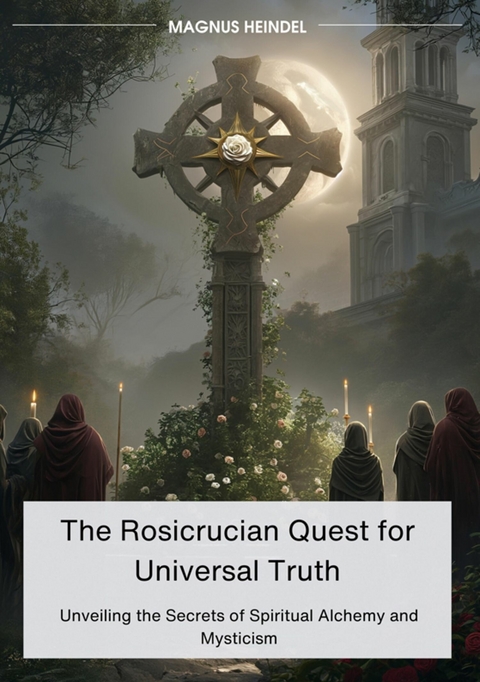
The Rosicrucian Quest for Universal Truth (eBook)
280 Seiten
tredition (Verlag)
9783384106155 (ISBN)
Chapter 4: The Rosicrucians and the Society
Throughout history, the Rosicrucians have had a significant impact on various sectors of society. In this chapter, we will examine their impact on art, culture, science, philosophy, and political movements in depth. In doing so, we will investigate the various traces left by the Rosicrucians in these areas.
The Rosicrucians and the Arts
The Rosicrucians' ideas, symbols, and teachings have influenced artists and works of art all over the world. Rosicrucian influences can be found in the work of artists such as William Blake and Salvador Dal. Their works contain deep symbolic meanings and mystical elements inspired by the Rosicrucian teachings. Composers such as Richard Wagner and Ludwig van Beethoven used Rosicrucian elements in their work, particularly in classical music. The Rosicrucians also had an impact on the literary world, particularly through the works of Johann Wolfgang von Goethe and the Romantics. Their writings are frequently filled with allegorical representations and esoteric themes based on Rosicrucian philosophies. Rosicrucian symbols were used in architecture to emphasize spiritual aspects and establish a connection to the divine dimension in structures such as cathedrals and temples. The Rosicrucians' impact on art and culture has been enormous, resulting in a rich artistic tradition.
The Rosicrucians and Science and Philosophy
The Rosicrucians have also had a significant impact on science and philosophy. Numerous notable figures, including Isaac Newton, have studied the Rosicrucian teachings and practices. Rosicrucian principles influenced Newton's alchemical studies and understanding of natural laws. Rosicrucian philosophy emphasizes the unity of spirit and matter, which has aided in the development of new scientific ways of thinking and understanding. The Rosicrucians also had an impact on the development of philosophy, particularly in psychology, metaphysics, and transcendental philosophy. Their emphasis on inner transformation, spiritual insight, and the synthesis of opposites has resulted in new philosophical concepts and expanded thinking in these disciplines.
The Rosicrucians and political movements
The Rosicrucians have also left their mark on political movements and social transformations. Their ideas of equality, freedom, and social responsibility have played a role in various political contexts. During the Enlightenment movement, the Rosicrucians played a role in promoting ideals of justice, tolerance, and democratic principles. Their philosophical approaches and emphasis on individual spiritual development helped lay the foundation for political systems based on the rights and welfare of the individual.
An example of Rosicrucian influence on political movements is the period of the French Revolution. During this time, Rosicrucian ideas of equality and freedom were present in political discourses and manifestos. Some well-known figures associated with the Rosicrucians, such as Cagliostro and Saint-Martin, had an influence on the revolutionary thoughts and ideals of this era.
Traces of Rosicrucian influence can also be found in modern political and social movements. Especially in the 20th century, there were spiritual and ecological movements inspired by the Rosicrucian teachings. These movements emphasized the importance of individual and collective spiritual growth, as well as the protection and preservation of the natural environment.
Influences of the Rosicrucians on Art and Culture
The Rosicrucians had a substantial impact on art and culture. Many artists and writers have been inspired by the Rosicrucian teachings and have expressed their ideas in their works. William Blake, an 18th century English poet and painter, is a prime example. The Rosicrucian symbols and the alchemical tradition captivated Blake. He used Rosicrucian elements in his works, such as "The Marriage of Heaven and Hell," to depict spiritual themes and man's inner struggle. The teachings of the Rosicrucians had a strong influence on his unique pictorial representation of the divine dimension and human existence.
Another example is Johann Wolfgang von Goethe, a well-known German poet and writer. Goethe was interested in alchemy and was involved with various Rosicrucian orders and societies during his lifetime. "The Mysteries," his work, contains Rosicrucian symbols and motifs that connect spiritual principles to human experience. Goethe's works reflect Rosicrucian philosophies and contributed to the revival of the Rosicrucian tradition.
Individual artists, however, were not immune to the Rosicrucian influence on art and culture. Rosicrucian symbolism was also reflected in architecture. For example, the Chartres Cathedral in France, a Gothic architectural masterpiece, was designed with Rosicrucian symbols and motifs. These symbols were chosen to emphasize the quest for spiritual enlightenment and the path to inner transformation.
Influences of the Rosicrucians in the Sciences
The Rosicrucians also had a significant impact on science. Sir Isaac Newton, one of the most famous physicists and mathematicians of all time, is a good example. Newton was an adherent of the alchemical and hermetic traditions, and he devoted a significant portion of his life to alchemical research. The teachings of the Rosicrucians influenced his alchemical studies, which in turn influenced his work in physics and the development of the law of gravity. Newton believed in the connection between natural laws and alchemical principles, which added a spiritual dimension to his scientific approaches.
Carl Gustav Jung, a Swiss psychiatrist and the founder of analytical psychology, is another example. Jung was fascinated by the Rosicrucian tradi tion's symbols and archetypes, which he used in his work to investigate the unconscious and psychic processes of humans. He established the concept of the individual and collective unconscious, as well as the significance of alchemical symbols and inner transformation for psychic growth and self-integration. Jung's association with the Rosicrucians aided him in developing a more comprehensive understanding of the human psyche and introducing new approaches to psychotherapy.
The Rosicrucians had a wide range of scientific influences, from physics to psychology to biology. They introduced new perspectives and concepts to these disciplines and promoted a more holistic view of man and nature.
Influences of the Rosicrucians in Philosophy
The Rosicrucians had a significant impact on philosophy as well. Georg Wilhelm Friedrich Hegel, a German philosopher active in the nineteenth century, is a notable example. Hegel was familiar with and inspired by the teachings of the Rosicrucians. Rosicrucian alchemy, in particular, and its concepts of unity and transformation, influenced Hegel's dialectical approach to philosophy. Hegel saw history and human consciousness as a constant process of change and development, analogous to the alchemical process of transformation. His philosophy emphasized the significance of the mind and individual consciousness in achieving absolute truth.
Arthur Schopenhauer was another philosopher influenced by the Rosicrucians. Schopenhauer was a German philosopher who studied Eastern philosophy and mysticism extensively in the nineteenth century. He was influenced by Rosicrucian concepts of will and imagination, which he incorporated into his philosophical concept of "world will." In order to achieve higher consciousness, Schopenhauer's philosophy emphasized the spiritual dimension of human existence and the need for liberation from the limitations of the individual ego.
The Rosicrucians' philosophical influences were revolutionary, and they had a significant impact on the development of modern philosophy. They established the link between spiritual principles and philosophical concepts and introduced new ways of thinking.
Influences of the Rosicrucians on Politics
The Rosicrucians were also influential in political circles. The Rosicrucians contributed to political discourse and influenced political movements during the 18th century Enlightenment period, when political freedom and justice were important concerns. Well-known figures such as Cagliostro and Saint-Martin had ties to the Rosicrucians and rose to prominence in political circles during their respective times.
The French Revolution, which began in the late 1780s, is an example of Rosicrucian influence on politics. Rosicrucian ideas of equality, freedom, and social responsibility were prominent in political debates and manifestos at the time. Influential figures like Cagliostro became associated with the Revolution's ideals. The French Revolution resulted in significant political changes, including the abolition of the feudal system, the establishment of human rights, and the formation of the First French Republic. Although determining the exact impact of the Rosicrucians on these political events is difficult, it is clear that their ideas and principles contributed to the political transformation.
Furthermore, the Rosicrucians have left their imprint on modern political and social movements. The teachings of the Rosicrucians inspired spiritual and esoteric movements in the twentieth century. One example is Helena Blavatsky's Theosophical Society, which incorporated Rosicrucian elements into its teachings. These movements emphasized the importance of personal spiritual development, the pursuit of higher consciousness, and the need to live in harmony with nature and humanity. They influenced political and social approaches such as environmental protection and social justice...
| Erscheint lt. Verlag | 3.1.2024 |
|---|---|
| Verlagsort | Ahrensburg |
| Sprache | englisch |
| Themenwelt | Sachbuch/Ratgeber ► Gesundheit / Leben / Psychologie ► Esoterik / Spiritualität |
| Geisteswissenschaften ► Philosophie ► Geschichte der Philosophie | |
| Sozialwissenschaften ► Soziologie ► Spezielle Soziologien | |
| Schlagworte | Amorc • Astrology • Christian Rosenkreuz • Francis Bacon • Freemasonry • Gnosis • hermetic order • Hermetic Society • John Dee • Mysticism • Numerology • Occultism • Order • Paracelsus • Rituals • Rosicrucians • secret wisdom • W.B. Yates |
| ISBN-13 | 9783384106155 / 9783384106155 |
| Informationen gemäß Produktsicherheitsverordnung (GPSR) | |
| Haben Sie eine Frage zum Produkt? |
 EPUB (Wasserzeichen)
DRM: Digitales Wasserzeichen
Dieses eBook enthält ein digitales Wasserzeichen und ist damit für Sie personalisiert. Bei einer missbräuchlichen Weitergabe des eBooks an Dritte ist eine Rückverfolgung an die Quelle möglich.
Dateiformat: EPUB (Electronic Publication)
EPUB ist ein offener Standard für eBooks und eignet sich besonders zur Darstellung von Belletristik und Sachbüchern. Der Fließtext wird dynamisch an die Display- und Schriftgröße angepasst. Auch für mobile Lesegeräte ist EPUB daher gut geeignet.
Systemvoraussetzungen:
PC/Mac: Mit einem PC oder Mac können Sie dieses eBook lesen. Sie benötigen dafür die kostenlose Software Adobe Digital Editions.
eReader: Dieses eBook kann mit (fast) allen eBook-Readern gelesen werden. Mit dem amazon-Kindle ist es aber nicht kompatibel.
Smartphone/Tablet: Egal ob Apple oder Android, dieses eBook können Sie lesen. Sie benötigen dafür eine kostenlose App.
Geräteliste und zusätzliche Hinweise
Buying eBooks from abroad
For tax law reasons we can sell eBooks just within Germany and Switzerland. Regrettably we cannot fulfill eBook-orders from other countries.
aus dem Bereich


