
Gorkan Ahmetoglu is Lecturer in Business Psychology at University College London (UCL), and co-founder of Meta Profiling Ltd.
Tomas Chamorro-Premuzic is Professor of Business Psychology at University College London (UCL), and CEO of Hogan Assessments.
Bailey Klinger is Founder and Executive Chairman of the Entrepreneurial Finance Lab, and was previously a Fellow at Harvard University's Center for International Development.
Tessa Karcisky is a Business Psychologist with a PhD from the University of Cologne.
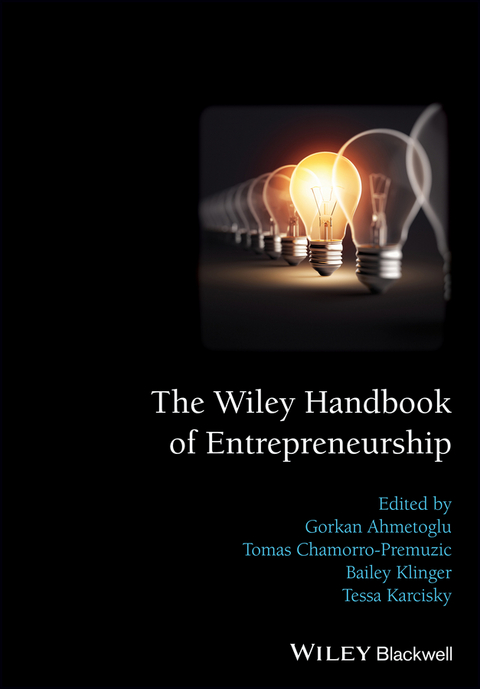
Written by leading scholars, The Wiley Handbook of Entrepreneurship provides a distinctive overview of methodological, theoretical and paradigm changes in the area of entrepreneurship research. It is divided into four parts covering history and theory, individual differences and creativity, organizational aspects of innovation including intrapreneurship, and macroeconomic aspects such as social entrepreneurship and entrepreneurship in developing countries. The result is a must-have resource for seasoned researchers and newcomers alike, as well as practitioners and advanced students of business, entrepreneurship, and social and organizational psychology.
Gorkan Ahmetoglu is Lecturer in Business Psychology at University College London (UCL), and co-founder of Meta Profiling Ltd. Tomas Chamorro-Premuzic is Professor of Business Psychology at University College London (UCL), and CEO of Hogan Assessments. Bailey Klinger is Founder and Executive Chairman of the Entrepreneurial Finance Lab, and was previously a Fellow at Harvard University's Center for International Development. Tessa Karcisky is a Business Psychologist with a PhD from the University of Cologne.
Preface
Although definitions of entrepreneurship vary, few dispute its importance in bringing positive change to the world. It is no wonder, therefore, that the academic field of entrepreneurship permeates a broad spectrum of disciplines. So much so, that the study of entrepreneurship has become an integral part of economics, management, and business studies. More recently, there has also been growing interest in entrepreneurship from the field of psychology. However, despite the large amount of interdisciplinary research and collaboration around this subject, a great deal of opportunities remain. Globalization and changes in technology are impacting every aspect of life, with entrepreneurship often driving such changes. Indeed, the impact of entrepreneurship is felt at many levels, including the individual, organizational, regional, national, and international.
Gaining a deeper understanding of the entrepreneurship phenomenon is no doubt of fundamental value to businesses, governments, and society at large. To that end, the aim of the current handbook is to provide an overview of the academic research in this field. This book contains chapters from leading researchers in the field to provide a thorough foundation for knowledge exchange around entrepreneurship. It is an attempt to provide the latest thinking around some of the most important areas of focus in the field: individuals, teams, and organizations who engage in entrepreneurship, and their regional, national, and international impact.
Thus this handbook intends to demonstrate the importance of entrepreneurship as a research discipline, highlighting what is known as well as what is still unknown, so as to inspire and guide future research in this area. This volume comprises four parts, each with a unique view on entrepreneurship on differing levels—Entrepreneurship: Theory and Research; The Individual: Psychology of Entrepreneurship; The Organization: Corporate Entrepreneurship and Entrepreneurial Teams; and National and International Entrepreneurship. With contributions from nearly 40 experts, this book was written for scholars and students with an interest in entrepreneurship. This volume may also be of interest to audiences of related fields such as psychology, business strategy, finance and venture capital, organizational behavior, and economics.
Chapter Summaries
Section I. Entrepreneurship: Theory and Research
Understanding Entrepreneurship
1 A Future of Entrepreneurship Research: Domain, Data, Theory, and Impact In this chapter Per Davidsson offers observations and speculations about current and possible future developments in the field of entrepreneurship research. The main topics focused on include the delineation of the “entrepreneurship research” field and community; data and data sources; the quest for increased theoretical precision, and demands for practical relevance and real-world impact. Davidsson goes on to conclude that the future of entrepreneurship research offers both challenges and opportunities, and he predicts that it will remain an exciting field for scholarly study.
2 Entrepreneurship as a Process: Empirical Evidence for Entrepreneurial Engagement Levels In this chapter Peter van der Zwan and Roy Thurik focus on several stages of the entrepreneurial process. These stages both incorporate the “cognitive” and “behavioral” type of stages. They highlight that at a certain moment in time an individual is engaged in any of these stages, and for this individual there is a likelihood of moving to the next stage. Implicit in this model are thresholds that indicate the transition from one stage to another. They argue that several strands of literature are integrated in this particular process, such as the literature on entrepreneurial intentions, nascent entrepreneurship and entrepreneurial survival. Van der Zwan and Thurik combine these streams of literature and show that the individual-level determinants of entrepreneurship deserve a separate treatment depending on the stage in the entrepreneurial process. They show evidence that the empirically validated determinants of self-employment or entrepreneurship differ across the several stages in the entrepreneurial process.
3 Types and Roles of Productive Entrepreneurship: A Conceptual Study Sander Wennekers and André van Stel recognize in this chapter that there are three recurring questions that appear in literature: What is entrepreneurship? What economic and social contributions does entrepreneurship make? How does entrepreneurship make these contributions? Many interesting answers have been given to these questions, but these answers do not result in a clear-cut, unambiguous picture. On the contrary, confusion prevails. Wennekers and van Stel aim to dispel this confusion by assessing which different dimensions and which major types of entrepreneurship can be identified. They then go on to decipher which entrepreneurial roles are being fulfilled by these major types. Wennekers and van Stel finally address how the causal chains from these entrepreneurial roles are linked to their final contributions.
4 Toward a Theory of Entrepreneurial Behavior Bruce T. Teague and William B. Gartner begin this chapter by reviewing several of the most prominent entrepreneurship frameworks in order to demonstrate that the entrepreneurship field lacks a theory of entrepreneurial behavior. However, they suggest that each of these existing frameworks would benefit from, and be complemented by, an entrepreneurial behavioral theory. Drawing from multiple streams of research, Teague and Gartner offer a preliminary theory of entrepreneurial behavior. Several propositions are offered which are then followed by recommendations for new research opportunities.
Section II. The Individual: Psychology of Entrepreneurship
5 The Psychology of Entrepreneurship: A Selective Review and a Path Forward Kelly G. Shaver and Amy E. Davis highlight that the creation of a new business is not an event, but a process undertaken by one person or by a team of people. As many writers have acknowledged, the cognitive processes, personal motives, actions performed, and interpersonal processes involved are all fair topics for psychological inquiry. In this selective review Shaver and Davis show how the “psychology of entrepreneurship” has evolved from a relatively simplistic beginning to a recent view that is much more highly nuanced. They first describe several of the ideas borrowed from psychology (mostly, though not exclusively, from personality and social psychology) that have been adapted for use in entrepreneurship. They then address the issues that arise when “the founder” changes to a “founding team.” Finally, Shaver and Davis conclude with an argument for greater complexity in future work on entrepreneurial psychology.
6 Tools Entrepreneurs Need for Converting Dreams to Reality—And Achieving Success In this chapter Robert A. Baron seeks to uncover some key in entrepreneurial success on the basis of current knowledge. To accomplish this task, in each section of the chapter Baron considers one component of why entrepreneurs fail or succeed, describing extant evidence concerning its importance. From this an overall picture of the personal ingredients in entrepreneurial success emerges. Despite many factors that contribute to an entrepreneur's success or failures being beyond the control of entrepreneurs, Baron adds to existing evidence and theory by suggesting that entrepreneurs themselves do indeed play a central role in the entrepreneurial process.
7 Creativity and Entrepreneurship: A Process Perspective Maike Lex and Michael M. Gielnik open this chapter with a reminder that creativity has often been described in literature as a key predictor of entrepreneurial success. Yet, there is surprisingly little empirical research on the effect of creativity on entrepreneurial success with some of the studies yielding nonsignificant results. In this chapter, they review the literature on creativity and entrepreneurship and argue that it has in general adopted a relatively basic approach to the main effects of creativity on entrepreneurship. Gielnik and Lex go beyond this basic approach by adopting a more differentiated perspective on the role of creativity in entrepreneurship. Specifically, they argue that both creativity and entrepreneurship comprise different components and phases which need to be taken into account in order to fully understand the effect of creativity in entrepreneurship. In addition, they posit that it is important to consider contextual factors which systematically promote or hinder the effect of creativity within the entrepreneurial process. Building on these assumptions, they develop a theoretical model on the role of creativity in the entrepreneurial process. Their model integrates past theoretical and empirical research into a comprehensive framework and illuminates both the positive and negative effects of creativity in the different phases of the entrepreneurial process.
8 The Dark Side of the Entrepreneurial Personality: Undesirable or Maladaptive Traits and Behaviors Associated with Entrepreneurs In this chapter Angelo S. DeNisi and Benjamin N. Alexander endeavor to extend the arguments made in recent papers on the “dark side” of the entrepreneurial personality and to integrate additional perspectives germane to the issue. DeNisi and Alexander examine the distinct mechanisms proposed in recent commentaries and also discuss the different outcomes that might be associated with dark-side...
| Erscheint lt. Verlag | 13.7.2017 |
|---|---|
| Sprache | englisch |
| Themenwelt | Sachbuch/Ratgeber ► Beruf / Finanzen / Recht / Wirtschaft |
| Geisteswissenschaften ► Psychologie ► Arbeits- und Organisationspsychologie | |
| Wirtschaft ► Betriebswirtschaft / Management ► Unternehmensführung / Management | |
| Schlagworte | Bailey Klinger • behaviros associated with entrepreneurs • beliefs about entrepreneurial ability • biology and entrepreneurship • Business & Management • Corporate Entrepreneurship • creativity and entrepreneurship • data on entrepreneurship • entrepreneurial tendencies • entrepreneurs achieving success • entrepreneurship as a process • evidence for entrepreneurial engagement levels • Existenzgründung • Female Entrepreneurship • future of entrepreneurship • Gorkan Ahmetoglu • guide to entrepreneurship • impact of entrepreneurship • IQ and female entrepreneurship • Klein- u. mittelständische Unternehmen u. Existenzgründung • Klein- und Mittelbetrieb • Psychology of entrepreneurship • research on entrepreneurship • Resource to entrepreneurship • roles of productive entrepreneurship • Small Business & Entrepreneurship • Tessa Karcisky • theory of entrepreneurial behaviour • theory of entrepreneurship • the person in social entrepreneurship • The Wiley Handbook of Entrepreneurship • Tomas Chamorro-Premuzic • tools for entrepreneurship • types of productive entrepreneurship • understanding entrepreneurship • undesirable personality traits of entrepreneurs • Unternehmertum • Wirtschaft u. Management |
| ISBN-13 | 9781118970720 / 9781118970720 |
| Informationen gemäß Produktsicherheitsverordnung (GPSR) | |
| Haben Sie eine Frage zum Produkt? |
 EPUB (Adobe DRM)
Kopierschutz: Adobe-DRM
Adobe-DRM ist ein Kopierschutz, der das eBook vor Mißbrauch schützen soll. Dabei wird das eBook bereits beim Download auf Ihre persönliche Adobe-ID autorisiert. Lesen können Sie das eBook dann nur auf den Geräten, welche ebenfalls auf Ihre Adobe-ID registriert sind.
Details zum Adobe-DRM
Dateiformat: EPUB (Electronic Publication)
EPUB ist ein offener Standard für eBooks und eignet sich besonders zur Darstellung von Belletristik und Sachbüchern. Der Fließtext wird dynamisch an die Display- und Schriftgröße angepasst. Auch für mobile Lesegeräte ist EPUB daher gut geeignet.
Systemvoraussetzungen:
PC/Mac: Mit einem PC oder Mac können Sie dieses eBook lesen. Sie benötigen eine
eReader: Dieses eBook kann mit (fast) allen eBook-Readern gelesen werden. Mit dem amazon-Kindle ist es aber nicht kompatibel.
Smartphone/Tablet: Egal ob Apple oder Android, dieses eBook können Sie lesen. Sie benötigen eine
Geräteliste und zusätzliche Hinweise
Buying eBooks from abroad
For tax law reasons we can sell eBooks just within Germany and Switzerland. Regrettably we cannot fulfill eBook-orders from other countries.
aus dem Bereich