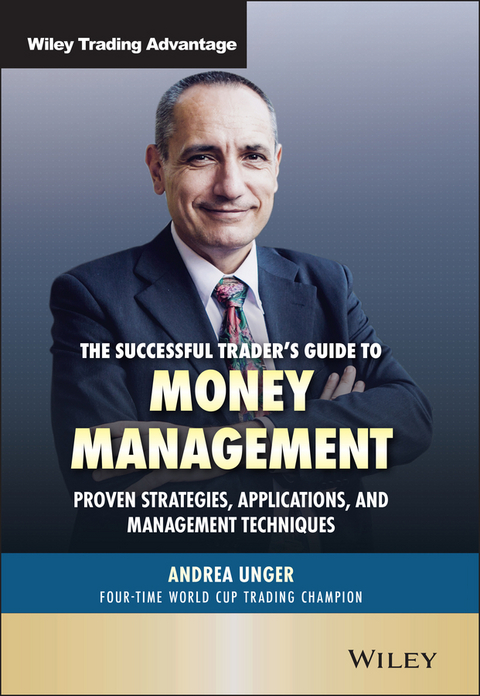
The Successful Trader's Guide to Money Management (eBook)
Discover how to maximize the effectiveness of your trading techniques by applying the right money management techniques
Money management is a central element of trading the financial markets, especially in uncertain times. Yet investors often misinterpret the central concepts of money management. To manage risk and obtain optimal rewards from your trades, you will benefit from a deeper understanding of how the professionals manage money. The Successful Trader's Guide to Money Management describes the operating methods that seasoned investors use. With this book, you'll avoid the common mistake of focusing too much on entry levels and stop-losses, and you'll learn to consider the impact of proper money management on your final portfolio results.
Successful traders focus on risk management, avoiding opening positions that are too large with respect to the total capital they have available. Packed with practical examples and with special focus on money management or position-sizing, The Successful Trader's Guide to Money Management offers a comprehensive coverage of widely practiced risk management models, examining their strengths and weaknesses. You will learn how to use the most effective operating models, including the Fixed Fractional, Fixed Ratio, and Percent Volatility models. This book also provides a thorough analysis of portfolio management models. These essential tips will nudge you toward a more winning position as you enter your next trades.
- Learn how the professionals manage money and avoid common trading mistakes
- Design a trading system that minimizes risk and maximizes reward through correct position sizing
- Understand the most important money and portfolio management models, including Fixed Ratio, Percent Volatility, Fixed Fractional, and more
- Equip yourself to trade smarter, individually or with a broker, on equity, derivatives and Forex markets
For individual and institutional investors alike, this book is a ticket to more solid trading strategy, especially in uncertain times.
Andrea Unger (Milan, Italy) is Founder and CEO of Unger Academy and a full-time trader, educator and author. He began his career as a professional trader in 2001, initially specializing in operations on covered warrants. He eventually shifted his focus on futures and shares after developing a preference for mechanical approach to trading and investing. He is the author of Trattato di Money Management, which was published by Hoepli in 2018, and an honorary member of SIAT (Italian Society of Technical Analysis), a branch of the IFTA. A highly regarded speaker, he is a frequent guest at conferences in Europe, the United States and Asia.
Discover how to maximize the effectiveness of your trading techniques by applying the right money management techniques Money management is a central element of trading the financial markets, especially in uncertain times. Yet investors often misinterpret the central concepts of money management. To manage risk and obtain optimal rewards from your trades, you will benefit from a deeper understanding of how the professionals manage money. The Successful Trader s Guide to Money Management describes the operating methods that seasoned investors use. With this book, you ll avoid the common mistake of focusing too much on entry levels and stop-losses, and you ll learn to consider the impact of proper money management on your final portfolio results. Successful traders focus on risk management, avoiding opening positions that are too large with respect to the total capital they have available. Packed with practical examples and with special focus on money management or position-sizing, The Successful Trader's Guide to Money Management offers a comprehensive coverage of widely practiced risk management models, examining their strengths and weaknesses. You will learn how to use the most effective operating models, including the Fixed Fractional, Fixed Ratio, and Percent Volatility models. This book also provides a thorough analysis of portfolio management models. These essential tips will nudge you toward a more winning position as you enter your next trades. Learn how the professionals manage money and avoid common trading mistakes Design a trading system that minimizes risk and maximizes reward through correct position sizing Understand the most important money and portfolio management models, including Fixed Ratio, Percent Volatility, Fixed Fractional, and more Equip yourself to trade smarter, individually or with a broker, on equity, derivatives and Forex markets For individual and institutional investors alike, this book is a ticket to more solid trading strategy, especially in uncertain times.
ANDREA UNGER is a full-time trader, educator, author and Founder and CEO of Unger Academy¯®. He is a highly sought-after speaker at conferences in Europe, the US, and APAC; a member of Mensa International; and an honorary member of the Italian Society of Technical Analysis.
Foreword xi
Preface xiii
Chapter 1 Martingale and Anti-Martingale 1
1.1 The Right Stake 1
1.2 Martingale 2
1.3 Anti-Martingale 9
1.4 More Examples 15
1.5 A Miraculous Technique? 17
1.6 Conclusions 20
Chapter 2 The Kelly Formula 21
2.1 Kelly and Co. 21
2.2 Conclusions 31
Chapter 3 A Banal Trading System 33
3.1 Analyzing a System Based on Moving Averages 33
3.2 Applying the Kelly Formula 37
3.3 Conclusions 52
Chapter 4 Money Management Models 53
4.1 The Fixed Fractional Method 54
4.2 Optimal f 60
4.3 Secure f 65
4.4 Fixed Ratio 68
4.5 Percent Volatility Model 81
4.6 Levels for Changing the Number of Contracts 91
4.7 Conclusions 92
Chapter 5 Refining the Techniques 94
5.1 The Importance of the Trader's Temperament 94
5.2 Reduced f 95
5.3 Aggressive Ratio 97
5.4 Asymmetric Ratio 99
5.5 Timid Bold Equity 100
5.6 Equity Curve Trading 103
5.7 z-Score 110
5.8 Conclusions 112
Chapter 6 The Monte Carlo Simulation 114
6.1 Using the Monte Carlo Simulation 114
6.2 Maximum Loss 135
6.3 Conclusions 139
Chapter 7 The Work Plan 141
7.1 Using a Work Plan 141
7.2 Conclusions 155
Chapter 8 Combining Forces 157
8.1 Using a Combination of Systems 157
8.2 Portfolio Money Management 168
8.3 Which Capital? 169
8.4 The Effects of Portfolio Money Management 173
8.5 Conclusions 180
Chapter 9 Money Management When Trading Stocks 181
9.1 Trading in the Stock Market 181
9.2 Conclusions 192
Chapter 10 Portfolio Management 193
10.1 A Portfolio Approach 195
10.2 Some Improvements to the System 208
10.3 Conclusions 214
Chapter 11 Discretionary Trading 215
11.1 Trading Criteria and Definition 215
11.2 An Example: Mediaset 218
11.3 Adjusting Volatility During the Trade 225
11.4 Trading Futures 228
11.5 Conclusions 245
Chapter 12 Questions and Answers 246
Appendix I 252
I.1 The Impact of a Trading System on Planning 252
I.2 The Trading System 252
Appendix II 268
II.1 Understanding the Type of Strategy 268
Appendix III 278
III.1 The Advantages of Forex 278
Appendix IV Online Trading 282
IV.1 The Trader 282
IV.2 Trading Profits 284
IV.3 Systematic or Discretionary? 286
IV.4 Choosing the Broker 287
IV.5 Which Platform? 288
Index 291
CHAPTER 1
Martingale and Anti‐Martingale
1.1 The Right Stake
As mentioned in the introduction, money management (M.m) aims to establish the best stake to place when opening a trade or, in general, how much of your capital to use in the gamble you are about to embark on.
I think we all tend to adopt quite a simple statistical approach that encourages us to hope in a positive result after one or more negative results, and to fear repeating a success after placing a successful stake. In general, this is why you don't want to continue after a certain number of consecutive winning trades, while after a series of losing trades you'll be sure the next one will be a winner.
This tendency induces us to adopt a sort of risk management that, in general, leads us to increase the stakes after a negative period (betting on the fact that after various losses one should statistically expect a success) and reduce them after a positive period (for exactly the opposite reason).
In this chapter, we'll deal with this question by moving away from the trading environment, to enter a world we're all in any case familiar with: that of the coin toss.
Flipping a coin to see whether it lands heads or tails is a classic statistical example of 50% probability, and analyzing how we manage the stakes, on the basis of one event or another, can produce some surprising results.
This isn't trading, and the intention isn't to compare a trading system to betting. The purpose of this first part is simply to demonstrate what might be the best way to manage your available capital, when ‘staking’ part of it on an event.
If we take 100 people with €100 each, I don't think many would come out winning if they had to bet on a series of 100 or 1,000 coin tosses. In my opinion, most would lose all their capital due to inadequate risk management.
Of the resources to download, at the link https://autc.pro/guide you'll find the Excel file ‘HeadOrTail.xls’ you can use to run coin‐toss simulations. This is the one I used for the various examples we'll be taking a look at.
As I said, let's suppose we have a capital of €100 and we'll use it for a series of 100 and 1,000 coin tosses, ‘heads’ wins, ‘tails’ loses. The win/loss ratio will be different for each analysis. In other words, let's imagine we lose €1 on every stake; the amount won, on the other hand, changes as we analyze various examples.
Stake calculation systems are mostly based on two styles that can be grouped together as Martingale systems and anti‐Martingale systems. The first aim to increase exposure in the case of a loss; while the second only increase exposure after a win and decrease it in the case of a loss.
1.2 Martingale
The Martingale system comes from the roulette wheel, and in practice is based on the impossibility of an infinite series of consecutive losses. Therefore, the concept is that the more consecutive losses there are, the greater the probability of a win next time. On this basis, the system involves doubling the stake after every loss. If you bet 1 on the first spin of the wheel, you'll bet 2 on the second if the first bet lost, and if you lose again you'll bet 4, then 8, and so on, and when you get a winning spin of the wheel you'll finally have made a profit. Note that, if you get a win on the second spin, you'd win 2, and after losing 1 on the first spin you'd be 1 up. If you lost also on the second spin, you'd have lost 1 + 2 = 3, so winning 4 on the third spin would again give you a profit of 1. If you lost on the third spin, you'd have lost 1 + 2 + 4 = 7, and winning on the fourth spin would make 8, giving you a profit of 8 – 7 = 1. As this simulation continues, we can see that, when we finally win, we make a profit of 1, just like we would have if we'd won on the first bet.
The above is true if you double the stake, and it's closely related to roulette‐betting systems where one bets on red and black or odd and even numbers. In much more general terms, all approaches that simply increase the stake after a loss, and not just ones that double it, are called Martingale approaches; vice versa, these approaches decrease the stake after a win.
I'd like to emphasize that most people probably have a natural inclination to prefer a Martingale‐type approach.
Now let's take a look at the simulations. The first is based on the supposition that, a win produces a profit of €1.25 for each €1 bet, while a loss loses the €1 bet. As mentioned above, the probability a coin toss comes down heads is 50%, so out of 1,000 tosses it should, in theory, land 500 times heads and 500 times tails, producing the final result:
€125 at the end for every €1 bet. Obviously, this is pure theory and the situation must be studied more carefully, as must the strategy to adopt.
As we've said, each gambler has €100, so let's analyze the results of 14 gamblers using the Martingale approach, which increases the stake by a factor x after every loss. Each gambler starts with a different risk percentage and, in particular, for the first it's 1%, the second 2%, the third 3%, the fourth 4%, the fifth 5%, the sixth 10%, then 15%, 20%, 25%, 30%, 35%, 40%, 45%, and 50%.
The first gambler with a factor x = 2 on the first spin risking 1% bets €1 euro (1% of the €100 capital is €1). If he wins, he'll again bet 1% of the new capital €101.25 (he won €1.25), which is €1.0125. If he lost, however, he'll have €99, and using a factor x = 2, he'll double the initial risk to risk 2%, so
If the gambler wins, he'll go back to staking 1%; he would have won in the previous stake
and would therefore have a capital of €101.475, of which he'll stake
If he lost, however, he'd have
At this point, he'd stake 4% (double the previous 2%) and bet
and so on.
The second gambler will immediately stake 2% equal to €2 (2% of €100) and then proceed using the same logic; the third would start with €3 (3% of €100) and the last, daring or reckless, would start by betting €50 (50% of €100).
Figure 1.1 shows the results after 100 and 1,000 coin tosses. The simulation produced 53 heads and 47 tails in the first 100 tosses and a total of 467 heads and 533 tails after 1,000 tosses. Note that after 100 tosses, only the gamblers who bet less than 10% still have available funds, while those who started with a greater risk have used up all their capital. The gambler who started with 5% has increased his capital tenfold to €1,051.98. Note that the gamblers' luck was in; in fact, the wins amounted to 53% of the total. Continuing the game, however, after 1,000 tosses, all the gamblers have lost every last penny, perhaps also due to an unfavourable turn of events that brought the percentage of wins in the first 100 tosses down to 46.7%.
| multiple = 2 |
| Martingale (increase bet after loss) |
| after 100 tosses | after 1000 tosses |
| heads | 53 | 53% | heads | 467 | 46.7% |
| tails | 47 | tails | 533 |
| % risk | ending capital | gain % | % risk | ending capital | gain... |
| Erscheint lt. Verlag | 27.4.2021 |
|---|---|
| Reihe/Serie | Wiley Trading |
| Wiley Trading Series | Wiley Trading Series |
| Sprache | englisch |
| Themenwelt | Recht / Steuern ► Wirtschaftsrecht |
| Wirtschaft ► Betriebswirtschaft / Management ► Finanzierung | |
| Schlagworte | Asset Allocation • Börsenhandel • crypto trading • Equity investing • Finance & Investments • Finanz- u. Anlagewesen • Finanzwesen • Forex Trading • individual investing • Money Management • Portfolio Management • position management • Position Sizing • retail investing • Stock Trading • Stop-Loss • take profit • Trading • trailing stop |
| ISBN-13 | 9781119798828 / 9781119798828 |
| Informationen gemäß Produktsicherheitsverordnung (GPSR) | |
| Haben Sie eine Frage zum Produkt? |
 EPUB (Adobe DRM)
Kopierschutz: Adobe-DRM
Adobe-DRM ist ein Kopierschutz, der das eBook vor Mißbrauch schützen soll. Dabei wird das eBook bereits beim Download auf Ihre persönliche Adobe-ID autorisiert. Lesen können Sie das eBook dann nur auf den Geräten, welche ebenfalls auf Ihre Adobe-ID registriert sind.
Details zum Adobe-DRM
Dateiformat: EPUB (Electronic Publication)
EPUB ist ein offener Standard für eBooks und eignet sich besonders zur Darstellung von Belletristik und Sachbüchern. Der Fließtext wird dynamisch an die Display- und Schriftgröße angepasst. Auch für mobile Lesegeräte ist EPUB daher gut geeignet.
Systemvoraussetzungen:
PC/Mac: Mit einem PC oder Mac können Sie dieses eBook lesen. Sie benötigen eine
eReader: Dieses eBook kann mit (fast) allen eBook-Readern gelesen werden. Mit dem amazon-Kindle ist es aber nicht kompatibel.
Smartphone/Tablet: Egal ob Apple oder Android, dieses eBook können Sie lesen. Sie benötigen eine
Geräteliste und zusätzliche Hinweise
Buying eBooks from abroad
For tax law reasons we can sell eBooks just within Germany and Switzerland. Regrettably we cannot fulfill eBook-orders from other countries.
aus dem Bereich