Scent and Chemistry (eBook)
Wiley-VCH GmbH (Verlag)
978-3-527-82998-9 (ISBN)
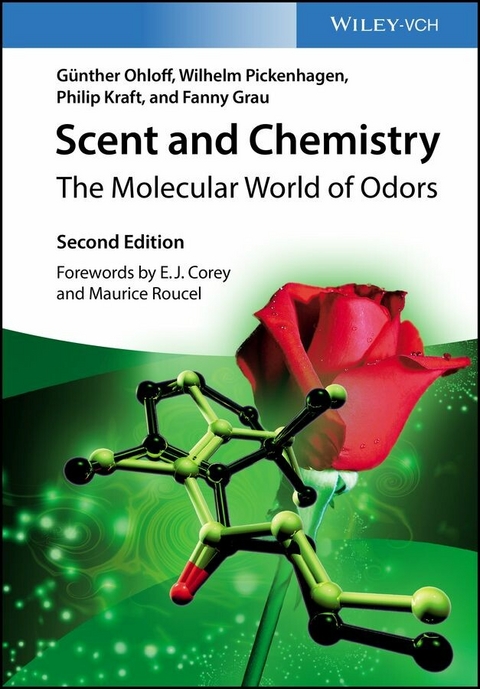
Odor impressions have cast a spell over mankind since the dim and distant past. But even today, we are -consciously or subconsciously- guided by our sense of smell and the chemistry behind it. The prominent fragrance chemists Günther Ohloff, Wilhelm Pickenhagen and Philip Kraft convey the scientist, the perfumer, and the interested layman with a vivid and up-to-date picture of the chemistry of odorants and the research in odor perception. In this second thoroughly revised and updated edition they are joined by creative perfumer Fanny Grau, a rising master in this métier, who complements the scientific treatise by a concise introduction to the art of perfumery and its composition techniques.
Besides this new chapter on the creative aspects of perfumery, the book details on the molecular basis of olfaction, olfactory characterization of perfumery materials, structure-odor relationships, the chemical synthesis of odorants, and the chemistry of essential oils and odorants from the animal kingdom, backed up by many perfume examples and historical aspects. It will serve as a thorough introductory text for everyone interested in the molecular world of odors.
Günther Ohloff (1924-2005) studied Pharmacy in Königsberg and Erlangen, as well as Chemistry at the TH Dresden. After his PhD with Heinrich Wienhaus he moved to Schimmel, Miltitz, in 1951, but left Eastern Germany in 1953 for Dragoco, Holzminden. From 1959-1962 he stayed at the Max Planck Institute, Mülheim, and then joined Firmenich, Geneva, where he was research director from 1968 until his retirement 1989. His price-awarded scientific work is documented in 228 publications and 111 patents.
Wilhelm Pickenhagen (*1939) obtained a PhD at the University of Paris with Edgar Lederer. After a fellowship with George Büchi at MIT, research chemist and then department head at Firmenich, Geneva, general manager Flavor Technology at Firmenich, Princeton, and from 1996-2003 head of corporate research of Dragoco, Holzminden. Lecturer and Honorary Professor at the University of Göttingen and lecturer at the ISIPCA Versailles. He has authored 60 scientific and 29 patent publications.
Philip Kraft (*1969) studied Chemistry at Kiel University, and obtained his PhD with Werner Tochtermann on macrocyclic musks in collaboration with H&R. In 1996, he joined the fragrance research of Givaudan and was promoted to the ranks of chief chemist (2001), group leader (2008) and research fellow (2015) with a special focus on rational odorant design. He has authored 97 publications and 38 patents, invented seven commercially successful perfumery materials, and read Fragrance Chemistry at the University of Bern, Zurich, and the ETH Zurich. In 2021, he joined Symrise, Holzminden, and now offers his Fragrance Chemistry lecture at the University of Göttingen.
Fanny Grau (*1980) studied Chemistry at the University of Toulouse and obtained her PhD in catalytic chemistry from the University of Nice. In 2007, she joined Symrise, Holzminden, as a post-doctoral researcher in odorant discovery and in 2009 started her perfumery training with Marc vom Ende, winning the Patchwork Perfumery contest. In 2012, she was promoted to perfumer and after a stay in Mexico City working in all segments, she is now focused on fine fragrances in São Paulo with a plethora of creations on the market for numerous brands.
Günther Ohloff (1924?2005) studied Pharmacy in Königsberg and Erlangen, as well as Chemistry at the TH Dresden. After his Ph.D. with Heinrich Wienhaus he moved to Schimmel, Miltitz, in 1951, but left Eastern Germany in 1953 for Dragoco, Holzminden. From 1959?1962 he stayed at the Max Planck Institute, Mülheim, and then joined Firmenich, Geneva, where he was research director from 1968 until his retirement 1989. His price-awarded scientific work is documented in 228 publications and 111 patents. Wilhelm Pickenhagen (*1939) obtained a Ph.D. at the University of Paris with Edgar Lederer. After a fellowship with George Büchi at MIT, research chemist and then department head at Firmenich, Geneva, general manager Flavor Technology at Firmenich, Princeton, and from 1996?2003 head of corporate research of Dragoco, Holzminden. Lecturer and Honorary Professor at the University of Göttingen and lecturer at the ISIPCA Versailles. He has authored 60 scientific and 29 patent publications. Philip Kraft (*1969) studied Chemistry at Kiel University, and obtained his Ph.D. with Werner Tochtermann on macrocyclic musks in collaboration with H&R. In 1996, he joined the fragrance research of Givaudan and was promoted to the ranks of chief chemist (2001), group leader (2008) and research fellow (2015) with a special focus on rational odorant design. He has authored 97 publications and 38 patents, invented seven commercially successful perfumery materials, and read Fragrance Chemistry at the University of Bern, Zurich, and the ETH Zurich. In 2021, he joined Symrise, Holzminden, and now offers his Fragrance Chemistry course at the University of Göttingen. Fanny Grau (*1980) studied Chemistry at the University of Toulouse and obtained her PhD in catalytic chemistry from the University of Nice. In 2007, she joined Symrise, Holzminden, as a post-doctoral researcher in odorant discovery and in 2009 started her perfumery training with Marc vom Ende, winning the Patchwork Perfumery contest. In 2012, she was promoted to perfumer and after a stay in Mexico City working in all segments, she is now focused on fine fragrances in São Paulo with a plethora of creations on the market for numerous brands.
Historical Aspects
The Chemical Senses
Structure-Odor Relationships
Odorants from Natural Sources
Odorants from Petrochemical Sources
Ionones, Damascones, and Iso E Super
Essential Oils
Odorants of Animal Origin
Fragrance Creation
Preface to the Second Edition
Ese olor. Reconocía ese olor de algún lugar. Y se ponía nervioso. No era olor de comida, ni el olor de los pisos cuando se enceran. No era nada que formase parte de la rutina. Lo había sentido en el pasillo alguna vez, pero era difícil saber de dónde provenía. Quizá del techo o del suelo. […] No era el olor a rancio del Papapa, ni los perfumes dulzones de la mamá ni el desodorante del papá ni el olor a sudor y barro de Sergio. Era mejor. Desesperantemente mejor. ¿De dónde vendría? Sintió un impulso desconocido y se preocupó. Sabía que era malo. […] Cosas del olor.
That smell. He recognized that smell from somewhere. And it made him nervous. It wasn't the smell of food, nor was it the smell of floors being waxed. No ordinary smell at all. He had smelled it in the hallway once, but it was hard to tell where it was coming from. Maybe from the ceiling or the floor. […] It wasn't Grandpa's rancid smell, nor was it Mom's sweet perfume, nor Dad's deodorant, nor Sergio's smell of sweat and mud. It was better. Desperately better. Where would it come from? He felt an unfamiliar urge and became worried. He knew it was bad. […] The way smells are.
Santiago Roncagliolo, ‘Pudor’ [1].
If you are (still) reading this Preface, you most likely care for smells, scents, and odors. Even more so, you are probably deeply fascinated, impressed, and excited by these, and you want to understand why the things smell the way they do. Perhaps you even want to create and design new fragrant impressions, may that be on a molecular level or by compounding perfumes from natural and/or synthetic perfumery materials. Maybe you even read the first edition of ‘Scent and Chemistry’ and crave for an updated and extended version – one with (even) more focus on perfumery? If that is the case, then we do hope that this new and revised second edition is for you!
The original German edition of ‘Riechstoffe und Geruchssinn: Die molekulare Welt der Düfte’ by Günther Ohloff [2] was published 30 years ago, and the little booklet (‘das Büchlein’ as Ohloff called it) has since become the bible for fragrance chemists and perfumistas alike, growing from 233 in the original German, and 238 in its English translation ‘Scent and Fragrances’, to 418 pages in the first English edition. What was intended as an account on the current state of our knowledge about the sense of smell and its active principles, the odorant stimuli, has consequently turned into a solid little textbook on Fragrance Chemistry.
Fragrance Chemistry is no more and no less than the foundation of olfaction, a fascinating science that comprises structure–odor correlations as well as the Organic Synthesis of these structurally diverse active olfactory principles and the knowledge of their natural occurrence and the biochemistry, neurophysiology, and psychology of odorant perception. This book is written for everyone interested in the molecular basis of odor and the relationships between chemical structures and their olfactory properties. With the ease of access, the Internet has granted everyone to perfumery materials, e.g., [3–5], virtually, everybody can now study the olfactory properties of perfumery raw materials, enjoy their fragrant sensations, and even create accords and perfumes with these. Likewise, there is a vast number of Internet sites, e.g., [6–10], on which one can order perfume decants to build up a library of olfactory families, enjoy fragrant masterpieces, or study the composition of classic creations [11]. It was therefore only too logical that one of the major wishes expressed for the next edition of ‘Scent and Chemistry’ was the addition of an introduction to the basic techniques, creation, and composition methods in perfumery. To this purpose, we are thus extremely pleased to welcome Fanny Grau, a successful perfumer with a PhD degree in Organic Chemistry who has worked in all categories and segments and is now very active in the vibrant Latin American fine fragrance market for Symrise. Not only does she know a lot about compounding and composition techniques but also on structure–odor correlations, and since she was also self‐taught before her official perfumery training with Marc vom Ende, who just took over as the head of the Symrise perfumery school and also works as research and commercial perfumer, she has an unconventional, hands‐on, or in modern speech ‘fresh‐and‐fruity’ approach to teaching perfumery techniques.
This new edition of Scent and Chemistry therefore should even be more attractive to perfumistas and scent aficionados as the entry point into the Molecular World of Odors. Since olfactory art is currently emerging as a contemporary form of art [12–15], we would be most delighted to even reach olfactory artists, art critics, and art philosophers as well as aestheticians. Perfumes as such can already be works of art [16,17], but so can be odorant molecules and their syntheses.
Since the concept of the book has proven successful over all these years, the overall structure and content outline were not changed. It was not our aim to include all new compounds or developments, such as, for instance, precursor technologies, for such an endeavor reviews such as Ref. [18] are far better suited. But those new materials and findings that we expect to make a lasting impact on perfumery were of course added, all errors were eliminated, and all figures updated – to the very best of our knowledge. In this respect, we would like to thank all the readers that spotted typos and mistakes or suggested improvements. For current market data, we are indebted to Heinz‐Jürgen Bertram, Symrise. For eliminating typos and for useful input, we are very grateful to Professor Albert Eschenmoser (Fig. 1), ETH Zurich; to Professor Konrad Tiefenbacher, University of Basel; and to Professor Ben List, Max‐Planck‐Institut für Kohlenforschung who was just awarded the Nobel prize in Chemistry “for the development of asymmetric organocatalysis.” For additional proof‐reading Philip Kraft is greatly indebted to his colleagues Johannes Panten and Alicia De Benito Cassado (both Symrise) and his student intern Anne Clisson (École Normale Supérieure de Paris, ENS Ulm). Certainly, also this edition will not be immaculate and error‐free. So, let us know about any typos, mistakes, or incorrect formulas, you come across while reading as hopefully this will not be the last edition of our compact guide into the Molecular World of Odors.
Figure 1 Letter of Albert Eschenmoser to Philip Kraft, for Christmas 2011
Can you judge a book by its odor? For ‘Scent and Chemistry’ we hope you can, both by the inspiring fragrant chemistry inside and by the odoriferous impressions it conjures while reading, and in addition we hope that the book also feels good and smells good in your hands!
August 2021
Wilhelm Pickenhagen
Philip Kraft, and Fanny Grau
Geneva, Zürich, and São Paulo
References
- 1 S. Roncagliolo, ‘Pudor’, Penguin Random House Grupo Editorial España, Barcelona, 2010, p. 35.
- 2 G. Ohloff, ‘Riechstoffe und Geruchssinn – Die molekulare Welt der Düfte’, Springer‐Verlag, Berlin and Heidelberg, 1990, 233 p.
- 3 https://pellwall.com/product-category/ingredients-for-perfumery/
- 4 https://shop.perfumersapprentice.com/
- 5 https://perfumersupplyhouse.com/
- 6 https://www.perfumersworld.com/aroma-ingredients.php
- 7 https://www.theperfumedcourt.com/
- 8 https://surrendertochance.com/perfume-decant-what-is-it/
- 9 https://www.scentsplit.com/
- 10 https://www.perfumesamplesanddecants.com/
- 11 C. Burr, ‘The Perfect Scent: A Year Inside the Perfume Industry in Paris and New York’, Henry Holt and Company, LLC, 2008, 307 p.
- 12 P. Kraft, Helv. Chim. Acta 2019, 102, e1800185.
- 13 P. de Cupere (Ed.), ‘Scent in Context | Olfactory Art’, Stockmans Publishers, Duffel, Belgium, 2016, 472 p.
- 14 C. Haley Epstein, ‘Nose Dive – A Book for the Curious Seeking Potential Through Their Noses’, Mindmarrow Publishers, Pacific Northwest, USA, 2019, 145 p.
- 15 L. Shiner, ‘Art Scents. Exploring the Aesthetics of Smell and the Olfactory Arts’, Oxford University Press, Oxford, UK, 2020, 355 p.
- 16 C. Burr, ‘The Art of Scent 1889–2012, Museum of Arts and Design, 20 October 2012–24 February 2013’, Museum of Arts and Design, New York, 2012, 28 p.
- 17 Collectif, ‘sentir, ressentir – Parfumeurs, odeurs et émotions’, Mudac – musée de design et d'arts...
| Erscheint lt. Verlag | 1.7.2022 |
|---|---|
| Sprache | englisch |
| Themenwelt | Naturwissenschaften ► Chemie |
| Schlagworte | Aromastoffe • Aromastoffe, Riechstoffe, Kosmetika • Biochemie • biochemistry • Biowissenschaften • Chemie • Chemistry • Flavor, Perfume & Cosmetic Science • Life Sciences • Organic Chemistry • Organische Chemie |
| ISBN-10 | 3-527-82998-9 / 3527829989 |
| ISBN-13 | 978-3-527-82998-9 / 9783527829989 |
| Informationen gemäß Produktsicherheitsverordnung (GPSR) | |
| Haben Sie eine Frage zum Produkt? |
 EPUB (Adobe DRM)
Kopierschutz: Adobe-DRM
Adobe-DRM ist ein Kopierschutz, der das eBook vor Mißbrauch schützen soll. Dabei wird das eBook bereits beim Download auf Ihre persönliche Adobe-ID autorisiert. Lesen können Sie das eBook dann nur auf den Geräten, welche ebenfalls auf Ihre Adobe-ID registriert sind.
Details zum Adobe-DRM
Dateiformat: EPUB (Electronic Publication)
EPUB ist ein offener Standard für eBooks und eignet sich besonders zur Darstellung von Belletristik und Sachbüchern. Der Fließtext wird dynamisch an die Display- und Schriftgröße angepasst. Auch für mobile Lesegeräte ist EPUB daher gut geeignet.
Systemvoraussetzungen:
PC/Mac: Mit einem PC oder Mac können Sie dieses eBook lesen. Sie benötigen eine
eReader: Dieses eBook kann mit (fast) allen eBook-Readern gelesen werden. Mit dem amazon-Kindle ist es aber nicht kompatibel.
Smartphone/Tablet: Egal ob Apple oder Android, dieses eBook können Sie lesen. Sie benötigen eine
Geräteliste und zusätzliche Hinweise
Buying eBooks from abroad
For tax law reasons we can sell eBooks just within Germany and Switzerland. Regrettably we cannot fulfill eBook-orders from other countries.
aus dem Bereich