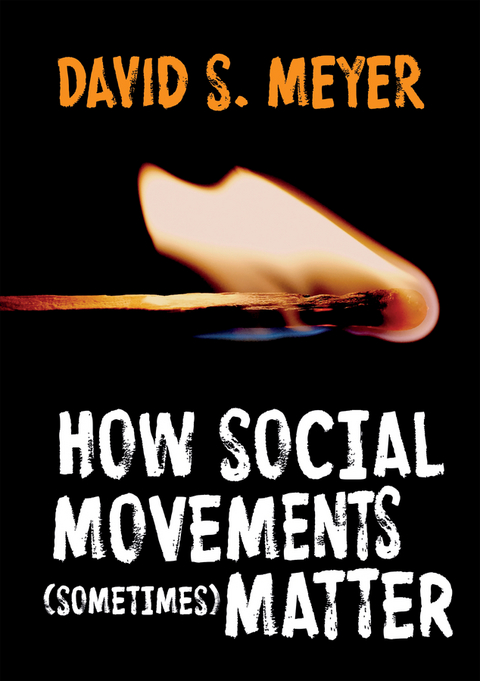
How Social Movements (Sometimes) Matter (eBook)
John Wiley & Sons (Verlag)
978-0-7456-9688-1 (ISBN)
People protest to try to change the world, because they think they can help change the world, and sometimes they do. But not by themselves, and generally not just how and when they want.
This incisive book explains how groups of ordinary individuals can affect the world, what makes it possible when it works, and why it sometimes doesn't go to plan. Digging into previous scholarship on social movements, David S. Meyer looks at the origins of social movements, how they contrast with revolutionary campaigns, and assesses the periodic influence of activists on politics, policy, culture, and the way people live their lives. He concludes by stressing the narratives about political change that activists construct and the power that lies in these stories.
With sharp insight and a wealth of intriguing cases, this book offers a fuller understanding of the politics and potential payoffs of protest politics.?
David S. Meyer is Professor of Sociology at the University of California, Irvine
People protest to try to change the world, because they think they can help change the world, and sometimes they do. But not by themselves, and generally not just how and when they want. This incisive book explains how groups of ordinary individuals can affect the world, what makes it possible when it works, and why it sometimes doesn't go to plan. Digging into previous scholarship on social movements, David S. Meyer looks at the origins of social movements, how they contrast with revolutionary campaigns, and assesses the periodic influence of activists on politics, policy, culture, and the way people live their lives. He concludes by stressing the narratives about political change that activists construct and the power that lies in these stories. With sharp insight and a wealth of intriguing cases, this book offers a fuller understanding of the politics and potential payoffs of protest politics.
David S. Meyer is Professor of Sociology at the University of California, Irvine
Introduction
Chapter 1. Why Movements Emerge and How They Work
Chapter 2. Protest, Revolution, and Regime Change
Chapter 3. Protest and Policy
Chapter 4. Protest, Organizations, and Institutionalization
Chapter 5. Protest Movements, Culture, and Participants
Chapter 6. Claiming Credit
References
"With characteristic eloquence and humor, realism and optimism, David Meyer has given us a new book about the success (sometimes) of social movements, both in America and abroad. Readers will appreciate Meyer's talent for synthesis, presenting complex arguments with clarity, and unearthing the deeper meanings behind familiar tropes. In a world that has become ever more protest-prone, Meyer's book will take its place alongside classics like Tilly's From Mobilization to Revolution and Gamson's Strategy of Social Protest."
Sidney Tarrow, author of Power in Movement
"David Meyer draws on expertise accumulated through a career studying and analyzing social movements to take the reader through the lifecycle of a social movement to understand how social movements sometimes lead to protest in the streets, revolution, political change, and all sorts of social and cultural outcomes."
Dana R. Fisher, University of Maryland
CHAPTER 1
Why Movements Emerge and How They Work
Contemporary visitors to Boston can tour the Boston Tea Party Ships and Museum, and follow a guided tour of “the event that started a Revolution”1 through a museum of the revolution, educated and entertained by actors who recreate heroic figures from America’s War of Independence. The tour ends with visitors mounting the deck of a replica of a colonial-era ship, throwing crates of tea over the side. Because the tour is pedagogical, rather than political, the crates, secured by ropes, don’t quite reach the waters of Boston Harbor. The boxes can be quickly retrieved so that the next visitor can enjoy the revolutionary experience.
The event holds an iconic place in American history. In the winter of 1773, colonists opposed to a selectively administered tax on tea – and British rule more generally – assembled by the harbor to stage a political protest. In the midst of his rally speech, rebel organizer Sam Adams signaled his supporters to act. Perhaps a hundred men who came prepared, costumed as Indians, screamed as they boarded the ships and began to throw tea over the side; they were joined by another hundred or so volunteers who had come to watch, but were inspired by the moment. More than 1,000 others watched, cheering the protesters on. Even in the drama of the moment, protesters were careful not to hurt anyone, nor to damage the ships (Griswold 1972).
The Boston Tea Party affected more than the next morning’s breakfast. Outraged and threatened, local police arrested and punished a few of the vandals they could find. And in London, Parliament instituted a series of “Coercive Acts,” intended to punish the colonists, particularly in Massachusetts. Among other insults, Parliament shut down the Boston Harbor, until the colony could pay for the tea in the sea, imposed direct British rule on the colony, and provided for the quartering of British soldiers in Massachusetts. Patriots called the response “The Intolerable Acts.”
In the short run, the Tea Party looked like a bad idea. Colonists had long opposed taxes on tea, and had found a way around them, buying untaxed smuggled tea, some of it shipped by John Hancock, who was already a major political figure in Massachusetts. The tea that ended up in the harbor, which was to be sold by the East India Company, would actually have been sold at discount, even cheaper than the smuggled tea. The tax break offered by the Crown represented Britain’s attempt to boost the company’s failing fortunes. The protest, which destroyed their goods, didn’t help. Meanwhile, tea smugglers, whose businesses were threatened by the cheaper official tea, were among those supporting the Tea Party.
Over a slightly extended time frame, however, the Tea Party further polarized politics in the colonies, increasing pressure on people to take sides. Opposition to the Intolerable Acts created additional protests over the next year, and resistance led to the first Continental Congress, held in Philadelphia the following year. That Congress petitioned King George III to end the Intolerable Acts, declared a boycott of British goods, and scheduled a second Constitutional Congress – just in case the Crown didn’t respond to the petition. It didn’t. Resistance grew in the colonies, and armed conflict between the British military erupted in the Battles of Lexington and Concord in the Spring of 1775. Shortly thereafter, the second Constitutional Congress convened, and that Congress eventually endorsed the Declaration of Independence and began to muster an armed resistance. Meanwhile, Thomas Paine (2019) published Common Sense in 1776, a series of pamphlets codifying and justifying the case for an independence movement. In this frame, the Tea Party was critical in setting into motion the events that culminated in American independence (Maier 1972).
So, we can tell a relatively coherent story in which the Tea Party was a catalyst for all that followed, including increased repression and provocation from the British, intensified organizing among the colonists both politically and militarily, and the cultivation of a liberal democratic ideology that supported an independence movement. But history didn’t begin on that December night in Boston Harbor. The circumstances that give rise to dramatic protest events, and to social movements more generally, also contribute to the broader process of social change.
We might start by acknowledging that European colonization of the United States began more than 150 years before the Boston Tea Party, and the immigrants were mostly people who were unhappy with their lives under British rule. Generations grew up in America, with British governance only a distant force in the background most of the time. The colonists built local governments and businesses, and conducted their own commerce and conflicts with each other and with the Indigenous people already occupying the continent.
The conflicts that led to the Tea Party can be traced back nearly a decade before that dramatic confrontation. In seeking to finance both current wars and debt from previous wars, King George and Parliament sought to extract as much value from their colonies as possible, imposing taxes on virtually anything that might generate revenue, starting with sugar, then adding glass, lead, paints, and paper. Britain imposed taxes on printed materials and imports generally. It also sought to exercise greater control over governance in the colonies, and maintained a large military presence in the New World. Parliament demanded that the colonists build barracks for the British soldiers and, failing that, to house them in stables, inns, and ale houses and, ultimately, in any vacant space. Parliament also held the colonists responsible for providing the funds to feed and support the British troops.
An organized resistance preceded the Tea Party. Virtually every provocation from Parliament generated a response. Political activists like Samuel Adams produced pamphlets and letters arguing that Parliament could not impose taxes on the colonies without their input. The arguments and letters circulated around the colonies, deepening the ties among the colonists, while building sympathy for the cause of independence. Britain responded with increased force; its efforts to squeeze the colonies all met with resistance, leading to the revocation of some laws, but also intensified conflict. In 1770, protest against the quartering of troops in Boston led to armed confrontation in the streets. In response to the colonists’ harassment of soldiers, British soldiers opened fire on a crowd, resulting in the death of five colonists. There was a level of conflict, often violent and disruptive, that preceded and followed the more theatrical Tea Party, but the better choreographed event has an iconic place in narratives of American history that often edit out more violent events (Schiff 2020).
The point is that a decade of disruption preceded the Tea Party and the Revolution; speeches and pamphlets, intensified by long discussions in parliaments and taverns, occupied a far larger part of the process of building support than the drama of a costumed attack on commerce – even though the Tea Party makes a better story in a history book. Over the period of growing resistance, support for British governance faded in the colonies, a response to both organizing in America and repeated incursions by the British. Efforts to deepen the ties among the colonies, which traced back at least 20 years before the Tea Party, gradually found greater support, as British policy gave the colonists a common enemy. To make sense of the growth of the independence movement and the Tea Party in particular, we need to understand the context in which it developed.
I don’t mean here to provide a comprehensive account of the American Revolution; rather, I want to use this movement to point out the necessity of putting any movement effort in a broader historical and political context. From the example of the Tea Party, we can identify factors that are critical to the emergence, organization, and impact of any significant social movement.
We want to recognize that most people don’t protest most of the time. Although a few committed organizers are virtually always trying to recruit others to their causes, most people think about their personal commitments and aspirations far more than they attend to larger issues of social change. Movements grow and gain the potential of influence when they engage large numbers of people who would otherwise be consumed with work, family and friends, and the pressures and possibilities of everyday life. Protest and political engagement come with some cost, and we have to pay attention to the circumstances under which people will take on the extra work of trying to change their world, rather than just live in it. Most people add social movement participation to their agendas only when they think that something’s wrong, it’s fixable, and that protest might matter.
Social Movements, Events, and Political Context
The world outside a movement is critical to how much that movement can grow, and we can think about that world as offering a set of political opportunities (McAdam 1982; Meyer 2004; Tarrow 2011; Tilly 1978). Potential participants in a social movement look at the world around them when they decide how to respond to an invitation to act. They need to believe that a cause is actionable, and that it’s possible – or safe enough – to join with...
| Erscheint lt. Verlag | 28.5.2021 |
|---|---|
| Sprache | englisch |
| Themenwelt | Naturwissenschaften ► Chemie |
| Sozialwissenschaften ► Politik / Verwaltung | |
| Schlagworte | activism • Activists • contentious politics • Gesellschaftliche Bewegungen, Bürgerbewegungen • movements • Political Science • Political Sociology • Politikwissenschaft • Politische Soziologie • Protest • Revolution • Social Action • social change • Social Movements • Social Movements / Activism • social movement society • social movements studies • Social Movement Studies • Social Policy • Social Policy & Welfare • social unrest • Sociology • Sozialpolitik • Sozialpolitik u. Wohlfahrt • Soziologie • Unintended Consequences |
| ISBN-10 | 0-7456-9688-0 / 0745696880 |
| ISBN-13 | 978-0-7456-9688-1 / 9780745696881 |
| Informationen gemäß Produktsicherheitsverordnung (GPSR) | |
| Haben Sie eine Frage zum Produkt? |
 EPUB (Adobe DRM)
Kopierschutz: Adobe-DRM
Adobe-DRM ist ein Kopierschutz, der das eBook vor Mißbrauch schützen soll. Dabei wird das eBook bereits beim Download auf Ihre persönliche Adobe-ID autorisiert. Lesen können Sie das eBook dann nur auf den Geräten, welche ebenfalls auf Ihre Adobe-ID registriert sind.
Details zum Adobe-DRM
Dateiformat: EPUB (Electronic Publication)
EPUB ist ein offener Standard für eBooks und eignet sich besonders zur Darstellung von Belletristik und Sachbüchern. Der Fließtext wird dynamisch an die Display- und Schriftgröße angepasst. Auch für mobile Lesegeräte ist EPUB daher gut geeignet.
Systemvoraussetzungen:
PC/Mac: Mit einem PC oder Mac können Sie dieses eBook lesen. Sie benötigen eine
eReader: Dieses eBook kann mit (fast) allen eBook-Readern gelesen werden. Mit dem amazon-Kindle ist es aber nicht kompatibel.
Smartphone/Tablet: Egal ob Apple oder Android, dieses eBook können Sie lesen. Sie benötigen eine
Geräteliste und zusätzliche Hinweise
Buying eBooks from abroad
For tax law reasons we can sell eBooks just within Germany and Switzerland. Regrettably we cannot fulfill eBook-orders from other countries.
aus dem Bereich