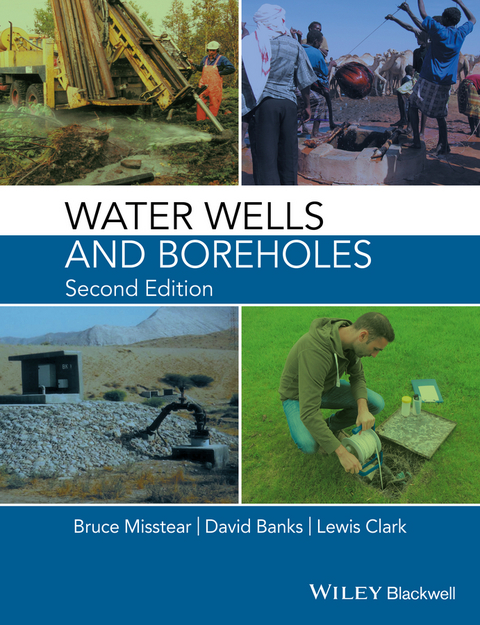
Water Wells and Boreholes (eBook)
John Wiley & Sons (Verlag)
9781118951699 (ISBN)
Water Wells and Boreholes focuses on wells that are used for drinking, industry, agriculture or other supply purposes. Other types of wells and boreholes are also covered, including boreholes for monitoring groundwater level and groundwater quality. This fully revised second edition updates and expands the content of the original book whilst maintaining its practical emphasis. The book follows a life-cycle approach to water wells, from identifying a suitable well site through to successful implementation, operation and maintenance of the well, to its eventual decommissioning.
Completely revised and updated throughout, Water Wells and Boreholes, Second edition, is the ideal reference for final-year undergraduate students in geology and civil engineering; graduate students in hydrogeology, civil engineering and environmental sciences; research students who use well data in their research; professionals in hydrogeology, water engineering, environmental engineering and geotechnical engineering; and aid workers and others involved in well projects.
Bruce Misstear teaches hydrogeology at Trinity College Dublin, where he is a Fellow of the College. He previously worked for an international firm of consulting engineers, carrying out groundwater development projects in many countries in Europe, Africa, the Middle East and Asia. His current research interests include groundwater pollution, aquifer recharge and groundwater engineering.
David Banks is a consulting hydrogeologist with Holymoor Consultancy Ltd in the UK and is a Research Fellow at the University of Glasgow. His particular interests include mine water, hydrochemistry and ground source heat. He has worked extensively internationally in Scandinavia, Eastern Europe, Russia, Central Asia, South America and Africa.
The late Lewis Clark worked for many years with the Water Research Centre in the UK before setting up his own consultancy. He was involved in many groundwater projects internationally, especially in Europe, Africa and Asia. He was also a Visiting Professor in Hydrogeology at University College London.
Water Wells and Boreholes focuses on wells that are used for drinking, industry, agriculture or other supply purposes. Other types of wells and boreholes are also covered, including boreholes for monitoring groundwater level and groundwater quality. This fully revised second edition updates and expands the content of the original book whilst maintaining its practical emphasis. The book follows a life-cycle approach to water wells, from identifying a suitable well site through to successful implementation, operation and maintenance of the well, to its eventual decommissioning. Completely revised and updated throughout, Water Wells and Boreholes, Second edition, is the ideal reference for final-year undergraduate students in geology and civil engineering; graduate students in hydrogeology, civil engineering and environmental sciences; research students who use well data in their research; professionals in hydrogeology, water engineering, environmental engineering and geotechnical engineering; and aid workers and others involved in well projects.
Bruce Misstear teaches hydrogeology at Trinity College Dublin, where he is a Fellow of the College. He previously worked for an international firm of consulting engineers, carrying out groundwater development projects in many countries in Europe, Africa, the Middle East and Asia. His current research interests include groundwater pollution, aquifer recharge and groundwater engineering. David Banks is a consulting hydrogeologist with Holymoor Consultancy Ltd in the UK and is a Research Fellow at the University of Glasgow. His particular interests include mine water, hydrochemistry and ground source heat. He has worked extensively internationally in Scandinavia, Eastern Europe, Russia, Central Asia, South America and Africa. The late Lewis Clark worked for many years with the Water Research Centre in the UK before setting up his own consultancy. He was involved in many groundwater projects internationally, especially in Europe, Africa and Asia. He was also a Visiting Professor in Hydrogeology at University College London.
Title Page 5
Copyright Page 6
Contents 7
Preface to Second Edition 12
Preface to First Edition 13
Lewis Clark (1937–2004):: An Appreciation 15
Acknowledgements 16
Chapter 1 Introduction 17
1.1 Wells and boreholes 17
1.2 Groundwater occurrence 21
1.2.1 Aquifers, aquicludes and aquitards 21
1.2.2 Porosity and aquifer storage 28
1.3 Groundwater flow 33
1.3.1 Darcy’s equation 33
1.3.2 General equations of groundwater flow 37
1.3.3 Radial flow to wells 41
Chapter 2 Groundwater Investigations for Locating Well Sites 44
2.1 Desk studies 47
2.2 Field reconnaissance 51
2.3 Well survey 52
2.4 Geophysical surveys 57
2.4.1 Electrical resistivity 58
2.4.2 Electromagnetics 65
2.5 Drilling investigations 68
2.6 Groundwater resources assessment 75
2.6.1 Inflow estimation: direct recharge 77
2.6.2 Inflow estimation: indirect recharge 80
2.6.3 Aquifer response analysis 81
2.6.4 Outflow estimation 82
2.6.5 Catchment water balance and modelling 82
2.7 Groundwater quality 85
2.7.1 Introduction 85
2.7.2 Chemical composition of groundwater 85
2.7.3 Groundwater for potable supply 88
2.7.4 Groundwater for irrigation 93
2.8 Pollution risk assessment and prevention 94
2.8.1 Groundwater vulnerability 95
2.8.2 Wellhead protection areas 97
2.8.3 Estimating the pollution risk for a new well site 101
2.9 Planning the well scheme 103
Chapter 3 An Introduction to Well and Borehole Design 107
3.1 Drilled wells 107
3.1.1 General design principles 107
3.1.2 Wells in crystalline aquifers 112
3.1.3 Wells in consolidated aquifers 116
3.1.4 Wells in unconsolidated aquifers 120
3.1.5 Economic considerations in well design 123
3.2 Hand-dug wells 125
3.2.1 Design for yield 129
3.2.2 Design for health 130
3.3 Infiltration galleries 132
3.4 Radial collector wells 136
3.5 Observation boreholes 136
3.6 Exploration boreholes 141
3.7 Pump selection 141
3.7.1 Vertical turbine pumps 144
3.7.2 Electrical submersible pumps 145
3.7.3 Motorized suction pumps 149
3.7.4 Helical rotor pumps 150
3.7.5 Hand pumps 151
Chapter 4 Issues in Well Design and Specialist Applications 156
4.1 Choice of construction materials 156
4.1.1 Strength 157
4.1.2 Jointing system 157
4.1.3 Durability 159
4.1.4 Chemical inertness 159
4.1.5 Standards 160
4.2 Casing 161
4.2.1 Steel casing 161
4.2.2 Plastic and fibreglass casing 162
4.3 Screen 163
4.3.1 Slot design and open area 163
4.3.2 Slot width 165
4.4 Gravel pack design 166
4.4.1 Natural gravel pack 166
4.4.2 Artificial gravel pack 167
4.5 Hydraulic design 170
4.5.1 Partial penetration effects 172
4.5.2 The damage zone and well bore skin 174
4.5.3 Gravel pack loss 175
4.5.4 Screen entrance loss 175
4.5.5 Well upflow losses 178
4.6 Economic optimization of well design 183
4.6.1 General principles 183
4.6.2 Example 184
4.7 Groundwater and wells for heating and cooling 187
4.7.1 Groundwater for cooling 188
4.7.2 Heating with groundwater: geothermal fluids 189
4.7.3 Heating with groundwater: heat pumps 190
4.7.4 Well configurations 191
4.8 Well doublets 193
4.8.1 Hydraulic equations 194
4.8.2 Feedback and breakthrough 194
4.8.3 Water chemistry 195
4.9 Recharge wells 196
4.9.1 Purpose 196
4.9.2 Construction of injection wells 198
4.9.3 Installations 199
4.9.4 Testing and operation 200
4.9.5 Clogging of recharge wells 200
4.9.6 Seismic risk from water injection 204
4.10 Aquifer storage and recovery 204
Chapter 5 Well and Borehole Construction 207
5.1 Percussion (cable-tool) drilling 209
5.1.1 Drilling in hard-rock formations 212
5.1.2 Drilling in soft, unstable formations 214
5.1.3 Light-percussion drilling 217
5.2 Rotary drilling 218
5.2.1 Direct circulation rotary 218
5.2.2 Fluids used in direct circulation rotary drilling 224
5.2.3 Reverse circulation 228
5.2.4 Top-hole and down-the-hole hammer drilling 231
5.2.5 Dual rotary 233
5.2.6 Borehole testing during drilling 234
5.2.7 Methods of casing and screen installation 236
5.3 Sonic drilling 237
5.4 Auger drilling 238
5.5 Jetting 239
5.6 Direct push and drive sampling 240
5.7 Driving of well?points 242
5.8 Manual construction 242
5.9 Well development 244
5.9.1 Well and aquifer damage 245
5.9.2 Developing the well 245
5.9.3 Developing the aquifer around the well 245
5.9.4 Methods of development 247
5.9.5 Disinfecting the well 256
5.10 Wellhead completion 256
Chapter 6 Formation Sampling and Identification 260
6.1 Observing the drilling process 260
6.1.1 Observing the drilling process in hard?rock aquifers 263
6.2 Collecting formation samples 264
6.2.1 Disturbed formation sampling 264
6.2.2 Undisturbed formation sampling 272
6.3 Description and analysis of drilling samples 276
6.3.1 Characterizing disturbed samples 277
6.3.2 Characterization of representative samples 277
6.3.3 Characterization of undisturbed samples 283
6.4 Downhole geophysical logging 285
6.4.1 The geophysical logging package 286
6.4.2 Organizing a geophysical logging mission 291
6.4.3 On arriving on site 291
6.4.4 Formation logs 292
6.4.5 Fluid logs 299
6.4.6 Well construction logs 303
6.5 Downhole geophysical imaging 303
6.6 Distributed (fibre-optic) temperature sensing (DTS) 306
6.7 Preparing a composite well log 308
Chapter 7 Well and Borehole Testing 311
7.1 Objectives of test pumping 311
7.1.1 Well performance 311
7.1.2 Water quality 312
7.1.3 Sustainability 312
7.1.4 Environmental impacts 314
7.1.5 Aquifer properties 314
7.2 Planning a well pumping test 314
7.2.1 Before starting 314
7.2.2 When to test pump 317
7.2.3 Consents and permissions 317
7.2.4 Equipment 318
7.2.5 The observation network 324
7.2.6 Recording of data 329
7.3 Types of pumping test 331
7.3.1 Dimension pumping 331
7.3.2 The step test 331
7.3.3 Medium to long-term (constant rate) test 332
7.3.4 Recovery test 333
7.4 Analysis of test pumping data from single wells 333
7.4.1 Fundamentals 333
7.4.2 The misuse of test pumping analysis 334
7.4.3 Well performance – the step test 336
7.4.4 Steady state analyses 339
7.4.5 Time-variant analysis 342
7.4.6 Analysis of recovery tests 347
7.5 Multiple wells 350
7.5.1 Steady state analysis of multiple pumping wells 350
7.5.2 Time-variant analysis of multiple wells 350
7.5.3 Application of the Cooper-Jacob approximation to multiple wells 350
7.6 The shape of the yield-drawdown curve: Deviations from the ideal response 351
7.6.1 A non-infinite aquifer: Presence of an impermeable barrier 352
7.6.2 Recharge during a pumping test 352
7.6.3 Unconfined aquifers: Delayed yield 355
7.6.4 Poroelasticity, subsidence and the ‘Noordbergum Effect’ 357
7.6.5 Large diameter wells 357
7.6.6 Diagnostic plots 358
7.7 Interpretation of pumping and recovery test data in hard-rock aquifers 360
7.7.1 High yielding hard-rock wells 361
7.7.2 Low-yielding hard-rock wells 362
7.7.3 Sustainable yield of hard-rock wells 364
7.8 Single borehole tests: slug tests 366
7.8.1 Slug tests 366
7.8.2 Packer testing 368
7.9 Tracer tests 369
7.10 Geophysical logging during pumping tests 371
7.11 Test pumping a major well field: the Gatehampton case study 372
7.12 Record-keeping 375
Chapter 8 Groundwater Sampling and Analysis 377
8.1 Water quality parameters and sampling objectives 379
8.1.1 Master variables 379
8.1.2 Main physicochemical parameters 379
8.1.3 Major ions 380
8.1.4 Drinking water 381
8.1.5 Water for agricultural and industrial purposes 383
8.1.6 Pollution-related parameters 383
8.1.7 Indicator parameters 385
8.1.8 Microbiological quality and indicator parameters 386
8.2 Field determinations 389
8.2.1 The purpose of field determinations 389
8.2.2 Downhole sondes and throughflow cells 390
8.2.3 Field kits for other parameters 391
8.2.4 Emergency water supply 393
8.3 Collecting water samples from production wells 396
8.3.1 The sample line 396
8.3.2 When to sample: well testing 396
8.3.3 When to sample: production wells 398
8.4 Collecting water samples from observation boreholes 399
8.4.1 Preparation for sampling 399
8.4.2 Bailers and depth samplers 400
8.4.3 Simple pumps 402
8.4.4 Submersible pumps 402
8.4.5 Other pumps 403
8.4.6 Sampling at specific depths 405
8.4.7 Sampling for non-aqueous phase liquids 407
8.5 Sample filtration, preservation and packaging 408
8.5.1 Sampling order 410
8.5.2 Physicochemical parameters 410
8.5.3 Microbial parameters 412
8.5.4 Inorganic parameters: acidification and filtration 413
8.5.5 Inorganic parameters: sampling 416
8.5.6 Organic parameters 416
8.5.7 Stable isotopes 419
8.5.8 Dissolved gases 420
8.6 Packing and labelling samples 422
8.7 Quality control and record keeping 423
8.8 Sample chemical analysis 424
8.9 Hydrochemical databases 428
Chapter 9 Well Monitoring and Maintenance 430
9.1 Factors affecting well system performance 431
9.1.1 Physical processes 431
9.1.2 Chemical processes 432
9.1.3 Microbiological processes 437
9.1.4 Well design and construction 439
9.1.5 Well system operation 439
9.2 Monitoring well system performance 440
9.2.1 Monitoring well performance 441
9.2.2 Well inspection tools 449
9.2.3 Pump performance 450
9.2.4 Water quality monitoring 452
9.2.5 Monitoring microbial processes 452
9.3 Well maintenance and rehabilitation measures 453
9.4 Well decommissioning 459
Chapter 10 Well and Borehole Records 462
10.1 Well archives 462
10.2 Operational well databases 463
10.3 An example of a hydrogeological database – Afghanistan 470
Appendix 1 Units and Conversion Tables 474
Appendix 2 Hydraulic Equations for Groundwater Engineers 476
A2.1 Energy requirements 476
A2.2 Turbulence 476
A2.2.1 Reynolds number (Re) for flow in pipes 476
A2.2.2 Hydraulic diameter of a pipe 476
A2.2.3 Turbulent flow in porous media 477
A2.3 Pressure Loss in Pipes 478
A2.3.1 Pressure loss by height gain in pipes 478
A2.3.2 Pressure loss by component resistancein pipes 478
A2.3.3 Pressure loss by friction in pipes 478
A2.3.4 Pressure loss by friction in rough pipes 478
A2.3.5 Pressure loss by friction in smoothcircular pipes 478
A2.3.6 The Hazen-Williams equation 479
Appendix 3 Health and Safety Plans 480
A3.1 Scope of a health and safety planfor a water well project 480
A3.2 Risk assessment 481
Appendix 4 World Health Organization Drinking Water Guidelines 483
Appendix 5 FAO Irrigation Water Quality Guidelines 489
References 491
Index 522
EULA 535
"This book is important. There are now many books on hydrogeology and groundwater, but there are very few that deal with the most essential fundamental part of hydrogeology. Whether you work in the field, lab or office, you need to know how to get into the subsurface, and how to make observations and take measurements that enable an understanding of the characteristics of the groundwater flow and bio-chemical system in the rocks and soils." (David Ball, Irish Groundwater Newsletter, Issue 55, May 2017)
"An excellent resource for the geologist-in-training as well as the seasoned groundwater professional." (Michael Schnieders, Groundwater, April 2018)
| Erscheint lt. Verlag | 27.2.2017 |
|---|---|
| Sprache | englisch |
| Themenwelt | Naturwissenschaften ► Biologie ► Ökologie / Naturschutz |
| Naturwissenschaften ► Geowissenschaften ► Geologie | |
| Naturwissenschaften ► Geowissenschaften ► Hydrologie / Ozeanografie | |
| Technik ► Bauwesen | |
| Technik ► Umwelttechnik / Biotechnologie | |
| Schlagworte | Appreciation • Balance • Bauingenieur- u. Bauwesen • Catchment • Civil Engineering & Construction • Clark • earth sciences • Edition • Environmental Science • Environmental Studies • Equations • estimation • First • flow • General • Geowissenschaften • groundwater • Groundwater Investigations • Hydrological Sciences • Hydrologie • Hydrologie im Bauwesen • Hydrology (Civil Engineering) • Introduction • Lewis • preface • radial • sites • Studies • Survey • Surveys • Umweltforschung • Umweltwissenschaften |
| ISBN-13 | 9781118951699 / 9781118951699 |
| Informationen gemäß Produktsicherheitsverordnung (GPSR) | |
| Haben Sie eine Frage zum Produkt? |
 PDF (Adobe DRM)
Kopierschutz: Adobe-DRM
Adobe-DRM ist ein Kopierschutz, der das eBook vor Mißbrauch schützen soll. Dabei wird das eBook bereits beim Download auf Ihre persönliche Adobe-ID autorisiert. Lesen können Sie das eBook dann nur auf den Geräten, welche ebenfalls auf Ihre Adobe-ID registriert sind.
Details zum Adobe-DRM
Dateiformat: PDF (Portable Document Format)
Mit einem festen Seitenlayout eignet sich die PDF besonders für Fachbücher mit Spalten, Tabellen und Abbildungen. Eine PDF kann auf fast allen Geräten angezeigt werden, ist aber für kleine Displays (Smartphone, eReader) nur eingeschränkt geeignet.
Systemvoraussetzungen:
PC/Mac: Mit einem PC oder Mac können Sie dieses eBook lesen. Sie benötigen eine
eReader: Dieses eBook kann mit (fast) allen eBook-Readern gelesen werden. Mit dem amazon-Kindle ist es aber nicht kompatibel.
Smartphone/Tablet: Egal ob Apple oder Android, dieses eBook können Sie lesen. Sie benötigen eine
Geräteliste und zusätzliche Hinweise
Buying eBooks from abroad
For tax law reasons we can sell eBooks just within Germany and Switzerland. Regrettably we cannot fulfill eBook-orders from other countries.
aus dem Bereich