


Mechanical Vibrations (eBook)
John Wiley & Sons (Verlag)
978-1-118-90019-2 (ISBN)
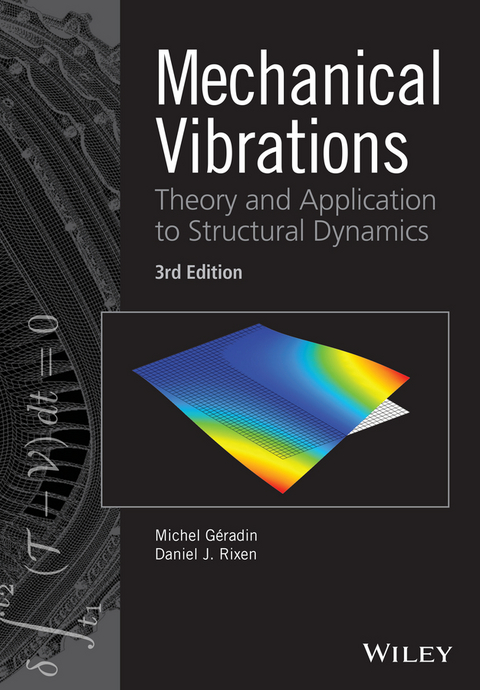
Mechanical Vibrations: Theory and Application to Structural Dynamics, Third Edition is a comprehensively updated new edition of the popular textbook. It presents the theory of vibrations in the context of structural analysis and covers applications in mechanical and aerospace engineering.
Key features include:
- A systematic approach to dynamic reduction and substructuring, based on duality between mechanical and admittance concepts
- An introduction to experimental modal analysis and identification methods
- An improved, more physical presentation of wave propagation phenomena
- A comprehensive presentation of current practice for solving large eigenproblems, focusing on the efficient linear solution of large, sparse and possibly singular systems
- A deeply revised description of time integration schemes, providing framework for the rigorous accuracy/stability analysis of now widely used algorithms such as HHT and Generalized-?
- Solved exercises and end of chapter homework problems
- A companion website hosting supplementary material
Michel Géradin holds an Engineering Degree in Physics and a PhD from ULg (University of Liège, Belgium). Successively he has been a research fellow from the Belgian FNRS (1968-1979), Professor of Structural Dynamics at ULg (1979-2010) and Unit Head of the European Laboratory for Structural Assessment (ELSA) of the JRC (European Commission Ispra, Italy) (1997-2010). He has also been a Visiting Scholar at Stanford University (1973-1974) and Visiting Professor at the University of Colorado (1986-1987).
He developed research activity in finite element methodology, computational methods in structural dynamics and multibody dynamics. He has been a co-author of the finite element software SAMCEF and co-founding member of Samtech SA in 1986.
He is Doctor Honoris Causa at the Technical University of Lisbon (1996) and École Centrale de Nantes (2007), and an Associate Member of the Royal Academy of Sciences of Belgium (2000).
He is the co-author of Flexible Multibody Dynamics. A Finite Element Approach (Wiley, 2000).
Daniel Rixen holds an MSc in Aerospace Vehicle Design from the College of Aeronautics in Cranfield (UK) and received his Mechanical Engineering and Doctorate degree from the University of Liège (Belgium) supported by the Belgium National Research Fund. After having spent two years as researcher at the Center for Aerospace Structures (University of Colorado, Boulder) between 2000 and 2012 he chaired the Engineering Dynamic group at the Delft University of Technology (The Netherlands). Since 2012 he heads the Institute for Applied Mechanics at the Technische Universität München (Germany). Next to teaching, his passion comprises research on numerical and simulation methods as well as experimental techniques, involving structural and multiphysical applications in e.g. aerospace, automotive, mechatronics, biodynamics and wind energy. A recurring aspect in his investigation is the interaction between system components such as in domain decomposition for parallel computing or component synthesis in dynamic model reduction and in experimental substructuring.
Mechanical Vibrations: Theory and Application to Structural Dynamics, Third Edition is a comprehensively updated new edition of the popular textbook. It presents the theory of vibrations in the context of structural analysis and covers applications in mechanical and aerospace engineering. Key features include: A systematic approach to dynamic reduction and substructuring, based on duality between mechanical and admittance concepts An introduction to experimental modal analysis and identification methods An improved, more physical presentation of wave propagation phenomena A comprehensive presentation of current practice for solving large eigenproblems, focusing on the efficient linear solution of large, sparse and possibly singular systems A deeply revised description of time integration schemes, providing framework for the rigorous accuracy/stability analysis of now widely used algorithms such as HHT and Generalized- Solved exercises and end of chapter homework problems A companion website hosting supplementary material
Michel Géradin holds an Engineering Degree in Physics and a PhD from ULg (University of Liège, Belgium). Successively he has been a research fellow from the Belgian FNRS (1968-1979), Professor of Structural Dynamics at ULg (1979-2010) and Unit Head of the European Laboratory for Structural Assessment (ELSA) of the JRC (European Commission Ispra, Italy) (1997-2010). He has also been a Visiting Scholar at Stanford University (1973-1974) and Visiting Professor at the University of Colorado (1986-1987). He developed research activity in finite element methodology, computational methods in structural dynamics and multibody dynamics. He has been a co-author of the finite element software SAMCEF and co-founding member of Samtech SA in 1986. He is Doctor Honoris Causa at the Technical University of Lisbon (1996) and École Centrale de Nantes (2007), and an Associate Member of the Royal Academy of Sciences of Belgium (2000). He is the co-author of Flexible Multibody Dynamics. A Finite Element Approach (Wiley, 2000). Daniel Rixen holds an MSc in Aerospace Vehicle Design from the College of Aeronautics in Cranfield (UK) and received his Mechanical Engineering and Doctorate degree from the University of Liège (Belgium) supported by the Belgium National Research Fund. After having spent two years as researcher at the Center for Aerospace Structures (University of Colorado, Boulder) between 2000 and 2012 he chaired the Engineering Dynamic group at the Delft University of Technology (The Netherlands). Since 2012 he heads the Institute for Applied Mechanics at the Technische Universität München (Germany). Next to teaching, his passion comprises research on numerical and simulation methods as well as experimental techniques, involving structural and multiphysical applications in e.g. aerospace, automotive, mechatronics, biodynamics and wind energy. A recurring aspect in his investigation is the interaction between system components such as in domain decomposition for parallel computing or component synthesis in dynamic model reduction and in experimental substructuring.
Introduction
We owe to Lord Rayleigh the formulation of the principles relative to the theory of vibration such as they are applied and taught nowadays. In his remarkable treatise entitled Theory of Sound and published in 1877 he introduced the fundamental concept of oscillation of a linear system about an equilibrium configuration and showed the existence of vibration eigenmodes and eigenfrequencies for discrete as well as for continuous systems. His work remains valuable in many ways, even though he was concerned with acoustics rather than with structural mechanics.
Because of their constant aim to minimize the weight of flying structures, the pioneers of aeronautics were the first structural designers who needed to get vibration and structural dynamic problems under control. From the twenties onwards, aeronautical engineers had to admit the importance of the mechanics of vibration for predicting the aeroelastic behaviour of aircraft. Since then, the theory of vibration has become a significant subject in aeronautical studies. During the next forty years, they had to limit the scope of their analysis and apply methods that could be handled by the available computational means: the structural models used were either analytical or resulted from a description of the structure in terms of a small number of degrees of freedom by application of transfer or Rayleigh-Ritz techniques.
The appearance and the progressive popularization of computing hardware since 1960 have led to a reconsideration of the entire field of analysis methods for structural dynamics: the traditional methods have been replaced by matrix ones arising from the discretization of variational expressions. In particular, the tremendous advances in the finite element method for setting up structural models gave rise to the development of new computational methods to allow design engineers to cope with always increasing problem sizes.
Today, the elaboration of efficient computational models for the analysis of the dynamic behaviour of structures has become a routine task. To give an example, Figure 1 illustrates the computational prediction of the vibration modes of a stator section of an aircraft engine. The fineness of the finite element model has been adapted in this case for the needs of the associated stress analysis, the latter requiring a level of detail that is not really needed for a modal analysis. The eigenmode represented is a 3-diameter mode exhibiting a global deformation of the structure. What makes the modal analysis of such a structure very difficult is the high level of cyclic symmetry (resulting from the number of stator blades) which is responsible for the appearance of a high number of nearly equal eigenvalues.
Figure 1 Finite element model of a stator section of aircraft engine. Source: Reproduced with permission from Techspace Aero—SAFRAN Group.
Development of computing, acquisition and sensing hardware has led to a similar revolution in the field of experimental techniques for identification of vibrational characteristics of structures. For more than thirty years, experimental modal analysis techniques have been developed which are based either on force appropriation or on arbitrary excitation.
The methods for dynamic analysis, whether they are numerical or experimental, have now taken an important place everywhere in engineering. If they were rapidly accepted in disciplines such as civil engineering, mechanical design, nuclear engineering and automotive production where they are obviously needed, they have now become equally important in the design of any manufactured good, from the micro-electromechanical device to the large wind turbine.
From its origin in the early sixties, the aerospace department of the University of Liège (Belgium) has specialized mainly in structural mechanics in its education programme. This book results from more than twenty years of lecturing on the theory of vibration to the students of this branch. It is also based on experience gathered within the University of Liège's Laboratory for Aerospace Techniques in the development of computational algorithms designed for the dynamic analysis of structures by the finite element method and implemented in the structural analysis code the team of the laboratory has developed since 1965, the SAMCEF™ software.1
The content of the book is based on the lecture notes developed over the years by the first author and later formatted and augmented by one of his former students (the second author). This work reflects the teaching and research experience of both authors. In addition to his academic activity at the University of Liège, the first author has also spent several years as head of the European Laboratory for Safety Assessment at the Joint Research Centre in Ispra (Italy). The second author has accumulated until 2012 lecturing and research experience at the Delft Technical University (The Netherlands) and is currently pursuing his career at the Technische Universität München (Germany). The book has been adopted internationally as course reference in several universities.
Due to its very objective, the book has a slightly hybrid character: the concepts of vibration theory are presented mainly with the intention of applying them to dynamic analysis of structures and significant attention is paid to the corresponding methods. Even though the foundations of analytical mechanics are reviewed, a preliminary acquaintance with this subject is necessary. A good knowledge of matrix algebra and theory of complex numbers, calculus, structural mechanics and numerical analysis for linear systems is required. It is also assumed that the reader is familiar with the theory of the single-degree-of-freedom oscillator. However, the presentation of the finite element method is deliberately made simple since its study requires a course of its own. Finally, the very important fields of nonlinear vibration and random vibration have been intentionally omitted in the present text since they are highly specialized subjects.
What is new in this third edition?
Although the overall structure of the book, its organization into individual chapters and the main topics addressed, remain unchanged, this new version is the result of important revision work to achieve major improvements.
Regarding the theoretical content itself, the main changes with respect to the previous edition are the following:
- The response of an either discrete or continuous system has been the object of deep rethinking and turned out to be a thread towards the important concepts of dynamic reduction and substructuring. The latter are explained and developed, starting from the observation that the response of a part from the overall system is the result either from an excitation of its support, or from the application of a set of loads at selected points of the structure. Such duality can be exploited in at least two ways. On the one hand, it allows a system description in terms of the classical concepts of mechanical impedance or admittance. On the other hand, it naturally leads to the concept of dynamic substructuring based on an expansion of the response in terms of the spectral content of the impedance and admittance relationships.
- Experimental modal analysis is an essential ingredient in structural dynamics since it allows to confirm by experiment the structural properties predicted through numerical modelling. Therefore it was felt necessary to include in this new version of the book the essentials of signal processing and identification techniques that allow us to extract the spectral properties of a linear structure from measured dynamic responses.
- In the same spirit, the concept of eigensolution sensitivity to physical parameters has been further detailed since it is the basis for the development of appropriate numerical tools for improving the numerical model of a real dynamic system.
- The considerable evolution of the size of the structural systems to be considered for eigenvalue extraction and transient dynamic analysis in the context of large engineering projects had to be reflected and addressed properly. Models reaching the size of several millions of degrees of freedom (such as the one displayed on Figure 1) are now common practice. The efficiency of the eigenvalue solvers (such as the Lanczos method) and implicit time integrators (based on the Newmark family) depends for one part on the tuning of the algorithms themselves, but perhaps even more on the performance of the linear solvers that are used at each solution step. Therefore it was felt necessary to cover in a deeper manner the topic of linear solvers, introducing not only the principle of the algorithms but also their implementation taking into accountthe sparse character of the large sets of equations generated by finite element discretization. Much attention is also brought to the case of singular systems since they frequently occur in the context of structural dynamics.
- The link that was made in the previous edition between vibration and wave propagation did not allow the reader to easily grasp the physical nature of the wave propagation phenomena that can occur in a continuous medium. The discussion of the fundamental cases of wave propagation in solids (both in one-dimensional and three-dimensional media) has thus been reviewed and better illustrated in order to improve the didactics of the presentation.
- The presentation of the finite element method has still been limited to one-dimensional structures (bars, beams) since the main objective of the book is not to go deeply into finite...
| Erscheint lt. Verlag | 24.12.2014 |
|---|---|
| Sprache | englisch |
| Themenwelt | Naturwissenschaften ► Physik / Astronomie ► Mechanik |
| Technik ► Bauwesen | |
| Technik ► Maschinenbau | |
| Schlagworte | Admittance • Aeronautic & Aerospace Engineering • Aerospace Engineering • algorithms • application • Approach • Bauingenieur- u. Bauwesen • Baustatik u. Baumechanik • Civil Engineering • Civil Engineering & Construction • Comprehensive • Concept • dynamic • eigenproblems • Exercises • Experimental • Festkörpermechanik • Festkörpermechanik • HHT • Homework • Identification • Large • Linear • Luft- u. Raumfahrttechnik • Maschinenbau • Mechanical • mechanical engineering • Method • modal analysis • Phenomena • Problems • propagation • reduction • Singular • solid mechanics • Solution • sparse • Structural Analysis • structural dynamics • Structural engineering • Structural Theory & Structural Mechanics • Substructuring • Systematic • Systems • Textbook • theory • time integration schemes • Vibration • vibrations • Wave • Website |
| ISBN-10 | 1-118-90019-7 / 1118900197 |
| ISBN-13 | 978-1-118-90019-2 / 9781118900192 |
| Informationen gemäß Produktsicherheitsverordnung (GPSR) | |
| Haben Sie eine Frage zum Produkt? |
 EPUB (Adobe DRM)
Kopierschutz: Adobe-DRM
Adobe-DRM ist ein Kopierschutz, der das eBook vor Mißbrauch schützen soll. Dabei wird das eBook bereits beim Download auf Ihre persönliche Adobe-ID autorisiert. Lesen können Sie das eBook dann nur auf den Geräten, welche ebenfalls auf Ihre Adobe-ID registriert sind.
Details zum Adobe-DRM
Dateiformat: EPUB (Electronic Publication)
EPUB ist ein offener Standard für eBooks und eignet sich besonders zur Darstellung von Belletristik und Sachbüchern. Der Fließtext wird dynamisch an die Display- und Schriftgröße angepasst. Auch für mobile Lesegeräte ist EPUB daher gut geeignet.
Systemvoraussetzungen:
PC/Mac: Mit einem PC oder Mac können Sie dieses eBook lesen. Sie benötigen eine
eReader: Dieses eBook kann mit (fast) allen eBook-Readern gelesen werden. Mit dem amazon-Kindle ist es aber nicht kompatibel.
Smartphone/Tablet: Egal ob Apple oder Android, dieses eBook können Sie lesen. Sie benötigen eine
Geräteliste und zusätzliche Hinweise
Buying eBooks from abroad
For tax law reasons we can sell eBooks just within Germany and Switzerland. Regrettably we cannot fulfill eBook-orders from other countries.
aus dem Bereich


