


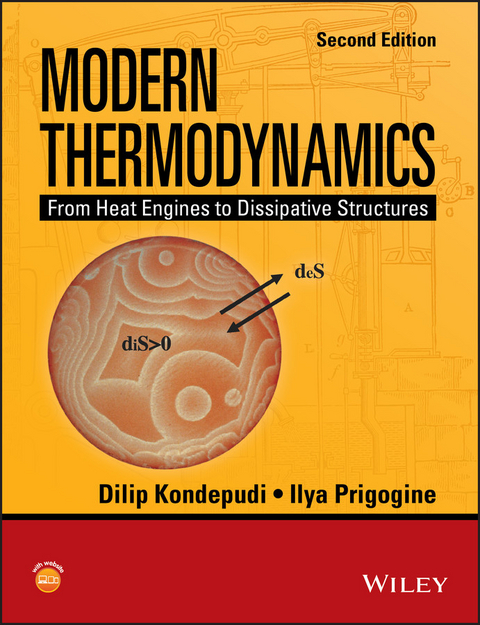
Modern Thermodynamics (eBook)
John Wiley & Sons (Verlag)
978-1-118-69870-9 (ISBN)
Modern Thermodynamics: From Heat Engines to Dissipative Structures, Second Edition presents a comprehensive introduction to 20th century thermodynamics that can be applied to both equilibrium and non-equilibrium systems, unifying what was traditionally divided into ‘thermodynamics’ and ‘kinetics’ into one theory of irreversible processes.
This comprehensive text, suitable for introductory as well as advanced courses on thermodynamics, has been widely used by chemists, physicists, engineers and geologists. Fully revised and expanded, this new edition includes the following updates and features:
• Includes a completely new chapter on Principles of Statistical Thermodynamics.
• Presents new material on solar and wind energy flows and energy flows of interest to engineering.
• Covers new material on self-organization in non-equilibrium systems and the thermodynamics of small systems.
• Highlights a wide range of applications relevant to students across physical sciences and engineering courses.
• Introduces students to computational methods using updated Mathematica codes.
• Includes problem sets to help the reader understand and apply the principles introduced throughout the text.
• Solutions to exercises and supplementary lecture material provided online at http://sites.google.com/site/modernthermodynamics/.
Modern Thermodynamics: From Heat Engines to Dissipative Structures, Second Edition is an essential resource for undergraduate and graduate students taking a course in thermodynamics.
Modern Thermodynamics: From Heat Engines to Dissipative Structures, Second Edition presents a comprehensive introduction to 20th century thermodynamics that can be applied to both equilibrium and non-equilibrium systems, unifying what was traditionally divided into thermodynamics and kinetics into one theory of irreversible processes. This comprehensive text, suitable for introductory as well as advanced courses on thermodynamics, has been widely used by chemists, physicists, engineers and geologists. Fully revised and expanded, this new edition includes the following updates and features: Includes a completely new chapter on Principles of Statistical Thermodynamics. Presents new material on solar and wind energy flows and energy flows of interest to engineering. Covers new material on self-organization in non-equilibrium systems and the thermodynamics of small systems. Highlights a wide range of applications relevant to students across physical sciences and engineering courses. Introduces students to computational methods using updated Mathematica codes. Includes problem sets to help the reader understand and apply the principles introduced throughout the text. Solutions to exercises and supplementary lecture material provided online at http://sites.google.com/site/modernthermodynamics/. Modern Thermodynamics: From Heat Engines to Dissipative Structures, Second Edition is an essential resource for undergraduate and graduate students taking a course in thermodynamics.
Dilip Kondepudi Wake Forest University, USA Ilya Prigogine Formerly Director, International Solvay Institutes, Belgium
Preface to the First Edition
Why Thermodynamics?
I
Since half a century ago, our view of Nature has changed drastically. Classical science emphasized equilibrium and stability. Now we see fluctuations, instability, evolutionary processes on all levels from chemistry and biology to cosmology. Everywhere we observe irreversible processes in which time symmetry is broken. The distinction between reversible and irreversible processes was first introduced in thermodynamics through the concept of ‘entropy’, the arrow of time, as Arthur Eddington called it. Therefore our new view of Nature leads to an increased interest in thermodynamics. Unfortunately, most introductory texts are limited to the study of equilibrium states, restricting thermodynamics to idealized, infinitely slow reversible processes. The student does not see the relationship between irreversible processes that naturally occur, such as chemical reactions and heat conduction, and the rate of increase of entropy. In this text, we present a modern formulation of thermodynamics in which the relation between the rate of increase of entropy and irreversible processes is made clear from the very outset. Equilibrium remains an interesting field of inquiry but in the present state of science, it appears essential to include irreversible processes as well.
It is the aim of this book to give a readable introduction to present-day thermodynamics, starting with its historical roots as associated with heat engines but including also the thermodynamic description of far-from-equilibrium situations. As is well known today, far-from-equilibrium situations lead to new space–time structures. For this reason the restriction to equilibrium situations hides, in our opinion, some essential features of the behavior of matter and energy. An example is the role of fluctuations. The atomic structure of matter leads to fluctuations. However, at equilibrium or near equilibrium, these fluctuations are inconsequential.
Indeed a characteristic feature of equilibrium thermodynamics is the existence of extremum principles. For isolated systems entropy increases and is therefore maximum at equilibrium. In other situations (such as constant temperature) there exist functions called thermodynamic potentials which are also extrema (that is maximum or minimum) at equilibrium. This has important consequences. A fluctuation that leads to a temporal deviation from equilibrium is followed by a response that brings back the system to the extremum of the thermodynamic potential. The equilibrium world is also a stable world. This is no longer so in far-from-equilibrium situations. Here fluctuations may be amplified by irreversible dissipative processes and lead to new space–time structures which one of us (I. Prigogine) has called ‘dissipative structures’ to distinguish them from ‘equilibrium’ structures such as crystals. Therefore distance from equilibrium becomes a parameter somewhat similar to temperature. When we lower the temperature, we go from the gaseous state to a liquid and then a solid. As we shall see, here the variety is even greater. Take the example of chemical reactions. Increasing the distance from equilibrium we may obtain in succession oscillatory reactions, new spatial periodic structures and chaotic situations in which the time behavior becomes so irregular that initially close trajectories diverge exponentially.
One aspect is common to all these nonequilibrium situations, the appearance of long-range coherence. Macroscopically distinct parts become correlated. This is in contrast to equilibrium situations where the range of correlations is determined by short-range intermolecular forces. As a result, situations that are impossible to realize at equilibrium become possible in far-from-equilibrium situations. This leads to important applications in a variety of fields. We can produce new materials in nonequilibrium situations where we escape from the restrictions imposed by the phase rule. Also, nonequilibrium structures appear at all levels in biology. We give some simple examples in Chapters 19 and the postface. It is now generally admitted that biological evolution is the combined result of Darwin's natural selection as well as of self-organization, which results from irreversible processes.
Since Ludwig Boltzmann (1844–1906) introduced a statistical definition of entropy in 1872, entropy is associated with disorder. The increase of entropy is then described as an increase of disorder, as the destruction of any coherence that may be present in the initial state. This has unfortunately led to the view that the consequences of the Second Law are self-evident, are trivial. This is, however, not true even for equilibrium thermodynamics, which leads to highly nontrivial predictions. Anyway, equilibrium thermodynamics covers only a small fraction of our everyday experience. We now understand that we cannot describe Nature around us without an appeal to nonequilibrium situations. The biosphere is maintained in nonequilibrium through the flow of energy coming from the Sun and this flow is itself the result of the nonequilibrium situation of our present state of the universe.
It is true that the information obtained from thermodynamics both for equilibrium and nonequilibrium situations is limited to a few general statements. We have to supplement them by the equation of state at equilibrium or the rate laws, such as chemical reaction rates. Still the information we obtain from thermodynamics is quite valuable precisely because of its generality.
II
Our book is subdivided into five parts. The first, Chapters 1 to 4, deals with the basic principles. The systems considered in thermodynamics are large systems (the number of particles N is a typical Avogadro number). Such systems are described by two types of variables, variables such as pressure or temperature, which are independent of the size of the system and are called ‘intensive’ variables, and variables such as the total energy, which are proportional to the number of particles (‘extensive variables’). Historically thermodynamics started with empirical observations concerning the relation between these variables (e.g. the relation between pressure and volume). This is the main subject of Chapter 1. However, the two conceptual innovations of thermodynamics are the formulation of the ‘First Law’ expressing conservation of energy (Chapter 2) and of the ‘Second Law’ introducing entropy (Chapter 3).
Ignis mutat res. Fire transforms matter; fire leads to chemical reactions, to processes such as melting and evaporation. Fire makes fuel burn and release heat. Out of all this common knowledge, nineteenth century science concentrated on the single fact that combustion produces heat and that heat may lead to an increase in volume; as a result, combustion produces work. Fire leads, therefore, to a new kind of machine, the heat engine, the technological innovation on which industrial society has been founded.
What is then the link between ‘heat’ and ‘work’? This question was at the origin of the formulation of the principle of energy conservation. Heat is of the same nature as energy. In the heat engine, heat is transferred into work but energy is conserved.
However, there was more. In 1811 Baron Jean-Joseph Fourier, the Prefect of Isère, won the prize of the French Academy of Sciences for his mathematical description of the propagation of heat in solids. The result stated by Fourier was surprisingly simple and elegant: heat flow is proportional to the gradient of temperature. It is remarkable that this simple law applies to matter, whether its state is solid, liquid or gaseous. Moreover, it remains valid whatever the chemical composition of the body, whether it is iron or gold. It is only the coefficient of proportionality between the heat flow and the gradient of temperature that is specific to each substance.
Fourier's law was the first example describing an irreversible process. There is a privileged direction of time as heat flows according to Fourier's law, from higher to lower temperature. This is in contrast with the laws of Newtonian dynamics in which the past and future play the same role (time enters only in Newton's law through a second derivative, so Newton's law is invariant in respect to time inversion). As already mentioned, it is the Second Law of thermodynamics that expresses the difference between ‘reversible’ and irreversible processes through the introduction of entropy. Irreversible processes produce entropy.
The history of the two principles of thermodynamics is a most curious one. Born in the middle of technological questions, they acquired rapidly a cosmological status. Let us indeed state the two principles as formulated by Rudolph Clausius (1822–1888) in the year 1865:
The energy of the universe is constant.
The entropy of the universe approaches a maximum.
It was the first evolutionary formulation of cosmology. This was a revolutionary statement as the existence of irreversible processes (and therefore of entropy) conflicts with the time-reversible view of dynamics. Of course, classical dynamics has been superseded by quantum theory and relativity. However, this conflict remains because, in both quantum theory and relativity, the basic dynamical laws are time-reversible.
The traditional answer to this question is to emphasize that the systems...
| Erscheint lt. Verlag | 5.11.2014 |
|---|---|
| Sprache | englisch |
| Themenwelt | Naturwissenschaften ► Chemie ► Physikalische Chemie |
| Naturwissenschaften ► Physik / Astronomie ► Thermodynamik | |
| Technik ► Maschinenbau | |
| Schlagworte | Appendix • BASIC • chemical engineering • chemical thermodynamics • Chemie • Chemische Thermodynamik • Chemische Verfahrenstechnik • Chemistry • Cosmology • der • Edition • Engines • Equation • First • gases • Heat • Instructors • Introduction • kinetic • Laws • Maschinenbau • matter • mechanical engineering • Partial • preface • Second • States • theory • thermodynamics • Thermodynamik • variables xlist • waals |
| ISBN-10 | 1-118-69870-3 / 1118698703 |
| ISBN-13 | 978-1-118-69870-9 / 9781118698709 |
| Informationen gemäß Produktsicherheitsverordnung (GPSR) | |
| Haben Sie eine Frage zum Produkt? |
 EPUB (Adobe DRM)
Kopierschutz: Adobe-DRM
Adobe-DRM ist ein Kopierschutz, der das eBook vor Mißbrauch schützen soll. Dabei wird das eBook bereits beim Download auf Ihre persönliche Adobe-ID autorisiert. Lesen können Sie das eBook dann nur auf den Geräten, welche ebenfalls auf Ihre Adobe-ID registriert sind.
Details zum Adobe-DRM
Dateiformat: EPUB (Electronic Publication)
EPUB ist ein offener Standard für eBooks und eignet sich besonders zur Darstellung von Belletristik und Sachbüchern. Der Fließtext wird dynamisch an die Display- und Schriftgröße angepasst. Auch für mobile Lesegeräte ist EPUB daher gut geeignet.
Systemvoraussetzungen:
PC/Mac: Mit einem PC oder Mac können Sie dieses eBook lesen. Sie benötigen eine
eReader: Dieses eBook kann mit (fast) allen eBook-Readern gelesen werden. Mit dem amazon-Kindle ist es aber nicht kompatibel.
Smartphone/Tablet: Egal ob Apple oder Android, dieses eBook können Sie lesen. Sie benötigen eine
Geräteliste und zusätzliche Hinweise
Buying eBooks from abroad
For tax law reasons we can sell eBooks just within Germany and Switzerland. Regrettably we cannot fulfill eBook-orders from other countries.
aus dem Bereich


