


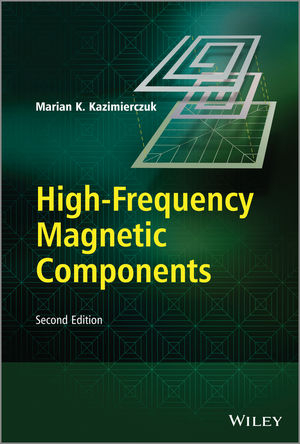
High-Frequency Magnetic Components (eBook)
760 Seiten
Wiley (Verlag)
978-1-118-71778-3 (ISBN)
A unique text on the theory and design fundaments of inductors and transformers, updated with more coverage on the optimization of magnetic devices and many new design examples
The first edition is popular among a very broad audience of readers in different areas of engineering and science. This book covers the theory and design techniques of the major types of high-frequency power inductors and transformers for a variety of applications, including switching-mode power supplies (SMPS) and resonant dc-to-ac power inverters and dc-to-dc power converters. It describes eddy-current phenomena (such as skin and proximity effects), high-frequency magnetic materials, core saturation, core losses, complex permeability, high-frequency winding resistance, winding power losses, optimization of winding conductors, integrated inductors and transformers, PCB inductors, self-capacitances, self-resonant frequency, core utilization factor area product method, and design techniques and procedures of power inductors and transformers. These components are commonly used in modern power conversion applications. The material in this book has been class-tested over many years in the author’s own courses at Wright State University, which have a high enrolment of about a hundred graduate students per term. The book presents the growing area of magnetic component research in a textbook form, covering the foundations for analysing and designing magnetic devices specifically at high-frequencies. Integrated inductors are described, and the Self-capacitance of inductors and transformers is examined. This new edition adds information on the optimization of magnetic components (Chapter 5). Chapter 2 has been expanded to provide better coverage of core losses and complex permeability, and Chapter 9 has more in-depth coverage of self-capacitances and self-resonant frequency of inductors. There is a more rigorous treatment of many concepts in all chapters. Updated end-of-chapter problems aid the readers’ learning process, with an online solutions manual available for use in the classroom.
- Provides physics-based descriptions and models of discrete inductors and transformers as well as integrated magnetic devices
- New coverage on the optimization of magnetic devices, updated information on core losses and complex permeability, and more in-depth coverage of self-capacitances and self-resonant frequency of inductors
- Many new design examples and end-of-chapter problems for the reader to test their learning
- Presents the most up-to-date and important references in the field
- Updated solutions manual, now available through a companion website
An up to date resource for Post-graduates and professors working in electrical and computer engineering. Research students in power electronics. Practising design engineers of power electronics circuits and RF (radio-frequency) power amplifiers, senior undergraduates in electrical and computer engineering, and R & D staff.
A unique text on the theory and design fundaments of inductors and transformers, updated with more coverage on the optimization of magnetic devices and many new design examples The first edition is popular among a very broad audience of readers in different areas of engineering and science. This book covers the theory and design techniques of the major types of high-frequency power inductors and transformers for a variety of applications, including switching-mode power supplies (SMPS) and resonant dc-to-ac power inverters and dc-to-dc power converters. It describes eddy-current phenomena (such as skin and proximity effects), high-frequency magnetic materials, core saturation, core losses, complex permeability, high-frequency winding resistance, winding power losses, optimization of winding conductors, integrated inductors and transformers, PCB inductors, self-capacitances, self-resonant frequency, core utilization factor area product method, and design techniques and procedures of power inductors and transformers. These components are commonly used in modern power conversion applications. The material in this book has been class-tested over many years in the author s own courses at Wright State University, which have a high enrolment of about a hundred graduate students per term. The book presents the growing area of magnetic component research in a textbook form, covering the foundations for analysing and designing magnetic devices specifically at high-frequencies. Integrated inductors are described, and the Self-capacitance of inductors and transformers is examined. This new edition adds information on the optimization of magnetic components (Chapter 5). Chapter 2 has been expanded to provide better coverage of core losses and complex permeability, and Chapter 9 has more in-depth coverage of self-capacitances and self-resonant frequency of inductors. There is a more rigorous treatment of many concepts in all chapters. Updated end-of-chapter problems aid the readers learning process, with an online solutions manual available for use in the classroom. Provides physics-based descriptions and models of discrete inductors and transformers as well as integrated magnetic devices New coverage on the optimization of magnetic devices, updated information on core losses and complex permeability, and more in-depth coverage of self-capacitances and self-resonant frequency of inductors Many new design examples and end-of-chapter problems for the reader to test their learning Presents the most up-to-date and important references in the field Updated solutions manual, now available through a companion website An up to date resource for Post-graduates and professors working in electrical and computer engineering. Research students in power electronics. Practising design engineers of power electronics circuits and RF (radio-frequency) power amplifiers, senior undergraduates in electrical and computer engineering, and R & D staff.
Professor Marian K. Kazimierczuk, Wright State University, Dayton, Ohio, USA Professor Kazimierczuk has been conducting research in the area of power electronics amplifiers for more than thirty years, twice chairing the Technical Committee of Power Electronics and Power Systems for the IEEE Circuits and Systems Society. Over twenty-two years he has taught three graduate courses in high-frequency power electronics, and has won the Excellence in Teaching Award several times. His Science Citation index is one of the highest in the field, at over 1000 citations; he owns seven patents, has published over 110 papers in the IEEE Transactions, and has published more than 150 papers in the IEEE international conferences on power conversion. An IEEE Fellow, he has served as Associate Editor for the IEEE Transactions on Circuits and Systems and is currently an Associate Editor of the IEEE Transactions on Industrial Electronics.
"What sets this book apart from previous magnetics books recently reviewed in How2Power Today is its depth of coverage, especially of topics that are hard to analyze such as winding resistance caused by the skin and proximity effects, and parasitic winding capacitances. Kazimierczuk--I'll call him "Kaz" for short, as Apple co-founder Steve Wozniak is called "Woz"--has worked out in sufficient detail the mathematical derivations of design equations that usually appear in the literature as either given (or else ignored entirely) rather than derived." (How2Power.com, 1 September 2015)
"Loaded with essential formulas and design methods, this book will give the designer of high-frequency magnetic components not only a better design but will reinforce an understanding of the high-frequency magnetic component design." (IEEE Electrical Engineering magazine, 1 March 2015)
List of Symbols
| A | Magnetic vector potential |
| Cross-sectional area of core |
| Cross-sectional area of winding cell |
| Cross-sectional area of copper |
| Specific inductance of core, inductance factor |
| Cross-sectional area of winding bare wire |
| Outer cross-sectional area of winding wire |
| Cross-sectional area of strand bare wire |
| Outer cross-sectional area of strand wire |
| Area product of core |
| Surface area of inductor or transformer |
| a | Unity vector |
| Unity vector normal to a surface |
| B | Magnetic flux density |
| DC component of magnetic flux density |
| Amplitude of the AC component of magnetic flux density |
| Residual flux density, remnant magnetization, and remnance |
| Peak value of total magnetic flux density () |
| Saturation flux density |
| Bandwidth |
| b | Breadth of winding |
| Breadth of bobbin winding window |
| C | Capacitance |
| Equivalent series-resonant capacitance |
| D | Electric flux density, DC component of on-duty cycle of switch |
| Minimum DC component of on-duty cycle of switch |
| Maximum DC component of on-duty cycle of switch |
| Inner diameter of toroidal core |
| Outer diameter of toroidal core |
| Dwell duty cycle |
| Diameter of winding bare wire |
| Outer diameter of insulated winding wire |
| Diameter of bare strand wire |
| Outer diameter of insulated strand wire |
| E | Electric field intensity |
| Electromotive force |
| F | Force |
| Fringing factor |
| Air gap factor |
| AC resistance factor |
| Harmonic AC resistance factor |
| Harmonic AC resistance factor of primary winding |
| Harmonic AC resistance factor of secondary winding |
| f | Frequency |
| Self-resonant frequency of inductor |
| Switching frequency |
| Upper 3-dB frequency |
| Lower 3-dB frequency |
| H | Magnetic field intensity |
| Coercive force |
| h | Thickness of winding conductor |
| Height of winding window of bobbin |
| DC input current of converter |
| Average or DC current through inductor L |
| Maximum current through inductor L |
| rms current through inductor L |
| Peak total current through inductor L |
| rms value of nth harmonic of inductor current |
| DC output current of converter |
| rms value of current i |
| Maximum value of DC load current |
| Minimum value of DC load current |
| i | Current |
| Inductor current |
| Current through magnetizing inductance |
| Current through primary winding |
| Current through secondary winding |
| J | Conduction current density |
| Displacement current density |
| Amplitude of current density |
| rms value of current density |
| Air factor |
| Bobbin factor |
| Air and wire insulation factor |
| Edge factor |
| Core geometry coefficient |
| Waveform factor |
| Wire insulation factor |
| Window utilization factor |
| k | Coupling coefficient, complex propagation constant |
| Magnetic path length (MPL) |
| Length of air gap |
| Mean turn length (MTL), length of turn |
| Length of winding wire |
| Length of primary winding wire |
| Length of secondary winding wire |
| L | Inductance |
| Leakage inductance |
| Magnetizing inductance of transformer |
| M | Mutual inductance |
| DC voltage transfer function of converter |
| Orbital magnetic moment |
| Spin magnetic moment |
| N | Number of turns |
| Number of layers |
| Number of layers of primary winding |
| Number of layers of secondary winding |
| Number of turns of primary winding |
| Number of turns of secondary winding |
| n | Transformer primary-to-secondary turns ratio |
| n | Unity vector normal to a surface |
| P | Power |
| Core loss |
| Core and winding power loss |
| Winding power loss |
| Winding DC power loss |
| Primary winding power loss |
| Primary winding DC power loss |
| Primary winding DC power loss with strands |
| Secondary winding power loss |
| Secondary winding DC power loss |
| Secondary winding DC power loss with strands |
| Output power of converter or amplifier |
| Core power loss per unit volume |
| Total apparent power |
| p | Winding pitch |
| Q | Quality factor |
| Loaded quality factor of resonant circuit at resonant frequency |
| Quality factor of inductor |
| Quality factor of magnetic material |
| R | Resistance |
| Core series equivalent resistance |
| Load resistance |
| Maximum load resistance |
| Minimum load resistance |
| Winding resistance |
| Winding DC resistance |
| Primary winding DC resistance |
| Primary strand winding DC resistance |
| Primary strand winding DC resistance |
| Secondary strand winding DC... |
| Erscheint lt. Verlag | 25.11.2013 |
|---|---|
| Sprache | englisch |
| Themenwelt | Naturwissenschaften ► Physik / Astronomie ► Elektrodynamik |
| Technik ► Elektrotechnik / Energietechnik | |
| Schlagworte | complex permeability • Components & Devices • Core Losses • core losses and complex permeability • core saturation • eddy-current phenomena • Electrical & Electronics Engineering • Electromagnetic theory • Elektromagnetismus • Elektrotechnik u. Elektronik • High-Frequency Magnetic Components • high-frequency magnetic materials • high-frequency winding resistance • Hochfrequenztechnik • Komponenten u. Bauelemente • Leistungselektronik • Marian K. Kazimierczuk • optimization of magnetic devices • Power Electronics • self-capacitances and self-resonant frequency of inductors • winding power losses |
| ISBN-10 | 1-118-71778-3 / 1118717783 |
| ISBN-13 | 978-1-118-71778-3 / 9781118717783 |
| Informationen gemäß Produktsicherheitsverordnung (GPSR) | |
| Haben Sie eine Frage zum Produkt? |
 EPUB (Adobe DRM)
Kopierschutz: Adobe-DRM
Adobe-DRM ist ein Kopierschutz, der das eBook vor Mißbrauch schützen soll. Dabei wird das eBook bereits beim Download auf Ihre persönliche Adobe-ID autorisiert. Lesen können Sie das eBook dann nur auf den Geräten, welche ebenfalls auf Ihre Adobe-ID registriert sind.
Details zum Adobe-DRM
Dateiformat: EPUB (Electronic Publication)
EPUB ist ein offener Standard für eBooks und eignet sich besonders zur Darstellung von Belletristik und Sachbüchern. Der Fließtext wird dynamisch an die Display- und Schriftgröße angepasst. Auch für mobile Lesegeräte ist EPUB daher gut geeignet.
Systemvoraussetzungen:
PC/Mac: Mit einem PC oder Mac können Sie dieses eBook lesen. Sie benötigen eine
eReader: Dieses eBook kann mit (fast) allen eBook-Readern gelesen werden. Mit dem amazon-Kindle ist es aber nicht kompatibel.
Smartphone/Tablet: Egal ob Apple oder Android, dieses eBook können Sie lesen. Sie benötigen eine
Geräteliste und zusätzliche Hinweise
Buying eBooks from abroad
For tax law reasons we can sell eBooks just within Germany and Switzerland. Regrettably we cannot fulfill eBook-orders from other countries.
aus dem Bereich


