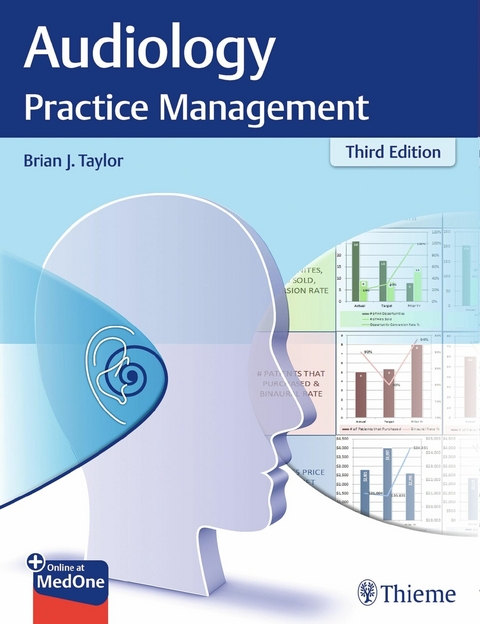
Audiology Practice Management (eBook)
326 Seiten
Georg Thieme Verlag KG
9781638533900 (ISBN)
2 An Introduction to Business Analytics, Administration, and Ethics
Brian J. Taylor
Abstract
Chapter 1 laid the foundation for effective management of an audiology-based practice by discussing some universal principles of running an organization. From soup to nuts, Chapter 2 takes the concept of effective management one step further by focusing on three essential, interconnected elements of managing a business: analytics, administration and ethics. While other practice management texts examine these three concepts in isolation, one objective of this chapter is to demonstrate how measuring processes and outcomes (analytics), hands-on oversight of the planning and measuring process (administration), and abiding by a core set of standardized principles (ethics) form the core of any sustainable organization. Additionally, Chapter 2 provides the reader with a systematic overview of various business types (e.g., LLC), the life stages of a business, and examples of actual business plans and unbundling fees for services delivered.
Keywords: the business plan, types of businesses entities, life stages of a business, profit and loss (P&L) statements, business terms for the not-so-business minded, cost of goods, gross margins, fixed vs. variable expenses, division of labor, breakeven analysis, billable hours, budgeting, unbundling, conflicts of interest, code of ethics
2.1 Introduction
Most audiologists are aware of the important role of evidence in the clinical decision-making process. The basic tenet of scientific principles, such as systematic reviews of pertinent peer reviewed studies, guides many of the critical decisions involving patients. For example, before making a recommendation of frequency lowering technology in older adults with mild to moderate hearing loss, it would be useful to evaluate the germane research in this area to see what it may (or may not) say about the effectiveness of this technology before recommending it. The inclusion of scientifically generated research into the clinical decision-making process is a multifaceted skill requiring audiologists to critically ask relevant questions, evaluate the design of studies, synthesize numerous pieces of sometimes disparate results of this research, and generate a decision about patient care—a decision that might be made based on incomplete information. Managing a business may not be quite that involved, but some of the same principles apply.
These same underlying principles used to make decisions about patient care can also be applied to running a business. The objective of this chapter is to demonstrate how data about a clinical practice can be used to improve the effectiveness of the practice. In the clinic, the word effective pertains to patient outcomes, but in the business world effective often pertains to business outcome, which is usually profit. Savvy audiologists who double as clinicians and business managers know both patient outcomes and profits are critical to long-term success. It is a matter of balancing them. This chapter will demonstrate how this can be achieved.
As this chapter will show, the process of using data starts before the business is born and continues through the life of it. This act of using data (termed analytics) to make business decision is a substantial part of the broader term, business administration. Although Chapter 1 covered some of the critical aspects of business administration, like managing a staff or using key performance indicators, this chapter is a continuation of those themes. A primary focus of this chapter will be how a practice owner or manager uses data from reports to make decisions about their business, while simultaneously juggling the responsibility of practicing with high ethical standards.
Because audiology is a unique blend of the medical and retail business models, ethics are a critical part of the discussion here. To make money in your practice, you are likely asking people to pay out of pocket for products and services you provide in your practice. At the same time, much of the testing conducted in an audiology clinic, especially with a new patient, is used to identify or rule out a medical condition. Direct involvement in medical decisions coupled with the need to “sell” something warrants a keen understanding of ethical behavior, which is tackled at the end of this chapter.
If you are a clinician who is not savvy to the world of business, it helps to start with a simple definition of the term administration. Business administration covers all parts of managing day-to-day operations and decision-making for an organization. It includes efficient organization and management of employees, items that were covered in Chapter 1. In addition, many other skills and resources needed to successfully operate a business will be addressed here. This chapter will start by examining the various types of corporations and the details of creating a business plan. The second half of the chapter will then take a deep dive into how to read various reports that are needed to operate a sustainable business. Let us get started by reviewing a topic you need to know about before you even start writing a business plan: types of business entities.
2.2 Types of Business Entities
Whether you are just starting your audiology practice or have been in business for a while, the type of entity you are operating under can have both a financial and a legal impact. A good fit for one practice may not be a good fit for another, as no two businesses are exactly alike. Asking yourself the following questions can help you begin the entity selection process:
• How large do I expect the business to become?
• Who will be the owners in my business?
• What are my financial goals over the next 3, 5, and 15 years?
• How much is it going to cost to organize and maintain the entity?
• How do I manage my tax obligations?
These are just a few of the critical questions that one has to ask in the early planning stages of building a practice. Seeking out sound advice from an expert, such as a certified public accountant or attorney, ensures that other critical questions are addressed by an expert and are beyond the scope of this chapter. There are a variety of business entity options. Each comes with its own advantages and disadvantages. Table 2.1 summarizes the most common entity choices, along with a summary of their respective characteristics.
Having the wrong entity in place can curtail profits and impact cash flows. For example, business owners often have difficulty budgeting for tax liabilities that may be owed throughout the year (estimated tax payments), and at year-end. Not making estimated tax payments throughout the year can create a cash crunch at year-end or when filing the required tax returns. Utilizing an S Corporation may alleviate this burden, as it requires a salary and withholding of taxes. This reduces the estimated tax payments and/or balances that might be due when filing the annual tax returns.
Operating an entity such as a proprietorship, LLC (limited liability company), or LLP (limited liability partnership) that requires payment of self-employment taxes and, in turn, higher quarterly estimates, requires a strict payment schedule. All too often, business owners put their estimated tax payments on hold and pay other liabilities first. This causes a financial stress when their actual return is being filed, and there is a balance due. Once they fall behind, catching up with the past tax bill and current estimates can be extremely difficult.
Transitioning to an S Corporation may ease some of these budgeting emergencies by getting the owner on a systematic payroll schedule, as well as building up tax withholding throughout the year. On the other hand, electing to be a C Corporation can limit the ultimate cash that makes it into the owner’s pocket. Experts say this is due to the fact that profits are taxed at the corporate level, at a maximum rate of 35%. The profits that are left after corporate tax are then taxed again as dividends when the owner(s) distribute them from the company. This results in double taxation of profits, making C Corporations less attractive than other entity selections. The double taxation effect can be minimized by paying bonuses to owners at the end of the year, thus driving down profit and, ultimately, the tax at the corporate level. With better entity alternatives available, and the risk of double taxation, C Corporations are rarely utilized in audiology practices.
Commingling personal and business expenses can have several negative consequences. Taxing agencies, such as the Internal Revenue Service (IRS) and your state revenue department, discourage combining the two as it often leads to the deduction of personal expenses on your business tax return. This can lead to serious penalties by the taxing agencies, and/or the possibility of legal action against you. Allocating business funds to pay personal expenditures also ties up important operating capital, limiting your business’s growth opportunities—and the ability to meet its debt obligations. This drain on cash often leads to increased debt loads, threatening the long-term viability of the business.
Legally, personal expenditures paid through a corporation may pierce the corporate “veil.” In other words,...
| Erscheint lt. Verlag | 10.4.2019 |
|---|---|
| Verlagsort | Stuttgart |
| Sprache | englisch |
| Themenwelt | Medizin / Pharmazie ► Gesundheitsfachberufe ► Logopädie |
| Medizin / Pharmazie ► Gesundheitswesen | |
| Medizin / Pharmazie ► Medizinische Fachgebiete ► HNO-Heilkunde | |
| Schlagworte | Accounting • Administration • Analytics • audiology • business • Change Management • documentation • Entrepreneurship • Finance • Financial • Improvement • Management • Practice Management • Pricing • quality • Reimbursement • Staffing • Strategy • Taylor • Valuation |
| ISBN-13 | 9781638533900 / 9781638533900 |
| Informationen gemäß Produktsicherheitsverordnung (GPSR) | |
| Haben Sie eine Frage zum Produkt? |
 EPUB (Wasserzeichen)
DRM: Digitales Wasserzeichen
Dieses eBook enthält ein digitales Wasserzeichen und ist damit für Sie personalisiert. Bei einer missbräuchlichen Weitergabe des eBooks an Dritte ist eine Rückverfolgung an die Quelle möglich.
Dateiformat: EPUB (Electronic Publication)
EPUB ist ein offener Standard für eBooks und eignet sich besonders zur Darstellung von Belletristik und Sachbüchern. Der Fließtext wird dynamisch an die Display- und Schriftgröße angepasst. Auch für mobile Lesegeräte ist EPUB daher gut geeignet.
Systemvoraussetzungen:
PC/Mac: Mit einem PC oder Mac können Sie dieses eBook lesen. Sie benötigen dafür die kostenlose Software Adobe Digital Editions.
eReader: Dieses eBook kann mit (fast) allen eBook-Readern gelesen werden. Mit dem amazon-Kindle ist es aber nicht kompatibel.
Smartphone/Tablet: Egal ob Apple oder Android, dieses eBook können Sie lesen. Sie benötigen dafür eine kostenlose App.
Geräteliste und zusätzliche Hinweise
Buying eBooks from abroad
For tax law reasons we can sell eBooks just within Germany and Switzerland. Regrettably we cannot fulfill eBook-orders from other countries.
aus dem Bereich