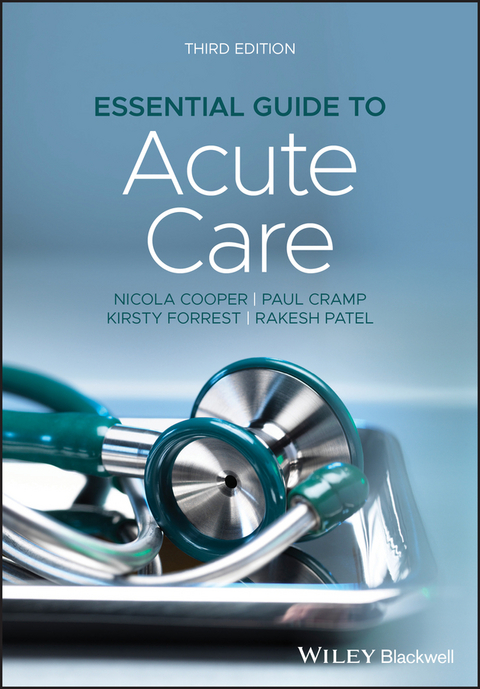
Essential Guide to Acute Care (eBook)
John Wiley & Sons (Verlag)
9781119584056 (ISBN)
What you really need to know, but no-one told you.
The best-selling Essential Guide to Acute Care contains everything you need to know about acute care that you can't find in a standard textbook. The third edition has been extensively revised and updated, presenting new oxygen guidelines, updated evidence and practice around sepsis, fluid balance and volume resuscitation, acute kidney injury, perioperative care, and much more.
The third edition retains the accessible style and comprehensive coverage that has made Essential Guide to Acute Care essential reading for those who look after acutely ill adults. Throughout the book, 'mini-tutorials' expand on the latest thinking or controversies, and there are practical case histories to reinforce learning at the end of each chapter. The chapters are designed to be read by individuals or used for teaching material in tutorials.
This new edition of Essential Guide to Acute Care:
- Provides up-to-date and practical guidance on the principles of acute care, written by experienced teachers and clinicians
- Offers a unique approach to the subject that focuses on understanding rather than lists and 'recipes'
- Explains the altered physiology that accompanies acute illness in adults
- Includes learning objectives, self-assessment questions, and illustrative examples related to clinical practice
Essential Guide to Acute Care is an indispensable volume for medical students and newly graduated doctors; doctors training in medicine, surgery, anaesthesia and emergency medicine; advanced clinical practitioners; nurses and allied health professionals working in acute and critical care; and teachers.
NICOLA COOPER, Consultant Physician and Clinical Associate Professor in Medical Education, University Hospitals of Derby and Burton NHS Foundation Trust, UK.
PAUL CRAMP, Consultant in Anaesthesia and Intensive Care (retired), Bradford Teaching Hospitals NHS Trust, UK.
KIRSTY FORREST, Dean of Medicine and Consultant Anaesthetist, Faculty of Health Sciences and Medicine, Bond University, Australia.
RAKESH PATEL, Clinical Associate Professor and Honorary Consultant Nephrologist, Faculty of Medicine and Health Sciences, Nottingham University, UK.
NICOLA COOPER, Consultant Physician and Clinical Associate Professor in Medical Education, University Hospitals of Derby and Burton NHS Foundation Trust, UK. PAUL CRAMP, Consultant in Anaesthesia and Intensive Care (retired), Bradford Teaching Hospitals NHS Trust, UK. KIRSTY FORREST, Dean of Medicine and Consultant Anaesthetist, Faculty of Health Sciences and Medicine, Bond University, Australia. RAKESH PATEL, Clinical Associate Professor and Honorary Consultant Nephrologist, Faculty of Medicine and Health Sciences, Nottingham University, UK.
Reviews of the Second Edition vii
Introduction ix
Acknowledgements xi
Foreword to the Second Edition xiii
Units Used in This Book xv
List of Abbreviations xvii
1 Patients at Risk 1
2 Oxygen Therapy 13
3 Acid-Base Balance 35
4 Respiratory Failure 49
5 Fluid Balance and Volume Resuscitation 77
6 Sepsis 101
7 Acute Kidney Injury 129
8 Brain Injury 149
9 Optimising Patients Before Surgery 167
10 Pain Control and Sedation 193
Index 205
CHAPTER 1
Patients at Risk
By the end of this chapter you will be able to:
- Define resuscitation
- Recognise the importance of the generic altered physiology that accompanies acute illness
- Know that early recognition and management improves outcomes
- Know how to assess and manage an acutely ill patient using the ABCDE system
- Understand the benefits and limitations of intensive care
- Know how to communicate effectively with colleagues about acutely ill patients
- Have a context for the chapters that follow
What is Resuscitation?
When we talk about ‘resuscitation’ we often think of cardio‐pulmonary resuscitation (CPR). CPR is a significant part of healthcare training. International organisations govern resuscitation protocols. Yet, survival to discharge after in‐hospital CPR is poor, around 50% if the rhythm is shockable and 10–14% if the rhythm is non‐shockable.1 Public perception of CPR is often informed by television which has far better outcomes than in reality.2
A great deal of attention and training is focussed on saving life after cardiac arrest. But the majority of in‐hospital cardiac arrests are predictable and preventable. Until the last few decades, hardly any attention was focussed on detecting commonplace reversible physiological deterioration and in preventing cardiac arrest in the first place. Now, we have early warning scores and medical emergency teams – but there still remain problems with the early recognition and management of sick patients in hospital.
In a study published in 1990, 84% of patients had documented observations of clinical deterioration or new complaints within 8 hours of cardio‐pulmonary arrest and 70% had either deterioration in respiratory or mental function observed during this time.3 While there did not appear to be any single reproducible warning signs, the average respiratory rate of the patients prior to arrest was 30/min. The investigators observed that the predominantly respiratory and metabolic derangements which preceded cardiac arrest (hypoxaemia, hypotension, and acidosis) were not rapidly fatal and that efforts to predict and prevent arrest would therefore be beneficial. Only 8% patients survived to discharge after CPR. A subsequent similar study observed that documented physiological deterioration occurred within 6 hours in 66% of patients with cardiac arrest, but effective action was often not taken.4
Researchers have commented that there appears to be a failure of systems to recognise and effectively intervene when patients in hospital deteriorate. A study by McQuillan et al. looked at 100 consecutive emergency ICU admissions.5 Two external assessors found that only 20 cases were well managed beforehand. The majority (54) received suboptimal care prior to admission to the ICU and there was disagreement over the remaining 26 cases. The patients were of a similar case‐mix and APACHE (acute physiological and chronic health evaluation) scores. In the suboptimal group, ICU admission was considered late in 69% cases and avoidable in up to 41%. The main causes of suboptimal care were considered to be failure of organisation, lack of knowledge, failure to appreciate the clinical urgency, lack of supervision, and failure to seek advice. Suboptimal care (failure to adequately manage the airway, oxygen therapy, breathing, and circulation) was equally likely on a surgical or medical ward and contributed to the subsequent mortality of one‐third of patients. The authors wrote: ‘This…suggests a fundamental problem of failure to appreciate that airway, breathing and circulation are the prerequisites of life and that their dysfunction are the common denominators of death’. Another study of adult general ward patients admitted to the ICU or dying unexpectedly found that both ICU and hospital mortality was significantly increased in patients who had received suboptimal care beforehand (52% vs 35% and 65% vs 42%, respectively).6 Similar findings have been reported in other studies.
Although things may have improved, these problems have not gone away. The UK National Confidential Enquiry into Patient Outcome and Death (NCEPOD) published a report in 2018: ‘Themes and recommendations common to all hospital specialties’.7 The report stated that:
Deficiencies in the recognition of ill patients have been identified for many years and the care of the acutely ill hospitalised patient presents ongoing problems for healthcare services. Deficiencies are often related to poor management of simple aspects of acute care – those involving the patient’s airway, breathing and circulation, oxygen therapy, fluid balance and monitoring. Other contributory factors highlighted in many NCEPOD reports include organisational failures, such as a lack of knowledge, failure to appreciate the clinical urgency of a situation, a lack of supervision, failure to seek advice, delayed response and poor communication.
A number of studies have showed that simple physiological observations can identify high‐risk hospital in‐patients8,9 and implementing a system whereby junior staff are obliged to call for help when there are seriously abnormal vital signs improves outcomes for patients and utilisation of intensive care resources.10,11
Resuscitation is therefore not only about CPR. It is about recognising and effectively treating patients in reversible physiological decline. This is an area of medicine that is often neglected outside critical care areas in terms of training, organisation, and resources.
Medical Emergency Teams
Medical emergency teams (METs) were developed in Australia and consist of doctors and nurses trained in advanced resuscitation skills. The idea is that seriously abnormal vital signs trigger an emergency call rather than waiting for cardio‐pulmonary arrest to trigger an emergency response. Box 1.1 shows the original MET calling criteria. In the UK, early warning scores have been developed to trigger urgent responses (see Table 1.1), usually to the patient’s own team or the ICU outreach team. The purpose of a medical emergency team instead of a cardiac arrest team is simple – early action saves lives. As one of the pioneers of resuscitation commented, ‘The most sophisticated Intensive Care often becomes unnecessarily expensive terminal care when the pre‐ICU system fails’.13
Box 1.1 MET Calling Criteria
Airway
If threatened
Breathing
All respiratory arrests
Respiratory rate <5/ min or >36/ min
Circulation
All cardiac arrests
Pulse rate <40/min or >140/min
Systolic blood pressure <90 mmHg
Neurology
Sudden fall in level of consciousness
Repeated or extended seizures
Other
Any patient you are seriously worried about that does not fit the above criteria
Source: Reproduced with permission by Prof Ken Hillman, University of New South Wales, Division of Critical Care, Liverpool Hospital, Sydney, Australia.
Table 1.1 UK National Early Warning Score (NEWS2).
Source: Reproduced with permission from Royal College of Physicians.12
| Physiological Parameter | 3 | 2 | 1 | 0 | 1 | 2 | 3 |
| Respiratory rate (per minute) | ≤8 | 9–11 | 12–20 | 21–24 | ≥25 |
| SpO2 Scale 1 (%) | ≤91 | 92–93 | 94–95 | ≥96 |
| SpO2 Scale 2 (%) | ≤83 | 84–85 | 86–87 | 88–92 ≥93 on air | 93–94 on oxygen | 95–96 on oxygen | ≥97 on oxygen |
| Air or oxygen? | Oxygen | Air |
| Systolic blood pressure (mmHg) | ≤90 | 91–100 | 101–110 | 111–219 | ≥220 |
| Pulse (per minute) | ≤40 | 41–50 | 51–90 | 91–110 | 111–130 | ≥131 |
| Consciousness | Alert | CVPU |
| Temperature (°C) | ≤35.0 | 35.1–36.0 | 36.1–38.0 | 38.1–39.0 | ≥39.1 |
CVPU = confused, responds to voice, responds to pain, unresponsive.
Use SpO2 Scale 2 if target saturations are 88–92% under the direction of a qualified clinician.
Each observation has a score. The total score determines the potential clinical risk and what should happen next. Higher scores also mandate closer monitoring:
- Total score 0–4: low risk, ward‐based response
- Score 3 in any single parameter: low–medium risk, urgent...
| Erscheint lt. Verlag | 24.9.2020 |
|---|---|
| Sprache | englisch |
| Themenwelt | Medizin / Pharmazie ► Allgemeines / Lexika |
| Medizin / Pharmazie ► Pflege | |
| Schlagworte | acute care guide • acute care physiology • acute care practice • acute care principles, acute care medical students • acute care reference • acute care training • acute internal medicine • Akutpflege • Anaesthesia • critical care guide • critical care nursing • critical care reference • emergency care medical students • Emergency Medicine • Emergency Medicine & Trauma • ICU reference • ?intensive care medicine • Intensive/Critical Care • Intensivpflege • Medical Science • Medizin • Notfallmedizin • Notfallmedizin u. Traumatologie • perioperative care |
| ISBN-13 | 9781119584056 / 9781119584056 |
| Informationen gemäß Produktsicherheitsverordnung (GPSR) | |
| Haben Sie eine Frage zum Produkt? |
 EPUB (Adobe DRM)
Kopierschutz: Adobe-DRM
Adobe-DRM ist ein Kopierschutz, der das eBook vor Mißbrauch schützen soll. Dabei wird das eBook bereits beim Download auf Ihre persönliche Adobe-ID autorisiert. Lesen können Sie das eBook dann nur auf den Geräten, welche ebenfalls auf Ihre Adobe-ID registriert sind.
Details zum Adobe-DRM
Dateiformat: EPUB (Electronic Publication)
EPUB ist ein offener Standard für eBooks und eignet sich besonders zur Darstellung von Belletristik und Sachbüchern. Der Fließtext wird dynamisch an die Display- und Schriftgröße angepasst. Auch für mobile Lesegeräte ist EPUB daher gut geeignet.
Systemvoraussetzungen:
PC/Mac: Mit einem PC oder Mac können Sie dieses eBook lesen. Sie benötigen eine
eReader: Dieses eBook kann mit (fast) allen eBook-Readern gelesen werden. Mit dem amazon-Kindle ist es aber nicht kompatibel.
Smartphone/Tablet: Egal ob Apple oder Android, dieses eBook können Sie lesen. Sie benötigen eine
Geräteliste und zusätzliche Hinweise
Buying eBooks from abroad
For tax law reasons we can sell eBooks just within Germany and Switzerland. Regrettably we cannot fulfill eBook-orders from other countries.
aus dem Bereich