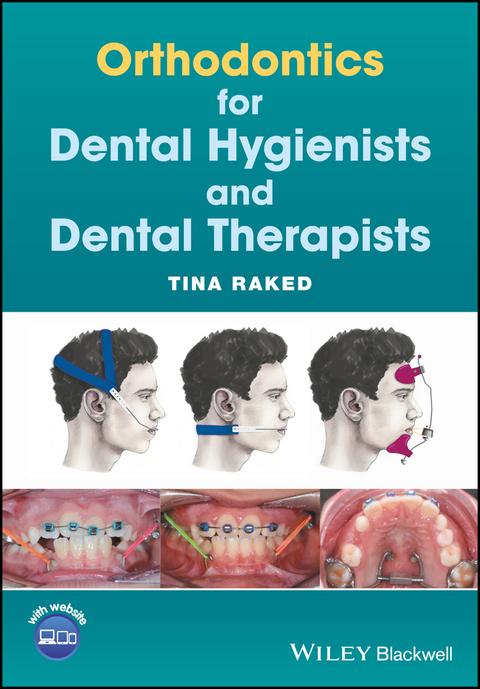
Orthodontics for Dental Hygienists and Dental Therapists (eBook)
John Wiley & Sons (Verlag)
978-1-119-25186-6 (ISBN)
Covers essential orthodontic theory for dental hygienists and dental therapists
Clear, comprehensive, and easy to read, Orthodontics for Dental Hygienists and Dental Therapists outlines orthodontic theory and explains clinical techniques, without assuming prior knowledge. By learning the orthodontic mechanics and fundamentals, dental hygiene and therapy students can become valuable team members in an orthodontic practice.
Written in a student-friendly style, the text begins by outlining craniofacial growth and tooth development, orthodontic assessment, and biomechanics and anchorage, before introducing fixed and removable appliances, class I, II and III treatment principles, and cleft palate treatment, and ending with a chapter on adult orthodontics.
- Student-friendly guide to essential orthodontic theory and clinical techniques for dental hygienists, dental therapists, and oral health therapists
- Superbly illustrated with explanations on terminologies, orthodontic appliances, instruments, and procedures
- Features multiple choice questions at the end of each chapter and interactive self-assessment questions on a companion website to help you test your knowledge
The ideal overall introduction to orthodontics, Orthodontics for Dental Hygienists and Dental Therapists is an indispensable companion for those wishing to pursue a career in orthodontic practices after graduation.
Tina Raked is an Oral Health Therapist at Chatswood Orthodontics, New South Wales, Australia.
Covers essential orthodontic theory for dental hygienists and dental therapists Clear, comprehensive, and easy to read, Orthodontics for Dental Hygienists and Dental Therapists outlines orthodontic theory and explains clinical techniques, without assuming prior knowledge. By learning the orthodontic mechanics and fundamentals, dental hygiene and therapy students can become valuable team members in an orthodontic practice. Written in a student-friendly style, the text begins by outlining craniofacial growth and tooth development, orthodontic assessment, and biomechanics and anchorage, before introducing fixed and removable appliances, class I, II and III treatment principles, and cleft palate treatment, and ending with a chapter on adult orthodontics. Student-friendly guide to essential orthodontic theory and clinical techniques for dental hygienists, dental therapists, and oral health therapists Superbly illustrated with explanations on terminologies, orthodontic appliances, instruments, and procedures Features multiple choice questions at the end of each chapter and interactive self-assessment questions on a companion website to help you test your knowledge The ideal overall introduction to orthodontics, Orthodontics for Dental Hygienists and Dental Therapists is an indispensable companion for those wishing to pursue a career in orthodontic practices after graduation.
Tina Raked is an Oral Health Therapist at Chatswood Orthodontics, New South Wales, Australia.
Preface ix
Acknowledgements xi
About the Companion Website xiii
1 Scope of Practice and Competency 1
2 Growth and Development 7
3 Orthodontic Assessment and Treatment Planning Strategies 29
4 Biomechanics and Treatment Principles 79
5 Fixed Appliances and Orthodontic Instruments 97
6 Treatment for Class I Malocclusion 121
7 Treatment for Class II Malocclusion 141
8 Treatment for Class III Malocclusion 161
9 Treatment for Cleft Palate 175
10 Retention 181
11 Adult Orthodontics 189
Self-Evaluation Answers 217
Index 219
1
Scope of Practice and Competency
Dental care services may require a team of dental professionals to carry out the necessary treatments. There are several divisions for registered dental practitioners in different types of healthcare settings with diverse scopes of practice based on their training, education and competence. These divisions in the dental industry vary greatly between countries.
Dentists
Dentists are independent practitioners with a range of responsibilities associated with assessment, prevention, diagnosis, treatment and management of dental lesions, deformities, traumas and diseases of human teeth and associated structures. Care is provided to patients of all ages. Dentists can practise all aspects of dentistry that is within their education, training and competency and can further pursue a specialist training to become dental specialists in various fields of dentistry. Examples of these specialties include:
- orthodontics
- endodontics
- oral and maxillofacial surgery
- oral pathology
- oral surgery
- periodontics
- paediatric dentistry
- prosthodontics
- special needs dentistry.
Oral Health Therapists
This dual‐qualified programme provides graduates with sufficient knowledge of all aspects of dental hygiene and dental therapy. In a general dental setting, the scope is to provide assessment, diagnosis and treatment for children and adolescents, working closely with dentists. Depending on the national board approved programme, the treatment can be carried out for patients of all ages. The scope is regulated to preventative services, restorative work and fillings, extraction of deciduous teeth, treatment of periodontal diseases, oral health education and promotion. Oral health therapists work closely with specialists in an orthodontic setting to carry out the treatment plan designed by the orthodontist. Based on the training and education provided in the programme, the level of competency greatly varies.
Dental Hygienists
Assessment, diagnosis, treatment and management of mild to moderate periodontal diseases are the primary roles of dental hygienists. Treating severe periodontal cases with a surgical approach is beyond the scope of dental hygienists. In these instances, dental hygienists work closely with periodontists to manage the condition. The main role is oral health education and prevention of oral diseases in patients of all ages, by promoting better oral health and hygiene. In a general dental setting, dental hygienists only work within a structured professional relationship with dentists. In the orthodontic setting, dental hygienists work under the guidance and supervision of an orthodontist.
Dental Therapists
The primary role of the dental therapist is assessment, diagnosis and management of dental caries. This is achieved by providing preventative care services, pulpotomies and extraction of deciduous teeth, restorative procedures for children and adolescents. Depending on the national board approved programmes, the age limits vary and some scopes allow treatment for patients of all ages. One of the key roles of dental therapists is enhancing better oral health with oral health promotion and education for patients of all ages. Dental therapists are only permitted to work within a structured professional relationship established with dentists.
Orthodontic Treatment
The scope of orthodontics is not narrowed solely to straightening teeth. The field of orthodontics is about treatment of irregularities in growth and development of the orofacial complex, enhancing function and aesthetics. Orthodontic treatment contributes to improving the physical and mental wellbeing of the patient. A team approach by dental professionals is needed to achieve successful outcomes and to provide the patient with a pleasant experience. Some cases may require a team of specialists cooperating together to guide the patient towards their orthodontic goal and providing them with a balanced facial appearance, healthy periodontium and a functional occlusion with an aesthetically pleasing smile.
In an orthodontic practice, oral health therapists, dental therapists and dental hygienists work closely with orthodontists to carry out the treatment plan under the supervision of the specialist. The level of training of dental practitioners varies greatly worldwide. Thus, for efficient and quality dental treatment, it is critical to confirm the limitations and scope of practice within each state or country before any form of clinical practice. Oral health therapists, dental hygienists and dental therapists can be valuable team members in an orthodontic setting, but they also play an important role in general dental clinics. A greater knowledge of orthodontics is therefore essential for these practitioners to help to monitor dental growth and development closely during regular dental visits and to make appropriate referrals as required.
Every orthodontist will manage their patients differently based on their education and training. Over the years, there have been well‐known specialists who have contributed to the evolution of orthodontics by introducing advanced and contemporary techniques and appliances. There can be numerous ways to reach a common goal using various treatment options and appliances. These goals may not always be what the specialist considers as the norm or ideal. The treatment objective is to address the chief complaint and to respect the goals and objectives requested by the patient.
There is sufficient knowledge and understanding of the ideal occlusion. One scheme that is well known and used as guidance by many specialists is Andrews’ six keys (Andrews, 1972). An ideal occlusion is shown in Figure 1.1. The six keys are as follows:
- Correct molar relationship
- Correct crown angulation
- Correct crown inclination
- No rotations
- No spaces
- Flat occlusal plane.
Figure 1.1 Normal occlusion.
Source: Courtesy of Professor Ali Darendeliler.
A variety of treatment options can be outlined to reach the desired goals. These goals and procedures must be discussed in depth and approved by the patient. A treatment plan may indicate the need or combination of the following:
- extractions
- functional appliances (influences dentoalveolar and muscular changes)
- orthopaedic appliances (stimulate bone growth and position)
- removable appliances
- full/partial upper and lower fixed appliances
- single arch fixed appliances
- orthognathic surgery
- acceptance of the malocclusion.
Typically, treatment in deciduous dentition is not indicated and is delayed until early mixed dentition, with an exception for significant facial asymmetry and craniofacial deformities. Early treatment aids in minimising the severity of the orthodontic problem and reduces the need for complex treatment once the permanent dentition is established. Adults of all ages can undergo treatment, depending on the health of the underlying periodontium. In severe cases, orthodontic therapy alone may not suffice and a combination of orthognathic surgery and restorative dental procedures may be needed, particularly if growth has ceased. In some instances, patients may choose to accept their orthodontic problem and may not seek treatment. Acceptance of the malocclusion or skeletal disharmony is always an option if the patient disagrees with all the treatment options provided by the specialist. Growth and development, orthodontic assessment, treatment planning and various appliances are discussed in the remaining chapters in this book.
Orthodontic Indices
Several orthodontic indices have been developed to create a better understanding of the severity of the orthodontic problem and the need for treatment. Some of the commonly used indices include the Index of Orthodontics Treatment Need (1987), the Peer Assessment Rating and the Index of Complexity Outcome and Need.
The Index of Orthodontic Treatment Need (Daniels and Richmond, 2000) is designed for children under the age of 18 years. There are two components to this index. The first is the dental health element and the second is aesthetics. The British Orthodontic Society provides five grades that allow clinicians to evaluate the rationale for treatment. The aesthetic aspect of this index employs a series of ten photographs. The index only assesses the incisors and does not consider all possible malocclusions, such as class III and open bites.
The Peer Assessment Rating (Richmond et al., 1992) was developed to assess the effectiveness and success of the orthodontic treatment outcome based on various occlusal traits. The traits assessed include crowding, buccal segment relationships, overjet, overbite and midlines. Each trait is given a score and the diagnosis of severity is made based on the total of the scores.
The Index of complexity Outcome and Need is the combination of scores from the Index of Orthodontic Treatment Need and the Peer Assessment Rating. The final scores indicate the severity of the orthodontic issue and the need for treatment. Score of more than 43 indicates a need for treatment. Other commonly used indices include the Treatment Priority Index (Grainger, 1967) and Dental Aesthetic Index (Cons et al.,...
| Erscheint lt. Verlag | 14.8.2017 |
|---|---|
| Sprache | englisch |
| Themenwelt | Medizin / Pharmazie ► Allgemeines / Lexika |
| Medizin / Pharmazie ► Gesundheitsfachberufe | |
| Medizin / Pharmazie ► Zahnmedizin | |
| Schlagworte | Adult Orthodontics • biomechanics and anchorage • braces • class I, class II, class III • Cleft Palate • Dental Hygiene & Therapy • Dental Hygienists • dental therapists • dentistry • fixed appliances • fixed retainers • <p>orthodontists • Malocclusion • Mundhygiene • oral health and maintenance • oral health therapists, orthodontic theories • oral therapist • Oral Therapy • orthodontic appliances • orthodontic assessment • orthodontic instruments • orthodontic maintenance • orthodontic mechanics • Orthodontic Practice • orthodontic procedures • Orthodontics • Orthodontics for Dental Hygienists and Dental Therapists</p> • orthodontic terminologies • Orthodontik • orthognathic surgery • radiographs • Removable appliances • removable retainers • Tina Raked • Zahnhygiene • Zahnmedizin • Zahnpflege • Zahn- u. Mundhygiene u. Therapie |
| ISBN-10 | 1-119-25186-9 / 1119251869 |
| ISBN-13 | 978-1-119-25186-6 / 9781119251866 |
| Informationen gemäß Produktsicherheitsverordnung (GPSR) | |
| Haben Sie eine Frage zum Produkt? |
 EPUB (Adobe DRM)
Kopierschutz: Adobe-DRM
Adobe-DRM ist ein Kopierschutz, der das eBook vor Mißbrauch schützen soll. Dabei wird das eBook bereits beim Download auf Ihre persönliche Adobe-ID autorisiert. Lesen können Sie das eBook dann nur auf den Geräten, welche ebenfalls auf Ihre Adobe-ID registriert sind.
Details zum Adobe-DRM
Dateiformat: EPUB (Electronic Publication)
EPUB ist ein offener Standard für eBooks und eignet sich besonders zur Darstellung von Belletristik und Sachbüchern. Der Fließtext wird dynamisch an die Display- und Schriftgröße angepasst. Auch für mobile Lesegeräte ist EPUB daher gut geeignet.
Systemvoraussetzungen:
PC/Mac: Mit einem PC oder Mac können Sie dieses eBook lesen. Sie benötigen eine
eReader: Dieses eBook kann mit (fast) allen eBook-Readern gelesen werden. Mit dem amazon-Kindle ist es aber nicht kompatibel.
Smartphone/Tablet: Egal ob Apple oder Android, dieses eBook können Sie lesen. Sie benötigen eine
Geräteliste und zusätzliche Hinweise
Buying eBooks from abroad
For tax law reasons we can sell eBooks just within Germany and Switzerland. Regrettably we cannot fulfill eBook-orders from other countries.
aus dem Bereich