


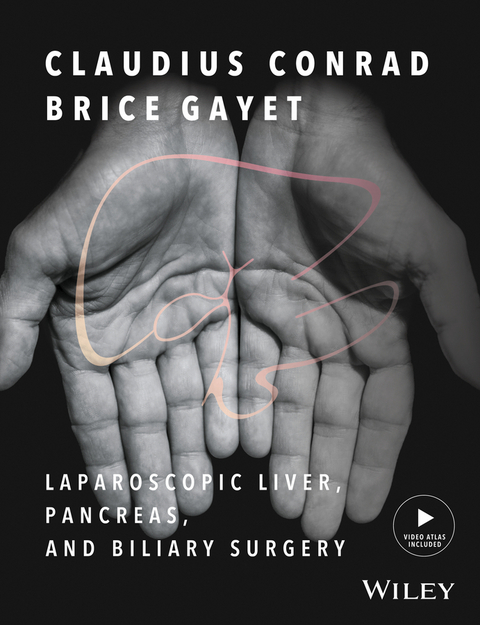
Laparoscopic Liver, Pancreas, and Biliary Surgery (eBook)
John Wiley & Sons (Verlag)
978-1-118-78114-2 (ISBN)
Laparoscopic Liver, Pancreas and Biliary Surgery: Textbook and Illustrated Video Atlas is the perfect learning tool for all surgeons managing patients requiring advanced liver, pancreas and biliary surgery minimally invasively.
This highly immersive text and video atlas will provide surgeons from trainee to advanced levels of practice, including, general surgeons, hepato-pacreatico-biliary surgeons, transplant surgeons and surgical oncologists, with a step-by-step, multi-media teaching atlas on performing laparoscopic liver surgery, anatomically correct, safely and effectively.
The atlas will teach the surgeons to perform anatomic liver resections of each liver segment expertly and logically, and will cover lobectomies, extended resections, advanced laparoscopic pancreas surgery (including Whipple) and other procedures. A special emphasis is placed on reproducibility of excellence in surgical technique.
Each video will be supported by outstanding illustrations for each technique and 3D renderings of the relevant anatomy. The educational step-by step high-definition videos teach everything you need to know, including critical aspects like patient positioning, port placement, dissection and much more.
Led by the pioneers in laparoscopic liver, pancreas and biliary surgery, Brice Gayet and Claudius Conrad, the textbook-chapters will be authored by world experts and will contain surgical tips and tricks garnered from their unique experiences, to improve care, management of complications, relevant society guidelines and excellence in oncologic care for patients with hepato-pancreato-biliary cancers.
Brice Gayet, MD, PhD, Head, Medical and Surgical Department of Digestive Diseases, Institut Mutualiste Montsouris, Paris, France. Claudius Conrad, MD, PhD, Assistant Professor, MD Anderson Cancer Center, Department of Surgical Oncology, Houston, Texas, USA.
"This is a fantastic resource. It is thorough in its discussion of the pertinent anatomy and the accompanying videos help to further describe these often daunting operative approaches...Given the increasing emphasis on laparoscopy, this is a timely addition to the literature and an excellent resource for hepatobiliary surgeons." (Doody Enterprises 21/04/2017)
"This textbook is a great learning tool for surgeons interested in laparoscopic hepatopancreatobiliary (HPB) surgery. It has a unique mix of chapters and videos that are relevant to surgeons at all levels of experience in the field. The focus of the book is on what skills are needed to develop and improve laparoscopic HPB techniques. Importantly, the text stresses the need for in-depth knowledge of open HPB surgery before tackling advanced laparoscopic cases...The editors have provided helpful commentary with each chapter to alert the reader to the key messages for each selected topic. One of the highlights of the book is the online videos that provide examples of most liver, pancreas, and spleen resections. These videos include narration and schematics to demonstrate port placement. The editorial team pairs a senior HPB surgeon with a more junior HPB surgeon, creating a book with a wide audience.....This book is also useful for surgeons with some laparoscopic HPB experience who are interested in expanding theri practice...Overall, this book is worth the investment for surgeons interested in expanding their laparoscopic HPB surgery capabilities" (Journal Annals of Surgery 25th July 2017)
Chapter 1
The Development of Minimal Access Hepatopancreatobiliary Surgery
Ruchir Puri, Nicolas Paleari, John Stauffer, and Horacio J. Asbun
Department of General Surgery, Mayo Clinic, Jacksonville, USA
Editor Comment
This wonderful chapter, which may spark the interest of surgeons beyond the field of HPB surgery, is an account of the challenges faced by the pioneers of minimally invasive HPB surgery, challenges of a scientific but also a social nature. Some of these pioneers' careers took an unfavorable turn because of their dedication to innovation. We owe these legends and also their families gratitude, not only for their ingenuity and the inquisitiveness from which the patients of minimally invasive HPB surgeons benefit in the operating room every day but also for taking on the societal challenge and risks to their career in order to drive innovation. The chapter also explores the available data on the development of modern laparoscopic and robotic liver, biliary, and pancreas surgery from its beginnings of limited resection to the advanced minimally invasive surgery that is practiced at many centers around the world today.
Keywords: advanced minimally invasive HPB surgery, history of minimally invasive HPB surgery
All truth passes through three stages:
- First it is ridiculed
- Second it is violently opposed
- Third it is accepted as self-evident
Arthur Schopenhauer
Hepatopancreatobiliary (HPB) operations are some of the most technically challenging procedures in surgery owing to the complex anatomy and proximity to vital structures. Over the years HPB procedures have excited, enthralled, and humbled surgeons all over the world. At the same time, the complexities of the disease processes have driven innovation not just in surgery but in medicine in general. The development of minimally invasive HPB surgery is synonymous with the development of laparoscopy and is perhaps the “holy grail” of laparoscopic surgery.
1.1 Beginnings
The term laparoscopy comes from “laparoskopie,” which is derived from two Greek words: laparo, meaning “flank,” and the verb skopos, meaning “to look or observe” [1]. The exploration of the human body through small or natural orifices dates back to the time of Hippocrates [2]. Hippocrates described the use of a primitive anoscope for the examination of hemorrhoids in 400 BC [2]. An Arab physician, Abulcasis, added a light source to the instrument for the exploration of the cervix in AD 1000 [2,3]. Many centuries later, in 1585, Giulio Cesare Aranzi inspected the nasal cavity by reflecting a beam of light through water [2].
In 1805 Phillipp Bozzini examined the urethra using an instrument that consisted of a wax candlelit chamber inside a tube which reflected light from a concave mirror [2,3]. Bozzini called it the “lichtleiter,” and it is considered the first real endoscope (Figure 1.1 and Figure 1.2) [2,3]. Using his lichtleiter, Bozzini managed to study the bladder directly, and his pioneering efforts laid the foundations of modern endoscopy.
Figure 1.1 Self-portrait of a young Bozzini (ca. 1805). Source: Frankfurt town archives.
Figure 1.2 The lichtleiter (an original owned by the American College of Surgeons, Bush Collection). The 200th Anniversary of the First Endoscope: Phillip Bozzini (1773–1809). Source: Morgenstern 2005 [4]. Reproduced with permission of Sage Publications.
Over the next century, Pierre Salomon Segalas and Antoine Jean Desormeaux from France refined Bozzini's lichtleiter and took the first steps in developing the modern cystoscope [2,3]. Desormeaux presented his idea to the Academy of Medicine in Paris, and for his efforts he is considered the “father of cystoscopy” [3]. Around the same time, over in the United States, John Fischer in Boston was using a similar instrument to perform vaginoscopies, and in Dublin, Ireland, Francis Cruise was performing endoscopies on the rectum [2].
In 1877 a urologist from Berlin, Maximilian Nitze, created what is considered the first modern endoscope using a platinum wire heated by electricity and encased in a metal tube (Figure 1.3 and Figure 1.4) [2,3]. A few years later, in 1880, Thomas Edison invented the light bulb, which revolutionized the way endoscopies were performed [3,6]. While these innovations all made advances in laparoscopy possible, little else occurred in the field until the beginning of the twentieth century.
Figure 1.3 Maxmilian Nitze. Source: https://de.wikipedia.org/wiki/Datei:Max_Nitze_Urologe.jpg#file. Used under CC BY-SA 3.0 - http://creativecommons.org/licenses/by-sa/3.0/legalcode.
Figure 1.4 Nitze cystoscope of 1877. Source: Mouton 1998 [5]. Reproduced with permission of Springer.
1.2 Advent of Laparoscopy
George Kelling from Germany is credited with exploring the abdominal cavity using a scope after creating pneumoperitoneum in 1901 (Figure 1.5). Kelling was a surgeon and first performed laparoscopies on dogs; he called the procedure “coelioskope” [2,3,6,7] (Box 1.1). The technique involved injecting the canine's abdomen with oxygen filtered through sterile cotton and then using Nitze's cystoscope to inspect the abdominal contents. Kelling performed this procedure in humans, but his findings were not published [3]. Around the same time, a Swedish internist called Hans Christian Jakobaeus popularized the procedure in humans by using a colposcope with a mirror to assess the abdomen of a pregnant woman [7]. In 1911 Jakobaeus presented his work Über Laparo- und Thorakoskopie and later continued his work in thoracoscopy (Figure 1.6) [3,6,7,8]. Jakobaeus used trocars very similar to the ones used today and is also credited with coining the term “laparoscopy” [3]. Not too far away in Petrograd (modern-day St Petersburg), Dimitri Ott performed the same procedure and called it “ventroscopy” [6,7]. The first to use the laparoscopic technique in the United States was Bertram M. Bernheim in 1911 [9]. Bernheim was a surgeon at the Johns Hopkins University, and he called this procedure “organoscopy” [2,3,6–8,11]. Bernheim, like many others at the time, had not heard of the work of Kelling and Jakobaeus.
Box 1.1 Different Terms Used Historically
Coelioscope: George Kelling, 1901 (Germany)
Ventroscopy: Dimitri Ott, 1901 (Petrograd/St Petersburg)
Organoscopy: Bertram Berheim, 1911 (Johns Hopkins University)
Figure 1.5 George Kelling. Source: https://en.wikipedia.org/wiki/Georg_Kelling#/media/File:Portrait_georg_kelling.jpg. Used under CC BY-SA 3.0 de - http://creativecommons.org/licenses/by-sa/3.0/de/deed.en.
Figure 1.6 Hans Christian Jakobaeus MD, performing a thoracoscopy. Source: Braimbridge 1993 [10]. Reproduced with permission of Elsevier.
Up to this point, all the procedures for exploring the abdominal cavity were performed with oxygen [3]. In 1924, Richard Zollikofer proposed that pneumoperitoneum be obtained using carbon dioxide. Carbon dioxide had two advantages: one was the rapid reabsorption of carbon dioxide by the peritoneal membrane and, unlike oxygen, it was noncombustible [3,6]. In 1929, Heinz Kalk, a German gastroenterologist, designed a new lens system with 135° vision and introduced the technique of “double trocar.” This invention eventually led to more refinements and the introduction of instruments into the cavities [2,3,6,7]. Between 1929 and 1959, Kalk submitted many articles on diagnostic laparoscopy; he is considered the “father of modern laparoscopy” [3].
The first therapeutic intervention was carried out by the German physician Fervers, who performed the lysis of abdominal adhesions and a liver biopsy [3,6]. Another significant advancement in laparoscopy is credited to the Hungarian physician Janos Veress. In 1938, he created a retractable needle to create pneumoperitoneum. We are all familiar with the Veress needle, but interestingly, it was initially used for the treatment of tuberculosis with pneumothorax in the preantibiotic era [2,3,6,7]. This technique was not accepted by all surgeons as it was considered unsafe. This led, in 1974, to Chicago-based gynecologist Harrith M. Hasson creating the open technique to access the abdominal cavity and achieve placement of the trocar that bears his name [2]. Raoul Palmer performed diagnostic laparoscopies in women and advised placing the patient in the Trendelenburg position for better visualization of the pelvis [2]. In addition, he was the first to control abdominal pressure during the procedure – two important aspects of modern laparoscopy [2].
In 1952, laparoscopic surgery underwent a revolution when French scientists M. Fourestier, A. Gladu, and J. Vulmiere created fiber-optics with cold light [3]. Two years later, scientists Lawrence Curtiss, Basil Hirschowitz, and Wilbur Peters did the same at the University of Michigan and brought cold light fiber-optics into practice in 1957. With improved visualization of the abdominal cavity, the advances in laparoscopy gained momentum [2].
Few surgeons have influenced the development of laparoscopic surgery more than the German gynecologist Kurt Semm. A pioneer in minimally invasive surgery,...
| Erscheint lt. Verlag | 7.11.2016 |
|---|---|
| Sprache | englisch |
| Themenwelt | Medizin / Pharmazie ► Medizinische Fachgebiete ► Chirurgie |
| Medizinische Fachgebiete ► Innere Medizin ► Hepatologie | |
| Schlagworte | Chirurgie u. chirurgische Spezialgebiete • Gastroenterologie u. Hepatologie • Gastroenterology & Hepatology • Gastrointestinal surgery • laparoscopy, liver surgery, pancreatic surgery, hepatobiliary surgery, minimally invasive surgery • Magen-Darm-Chirurgie • Medical Science • Medizin • Surgery & Surgical Specialities |
| ISBN-10 | 1-118-78114-7 / 1118781147 |
| ISBN-13 | 978-1-118-78114-2 / 9781118781142 |
| Informationen gemäß Produktsicherheitsverordnung (GPSR) | |
| Haben Sie eine Frage zum Produkt? |
 EPUB (Adobe DRM)
Kopierschutz: Adobe-DRM
Adobe-DRM ist ein Kopierschutz, der das eBook vor Mißbrauch schützen soll. Dabei wird das eBook bereits beim Download auf Ihre persönliche Adobe-ID autorisiert. Lesen können Sie das eBook dann nur auf den Geräten, welche ebenfalls auf Ihre Adobe-ID registriert sind.
Details zum Adobe-DRM
Dateiformat: EPUB (Electronic Publication)
EPUB ist ein offener Standard für eBooks und eignet sich besonders zur Darstellung von Belletristik und Sachbüchern. Der Fließtext wird dynamisch an die Display- und Schriftgröße angepasst. Auch für mobile Lesegeräte ist EPUB daher gut geeignet.
Systemvoraussetzungen:
PC/Mac: Mit einem PC oder Mac können Sie dieses eBook lesen. Sie benötigen eine
eReader: Dieses eBook kann mit (fast) allen eBook-Readern gelesen werden. Mit dem amazon-Kindle ist es aber nicht kompatibel.
Smartphone/Tablet: Egal ob Apple oder Android, dieses eBook können Sie lesen. Sie benötigen eine
Geräteliste und zusätzliche Hinweise
Buying eBooks from abroad
For tax law reasons we can sell eBooks just within Germany and Switzerland. Regrettably we cannot fulfill eBook-orders from other countries.
aus dem Bereich


