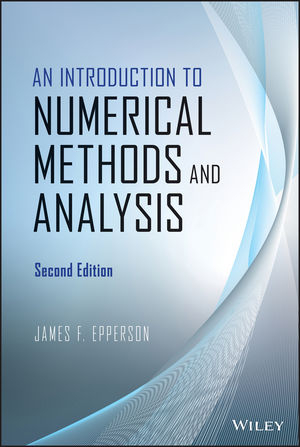
An Introduction to Numerical Methods and Analysis (eBook)
John Wiley & Sons (Verlag)
9781118407462 (ISBN)
Praise for the First Edition
'. . . outstandingly appealing with regard to its style, contents, considerations of requirements of practice, choice of examples, and exercises.'—Zentralblatt MATH
'. . . carefully structured with many detailed worked examples.'—The Mathematical Gazette
The Second Edition of the highly regarded An Introduction to Numerical Methods and Analysis provides a fully revised guide to numerical approximation. The book continues to be accessible and expertly guides readers through the many available techniques of numerical methods and analysis.
An Introduction to Numerical Methods and Analysis, Second Edition reflects the latest trends in the field, includes new material and revised exercises, and offers a unique emphasis on applications. The author clearly explains how to both construct and evaluate approximations for accuracy and performance, which are key skills in a variety of fields. A wide range of higher-level methods and solutions, including new topics such as the roots of polynomials, spectral collocation, finite element ideas, and Clenshaw-Curtis quadrature, are presented from an introductory perspective, and the Second Edition also features:
- Chapters and sections that begin with basic, elementary material followed by gradual coverage of more advanced material
- Exercises ranging from simple hand computations to challenging derivations and minor proofs to programming exercises
- Widespread exposure and utilization of MATLAB
- An appendix that contains proofs of various theorems and other material
The book is an ideal textbook for students in advanced undergraduate mathematics and engineering courses who are interested in gaining an understanding of numerical methods and numerical analysis.
JAMES F. EPPERSON, PhD, is Associate Editor of Mathematical Reviews for the American Mathematical Society. He was previously associate professor in the Department of Mathematics at The University of Alabama in Huntsville and assistant professor at the University of Georgia in Athens. He earned his doctorate at Carnegie Mellon University in Pittsburgh and his undergraduate degree from the College of Engineering at the University of Michigan, Ann Arbor.
JAMES F. EPPERSON, PHD, is Associate Editor of Mathematical Reviews for the American Mathematical Society. He was previously associate professor in the Department of Mathematics at The University of Alabama in Huntsville and assistant professor at the University of Georgia in Athens. He earned his doctorate at Carnegie Mellon University in Pittsburgh and his undergraduate degree from the College of Engineering at the University of Michigan, Ann Arbor.
Preface xiii
1 Introductory Concepts and Calculus Review 1
2 A Survey of Simple Methods and Tools 43
3 Root-Finding 89
4 Interpolation and Approximation 171
5 Numerical Integration 269
6 Numerical Methods for Ordinary Differential Equations 329
7 Numerical Methods for the Solution of Systems of Equations 417
8 Approximate Solution of the Algebraic Eigenvalue Problem 479
9 A Survey of Numerical Methods for Partial Differential Equations 521
10 An Introduction to Spectral Methods 555
Appendix A: Proofs of Selected Theorems, and Other Additional Material 581
Index 587
"This is an excellent textbook for a numerical analysis
course although it will be difficult to cover all the material in
just one course. Because the text is so complete, it could as
well be used for self-study." (American Mathematical
Society, 1 August 2014)
PREFACE
Preface to the Second Edition
This third version of the text is officially the Second Edition, because the second version was officially dubbed the Revised Edition. Now that the confusing explanation is out of the way, we can ask the important question: What is new?
- I continue to chase down typographical errors, a process that reminds me of herding cats. I’d like to thank everyone who has sent me information on this, especially Prof. Mark Mills of Central College in Pella, Iowa. I have become resigned to the notion that a typo-free book is the result of a (slowly converging) limiting process, and therefore is unlikely to be actually achieved. But I do keep trying.
- The text now assumes that the student is using MATLAB for computations, and many MATLAB routines are discussed and used in examples. I want to emphasize that this book is still a mathematics text, not a primer on how to use MATLAB.
- Several biographies were updated as more complete information has become widely available on the Internet, and a few have been added.
- Two sections, one on adaptive quadrature (§5.8.3) and one on adaptive methods for ODEs (§6.9) have been re-written to reflect the decision to rely more on MATLAB.
- Chapter 9 (A Survey of Numerical Methods for Partial Differential Equations) has been extensively re-written, with more examples and graphics.
- New material has been added:
- Several sections have been modified somewhat to reflect advances in computing technology.
- Later in this preface I devote some time to outlining possible chapter and section selections for different kinds of courses using this text.
It might be appropriate for me to describe how I see the material in the book. Basically, I think it breaks down into three categories:
- The fundamentals: All of Chapters 1 and 2, most of Chapters 3 (3.1, 3.2, 3.3, 3.5, 3.8, 3.9), 4 (4.1, 4.2, 4.3, 4.6, 4.7, 4.8, 4.11), and 5 (5.1, 5.2, 5.3, 5.4, 5.7); this is the basic material in numerical methods and analysis and should be accessible to any well-prepared students who have completed a standard calculus sequence.
- Second level: Most of Chapters 6, 7, and 8, plus much of the remaining sections from Chapters 3 (3.4, 3.6, 3.7, 3.10), 4 (4.4, 4.5), and 5 (5.5, 5.6), and some of 6 (6.8) and 7 (7.7); this is the more advanced material and much of it (from Chap. 6) requires a course in ordinary differential equations or (Chaps. 7 and 8) a course in linear algebra. It is still part of the core of numerical methods and analysis, but it requires more background.
- Advanced: Chapters 9 and 10, plus the few remaining sections from Chapters 3, 4, 5, 6, 7, and 8.
- It should go without saying that precisely what is considered “second level” or “advanced” is largely a matter of taste.
As always, I would like to thank my employer, Mathematical Reviews, and especially the Executive Editor, Graeme Fairweather, for the study leave that gave me the time to prepare (for the most part) this new edition; my editor at John Wiley & Sons, Susanne Steitz-Filler, who does a good job of putting up with me; an anonymous copy-editor at Wiley who saved me from a large number of self-inflicted wounds; and—most of all—my family of spouse Georgia, daughter Elinor, son James, and Border Collie mutts Samantha and Dylan. James was not yet born when I first began writing this text in 1997, and now he has finished his freshman year of high school; Elinor was in first grade at the beginning and graduated from college during the final editing process for this edition. I’m very proud of them both! And I can never repay the many debts that I owe to my dear spouse.
Online Material
There will almost surely be some online material to supplement this text. At a minimum, there will be
- MATLAB files for computing and/or reading Gaussian quadrature (§5.6) weights and abscissas for N = 2m, m = 0, 1, 2, …, 10.
- Similar material for computing and/or reading Clenshaw-Curtis (§10.3) weights and abscissas.
- Color versions of some plots from Chapter 9.
- It is possible that there will be an entire additional section for Chapter 3.
To access the online material, go to
www.wiley.com/go/epperson2edition
The webpage should be self-explanatory.
A Note About the Dedication
The previous editions were dedicated to six teachers who had a major influence on the author’s mathematics education: Frank Crosby and Ed Croteau of New London High School, New London, CT; Prof. Fred Gehring and Prof. Peter Duren of the University of Michigan Department of Mathematics; and Prof. Richard MacCamy and Prof. George J. Fix of the Department of Mathematics, Carnegie-Mellon University, Pittsburgh, PA. (Prof. Fix served as the author’s doctoral advisor.) I still feel an unpayable debt of gratitude to these men, who were outstanding teachers, but I felt it appropriate to express my feelings about my parents for this edition, hence the new dedication to the memory of my mother and step-father.
Course Outlines
One can define several courses from this book, based on the level of preparation of the students and the number of terms the course runs, as well as the level of theoretical detail the instructor wishes to address. Here are some example outlines that might be used.
- A single semester course that does not assume any background in linear algebra or differential equations, and which does not emphasize theoretical analysis of methods:
- A two-semester course which assumes linear algebra and differential equations for the second semester:
- A two-semester course for well-prepared students:
Some sections appear to be left out of all these outlines. Most textbooks are written to include extra material, to facilitate those instructors who would like to expose their students to different material, or as background for independent projects, etc.
I want to encourage anyone—teachers, students, random readers—to contact me with questions, comments, suggestions, or remaining typos. My professional email is still jfe@ams.org
Computer Access
Because the author no longer has a traditional academic position, his access to modern software is limited. Most of the examples were done using a very old and limited version of MATLAB from 1994. (Some were done on a Sun workstation, using FORTRAN code, in the late 1990s.) The more involved and newer examples were done using public access computers at the University of Michigan’s Duderstadt Center, and the author would like to express his appreciation to this great institution for this.
A Note to the Student
(This is slightly updated from the version in the First Edition.) This book was written to be read. I am under no illusions that this book will compete with the latest popular novel for interest or thrilling narrative. But I have tried very hard to write a book on mathematics that can be read by students. So do not simply buy the book, work the exercises, and sell the book back to the bookstore at the end of the term....
| Erscheint lt. Verlag | 24.12.2013 |
|---|---|
| Sprache | englisch |
| Themenwelt | Mathematik / Informatik ► Mathematik ► Analysis |
| Technik | |
| Schlagworte | algebraic multigrid method • Applied Mathematics in Science • Broyden?s Method • fourier analysis • galerkin/finite element ideas for BVPS • Mathematical Analysis • Mathematics • Mathematik • Mathematik in den Naturwissenschaften • Mathematische Analyse • Monte Carlo methods • Numerical analysis • Numerical Methods • Numerische Mathematik • numerische Methoden • Numerisches Verfahren • polynomials • radical basis function interpolation • spectral/collocation methods for PDEs • Taylor?s Theorem • tension splines • trigonomic interpolation |
| ISBN-13 | 9781118407462 / 9781118407462 |
| Informationen gemäß Produktsicherheitsverordnung (GPSR) | |
| Haben Sie eine Frage zum Produkt? |
 EPUB (Adobe DRM)
Kopierschutz: Adobe-DRM
Adobe-DRM ist ein Kopierschutz, der das eBook vor Mißbrauch schützen soll. Dabei wird das eBook bereits beim Download auf Ihre persönliche Adobe-ID autorisiert. Lesen können Sie das eBook dann nur auf den Geräten, welche ebenfalls auf Ihre Adobe-ID registriert sind.
Details zum Adobe-DRM
Dateiformat: EPUB (Electronic Publication)
EPUB ist ein offener Standard für eBooks und eignet sich besonders zur Darstellung von Belletristik und Sachbüchern. Der Fließtext wird dynamisch an die Display- und Schriftgröße angepasst. Auch für mobile Lesegeräte ist EPUB daher gut geeignet.
Systemvoraussetzungen:
PC/Mac: Mit einem PC oder Mac können Sie dieses eBook lesen. Sie benötigen eine
eReader: Dieses eBook kann mit (fast) allen eBook-Readern gelesen werden. Mit dem amazon-Kindle ist es aber nicht kompatibel.
Smartphone/Tablet: Egal ob Apple oder Android, dieses eBook können Sie lesen. Sie benötigen eine
Geräteliste und zusätzliche Hinweise
Buying eBooks from abroad
For tax law reasons we can sell eBooks just within Germany and Switzerland. Regrettably we cannot fulfill eBook-orders from other countries.
aus dem Bereich