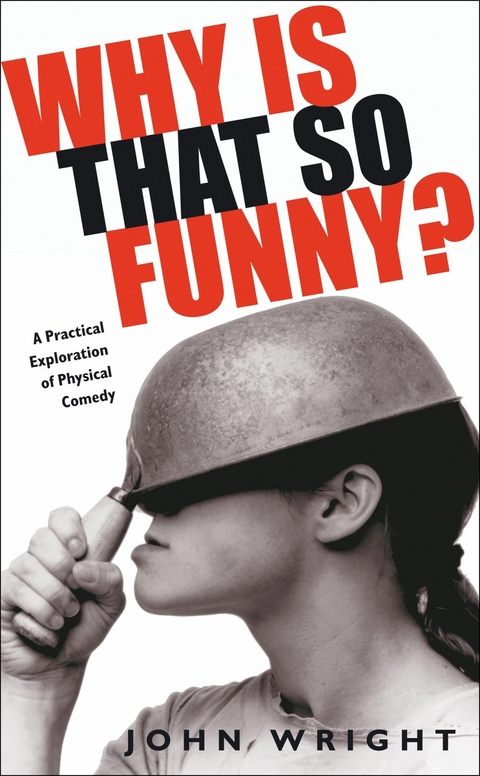
Why Is That So Funny? (eBook)
433 Seiten
Nick Hern Books (Verlag)
978-1-78001-072-4 (ISBN)
John Wright is an award-winning international teacher and theatre-maker. He co-founded Trestle Theatre Company in 1980 and Told by an Idiot in 1993. He has worked on a string of productions and projects extending over three decades in Europe, Scandinavia, Asia and the UK, where his work has been seen at the National Theatre, the RSC, the Royal Court, the Almeida and the Royal Opera House. He was granted a Greater London Arts Award for his contribution to professional training; and his belief that teaching is the greatest source of learning has enabled his ideas to be shaped and moulded by generations of students. He pioneered the teaching of Clown at university level and was one of the ?rst people in the country to offer courses in devising. He is the author of two books, Why Is That So Funny?: A Practical Exploration of Physical Comedy and Playing the Mask: Acting Without Bullshit.
A practical investigation of how comedy works, by a well-respected practitioner and teacher. With a Foreword by Toby Jones. Comedy is recognised as one of the most problematic areas of performances. For that reason, it is rarely written about in any systematic way. John Wright, founder of Trestle Theatre and Told by an Idiot, brings a wide range of experience of physical comedy to this unique exploration of comedy and comedic techniques. The book opens with an analysis of the different kinds of laughter that can be provoked by performance. This is followed by the main part of the book: games and exercises devised to demonstrate and investigate the whole range of comic possibilities open to a performer. Why Is That So Funny? is an invaluable book for teachers and performers, and a fascinating read for anyone interested in how comedy works.
John Wright is a director and teacher of theatre whose work is in much demand all over the world. He co-founded Trestle Theatre Company in the early eighties and co-directed much of their work. In 1992 he co-founded Told by an Idiot with Paul Hunter and Hayley Carmichael.
Preface
On receiving his lifetime achievement award at the 2002 British Comedy Awards, Michael Palin said that comedy was a great leveller. He explained that his facility for making people laugh had been a key element in enabling him to find something in common with those he had met on his travels to the most far-flung corners of the world. He finished his speech with the conclusion that he was so confident in the unifying power of comedy that, instead of dropping bombs on Iraq, we should drop comedians instead. This idea was received with great enthusiasm – but then he was preaching to the converted. Had he been making that speech at a theatre function it is unlikely that these sentiments would have been received with such unanimous and uncritical acclaim. John Peter, the drama critic for the Sunday Times, criticised Mark Rylance for finding comedy in his performance of Shakespeare’s Richard II at the Globe Theatre on London’s South Bank (May 2003). He wrote:
He treats some of Richard’s great speeches as oddball comedy. The timing of pauses and the nerdish self-deprecating chuckles during ‘my large kingdom from a little grave – a little, little grave – an obscure grave’ reduce tragic self-pity to smug stand-up comedy.
Clearly, Mark Rylance hadn’t read the rules properly, but I don’t suppose Shakespeare had either. The idea that ‘comedy’ and ‘tragedy’ are mutually exclusive and that ‘comedy’ will inevitably result in a ‘reduction’ of ‘tragedy’ goes back to Aristotle. Comedy has always been the poor relation in theatre. Oh, it might put bums on seats occasionally, but alongside tragedy (whatever we mean by that today), comedy is regarded as the lesser of the two genres. The tighter we cling to the idea that comedy and tragedy are as compatible as hot fat and water, the more distorted our view of life becomes. In life, the comic and the tragic are interdependent. We see this on film and we see it on television. Our best sitcoms freely interweave the two. Steptoe and Son is as moving as it is funny, and One Foot in the Grave killed off its comic hero, Victor Meldrew, at the end of the series. The writers weren’t inhibited because they were supposed to be doing comedy. We’ve seen it on the big screen and we’ve seen it on prime-time television and not only in ‘smug stand-up comedy’. Over the years we’ve seen people laughing at funerals, laughing in the face of pain. We’ve seen people laugh at misfortune, injustice, violence and death. We’ve even seen people laugh during sex. Laughter is more a survival strategy than an idle diversion because real life is a far more complex and disorderly affair than ancient literary theory would have us believe.
But comparisons with life will only take us so far. Life isn’t like art. Art is a reflection of life, and sometimes that reflection is deliberately distorted. We sell ourselves short if we confuse theatrical credibility with verisimilitude. Art is a carefully selected view of life, and different generations of artists make different choices according to contemporary values. For instance, today the notion of kingship is an anachronism. Most of us don’t believe in God any more and Harry Potter is outselling the Bible. Big texts in the theatre – a Christopher Fry play or a Webster, for example – no longer hold big audiences, at least not for as long as they used to. The visual image has never been so powerful, and genre boundaries are being deliberately broken down. We can’t agree what art is and we don’t know what is beautiful any more. Popular culture has never been so diverse, and the old rule books have all been thrown away. There’s only one rule in theatre: Don’t be boring!
Elitism in theatre runs much deeper than John Peter’s opinions on tragedy. This elitism goes right back to the basic premise behind our approach to actor training, and how we deal with emotions. It’s this elitism that divorces comedy from life, and laughter from other forms of emotional expression.
In most of our drama schools far more attention is paid to making students cry than is ever paid to making them laugh. This is partly due to the legacy of Stanislavski, and the majority of our acting teachers base their approach on some aspect of his teaching. There probably isn’t a drama student in the country who hasn’t encountered ideas like the ‘magic if’, inner monologue, motivation, or emotion memory. I once worked with a self-styled Stanislavskian who, in the best traditions of the great man, would place a chair at the end of the studio with a box of tissues nearby. Then, one at a time, each person was asked to talk to the group about some traumatic incident in their lives. They had to stay there talking until they had made themselves cry. A student came to me in floods of tears after one of these sessions saying that she’d been told she couldn’t make contact with her emotions. On another occasion, a student confessed that everyone had complimented her for her description of the death of her mother when in reality her mother was alive and well and living in France. What infuriated me about this approach wasn’t the exercise itself – it’s actually quite a good one – it was the spurious value placed on so-called ‘truth’. Who cares if you slept with your grandmother? It’s none of my business. And it’s beyond my professional expertise to be able to handle this information. I’m not a therapist and neither was my colleague. If the worst thing that has ever happened in your life is the death of your hamster, it’s difficult to score high in the personal-experience stakes.
Being able to cry at will is a useful skill, and tears can be induced in a variety of ways, but this exercise was only the tip of the iceberg. That same colleague told me that comedy was an emotional copout and that it was simply a get-out clause to avoid our ‘big’ feelings. He divided the world into comic actors, on the one hand, whom he referred to as ‘comedians’, and ‘actors’, on the other, who presumably were very serious, could cry at the drop of a hat, were perfectly in touch with their emotions and didn’t do comedy. This is the real elitism in theatre: the belief that comedy is incapable of ever being profound and, by implication, is always superficial and essentially trivial.
Let’s be under no illusions here, comedy can wreck anything. It can debunk, it can trivialise and ‘reduce’ anything you like down to some puerile idiot doing nothing in particular just for a laugh. But, like it or loathe it, there’s skill in this destruction – sometimes great skill. The fact that comedy is capable of being such a wrecker is all the more reason for exploring how it works. Live theatre is a tightrope act. We all admire the skill and the grace and the daring of somebody up there on the high wire. But ‘no one can be that good’, we think to ourselves, ‘no one can be that clever.’ Let’s face it – rock-solid virtuosity is boring. Deep down, the only thing that really keeps us watching is the thought that the acrobat up there might fall off at any minute. Then at least we’d see something a bit more human. It would destroy everything, of course it would, it could be life threatening, of course it could, but at least it would be a bit more like us. The thought is delicious. We watch in anticipation for the first telltale wobble. Live theatre is at its most compelling when things are just slightly off-balance. These wobbles aren’t jokes, they’re not clever and they’re not witty. They’re funny because they’re scary, and they’re scary because they’re slightly out of control. We all keep watching that person up there because they’re only just all right. Too much security, too much control, too much purity, or too much aestheticism is ultimately very boring.
The masks of comedy and tragedy are misleading. Having worked with masks for years, I can assure you that a big smiley face doesn’t take long to become deeply irritating, and if you put that mask in slightly different circumstances it will soon appear to be barking mad. But if you put a party hat on the frowning face of tragedy it will immediately become amusing, and if you can then persuade that mask to dance, it will become very funny indeed. Comedy and tragedy are unhelpful distinctions. Rather than being opposite sides of a coin, they’re just equal parts of the whole. The fact that we see theatre as a predominantly literary medium – and psychological realism remains our dominant form of theatrical representation – does nothing for our rediscovery of theatre as a live event. To appreciate that, we need to refer back to those pre-literary skills of performative acting and presentational drama from the age-old popular forms of Commedia dell’Arte and clowning, when the contract between ‘you up there’ playing to ‘us down here’ was much clearer – you had to be compelling or you had to get off. I’m not talking about historical authenticity here and I’m not taking about genre either, but rather, that oral tradition amongst actors concerning what’s going to be funny.
It’s understandable that John Peter wrote that review at the Globe – as a full-size recreation of an Elizabethan...
| Erscheint lt. Verlag | 29.9.2016 |
|---|---|
| Vorwort | Toby Jones |
| Verlagsort | London |
| Sprache | englisch |
| Themenwelt | Kunst / Musik / Theater ► Theater / Ballett |
| Schlagworte | Acting • Actor • comedic • Comedy • directing • Director • Drama • Funny • how-to guide • performers • Practice • Rehearsal • rehearsal room • Teachers • technique • Theatre • theatre director • Theatre Studies • Toby Jones • told by an idiot • trestle theatre |
| ISBN-10 | 1-78001-072-9 / 1780010729 |
| ISBN-13 | 978-1-78001-072-4 / 9781780010724 |
| Informationen gemäß Produktsicherheitsverordnung (GPSR) | |
| Haben Sie eine Frage zum Produkt? |
 EPUB (Adobe DRM)
Kopierschutz: Adobe-DRM
Adobe-DRM ist ein Kopierschutz, der das eBook vor Mißbrauch schützen soll. Dabei wird das eBook bereits beim Download auf Ihre persönliche Adobe-ID autorisiert. Lesen können Sie das eBook dann nur auf den Geräten, welche ebenfalls auf Ihre Adobe-ID registriert sind.
Details zum Adobe-DRM
Dateiformat: EPUB (Electronic Publication)
EPUB ist ein offener Standard für eBooks und eignet sich besonders zur Darstellung von Belletristik und Sachbüchern. Der Fließtext wird dynamisch an die Display- und Schriftgröße angepasst. Auch für mobile Lesegeräte ist EPUB daher gut geeignet.
Systemvoraussetzungen:
PC/Mac: Mit einem PC oder Mac können Sie dieses eBook lesen. Sie benötigen eine
eReader: Dieses eBook kann mit (fast) allen eBook-Readern gelesen werden. Mit dem amazon-Kindle ist es aber nicht kompatibel.
Smartphone/Tablet: Egal ob Apple oder Android, dieses eBook können Sie lesen. Sie benötigen eine
Geräteliste und zusätzliche Hinweise
Buying eBooks from abroad
For tax law reasons we can sell eBooks just within Germany and Switzerland. Regrettably we cannot fulfill eBook-orders from other countries.
aus dem Bereich