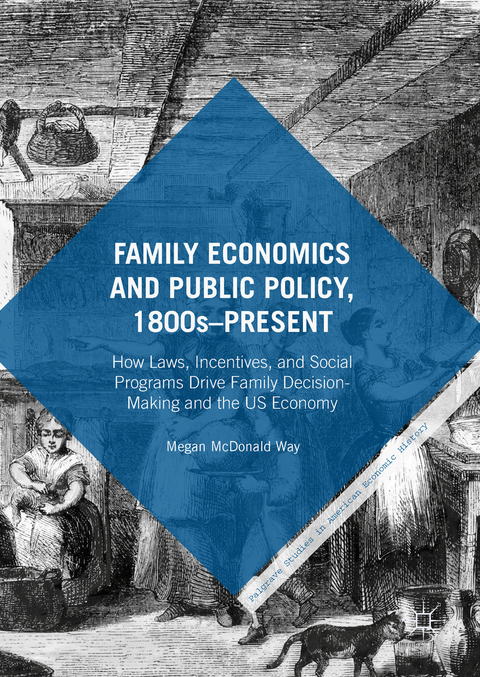
Family Economics and Public Policy, 1800s–Present (eBook)
XIX, 315 Seiten
Palgrave Macmillan US (Verlag)
978-1-137-43963-5 (ISBN)
Megan McDonald Way is Associate Professor and Chair of the Economics Division at Babson College, USA. She teaches graduate and undergraduate microeconomics principles and undergraduate labor courses. Her research focuses on intergenerational financial transfers within families, specifically how demographic changes in family structure are affecting the way money gets passed between the generations. She also studies gender earnings gaps, particularly among the self-employed. Prior to her career in academia, Dr. Way spent eight years as a marketing professional in the software industry.
This book explores family economic decision-making in the United States from the nineteenth century through present day, specifically looking at the relationship between family resource allocation decisions and government policy. It examines how families have responded to incentives and constraints established by diverse federal and state policies and laws, including the regulation of marriage and of female labor force participation, child labor and education policies-including segregation-social welfare programs, and more. The goal of this book is to present family economic decisions throughout US history in a way that contextualizes where the US economy and the families that drive it have been. It goes on to discuss the role public policies have played in that journey, where we need to go from here, and how public policies can help us get there. At a time when American families are more complex than ever before, this volume will educate readers on the often unrecognized role that government policies have on our family lives, and the uncelebrated role that family economic decision-making has on the future of the US economy.
Megan McDonald Way is Associate Professor and Chair of the Economics Division at Babson College, USA. She teaches graduate and undergraduate microeconomics principles and undergraduate labor courses. Her research focuses on intergenerational financial transfers within families, specifically how demographic changes in family structure are affecting the way money gets passed between the generations. She also studies gender earnings gaps, particularly among the self-employed. Prior to her career in academia, Dr. Way spent eight years as a marketing professional in the software industry.
1. Introduction: Public Policy and Family Economics in US History2. Families: Economic Functions and Decision-Making3. The Path of US Fertility: Micro Decisions with Macro Consequences4. Private and Public Investments in Children: Creating the Human Capital to Meet US Economic Needs5. Labor Force Participation and Home Production: Evolving Rights, Roles, and Opportunities for Women and Men 6. The Economics of Changing Family Structures: The Public Interest in Marriage and Family Formation7. Intergenerational Economics: Public and Family Support for Retirees in US History and Looking Forward8. Family Economics, Public Policy, and Inequality: Diverging Family Fortunes and the Risk to the US Economy
| Erscheint lt. Verlag | 29.8.2018 |
|---|---|
| Reihe/Serie | Palgrave Studies in American Economic History | Palgrave Studies in American Economic History |
| Zusatzinfo | XIX, 315 p. 26 illus. |
| Verlagsort | New York |
| Sprache | englisch |
| Themenwelt | Geschichte ► Teilgebiete der Geschichte ► Wirtschaftsgeschichte |
| Sozialwissenschaften ► Politik / Verwaltung ► Staat / Verwaltung | |
| Wirtschaft ► Allgemeines / Lexika | |
| Schlagworte | Child labor • Decision-Making • family economic policy • Family Economics • Family Structure • Gender Economics • Human Capital • industrial economy • Inequality • Knowledge Economy • opportunity cost • Public Policy • US economic policy |
| ISBN-10 | 1-137-43963-7 / 1137439637 |
| ISBN-13 | 978-1-137-43963-5 / 9781137439635 |
| Informationen gemäß Produktsicherheitsverordnung (GPSR) | |
| Haben Sie eine Frage zum Produkt? |
 PDF (Wasserzeichen)
DRM: Digitales Wasserzeichen
Dieses eBook enthält ein digitales Wasserzeichen und ist damit für Sie personalisiert. Bei einer missbräuchlichen Weitergabe des eBooks an Dritte ist eine Rückverfolgung an die Quelle möglich.
Dateiformat: PDF (Portable Document Format)
Mit einem festen Seitenlayout eignet sich die PDF besonders für Fachbücher mit Spalten, Tabellen und Abbildungen. Eine PDF kann auf fast allen Geräten angezeigt werden, ist aber für kleine Displays (Smartphone, eReader) nur eingeschränkt geeignet.
Systemvoraussetzungen:
PC/Mac: Mit einem PC oder Mac können Sie dieses eBook lesen. Sie benötigen dafür einen PDF-Viewer - z.B. den Adobe Reader oder Adobe Digital Editions.
eReader: Dieses eBook kann mit (fast) allen eBook-Readern gelesen werden. Mit dem amazon-Kindle ist es aber nicht kompatibel.
Smartphone/Tablet: Egal ob Apple oder Android, dieses eBook können Sie lesen. Sie benötigen dafür einen PDF-Viewer - z.B. die kostenlose Adobe Digital Editions-App.
Buying eBooks from abroad
For tax law reasons we can sell eBooks just within Germany and Switzerland. Regrettably we cannot fulfill eBook-orders from other countries.
aus dem Bereich